
During the early stages of developing a medical device, it’s important to factor-in the need for eventual regulatory compliance, even though that may be many months or years down the line.
This is all the more important because it can be tempting to modify goals and augment requirements as developments progress – for example, by adding new functions or expanding to a wider range of users. If compliance isn’t considered as part of even apparently minor design decisions, then there’s a risk that the project will later sink under the weight of an unexpectedly heavy compliance burden.
This isn’t to say that compliance should be integrated into every conversation, but merely that the right issues must be considered at the right time. As technical leads will instinctively know, spending too much time on regulatory considerations early on can drag the focus away from achieving key technology milestones, while at the same time eating into time and budgets. So where does the middle ground lie?
Compliance challenges for med-tech
To achieve the right balance between design freedom and compliance readiness while being mindful to avoid project slippage, we recommend a ‘light-touch’ analysis that covers the most challenging aspects faced by developers of implantable and wearable medical devices - in this example, biosensors.
These aspects include:
• Intended use and patient demographic
• Sensor accuracy and specificity
• Biocompatibility
• Sterilisation
• Particles and surface contamination
• Electronic and mechanical safety
• Cybersecurity and data integrity
• Foreseeable misuse.
This analysis should aim to consider each of these aspects, and how they will eventually contribute to the compliance workload. For example, if the intended use indicates that the device will be used for high-risk clinical decisions or for a vulnerable patient demographic, then a greater degree of testing and safety mitigations will be required later down the line.
Alternatively, it can be tempting to target a long working lifetime for early versions of, for example, a fully implanted biosensor, without understanding the implications for biocompatibility verification, material degradation, hermeticity or battery requirements. These decisions can add months or years onto a development and detract focus away from proving out the core sensor technology.
Integrating compliance considerations into the early development process may seem unnecessary to the more technically-focused members of the team. But focusing on the above key aspects makes it much easier to integrate compliance into the design from the start, guiding the development towards eventual compliance, rather than stifling innovation or creativity.
Staged testing for a streamlined compliance journey
Following on from those discussions, some preliminary tests are also likely to be needed. These don’t have to be extensive, but can be carefully targeted to the parts of the design upon which other parts depend, providing data that is indicative rather than comprehensive.
So for example, it may be useful to assess components against key compliance requirements, long before they’re integrated into the prototype. The key is to accumulate evidence in stages and as the design matures, allowing the design to evolve in response, rather than leaving compliance testing until late into the program and risking uncovering a flaw that upends your design.
Making the most of your compliance journey
To achieve all of this, partner with technical experts with an understanding of the compliance trade-offs, who can help you develop a clear compliance plan. This can avoid the scenario in which a project is pushed over time and over budget by a design decision with unforeseen compliance consequences, or the late-stage discovery of an overlooked standard. Consideration of these aspects also demands a cross-disciplinary project structure. By bringing together experts from different disciplines, trade-offs can be explored, and risks managed appropriately, keeping a design on track.
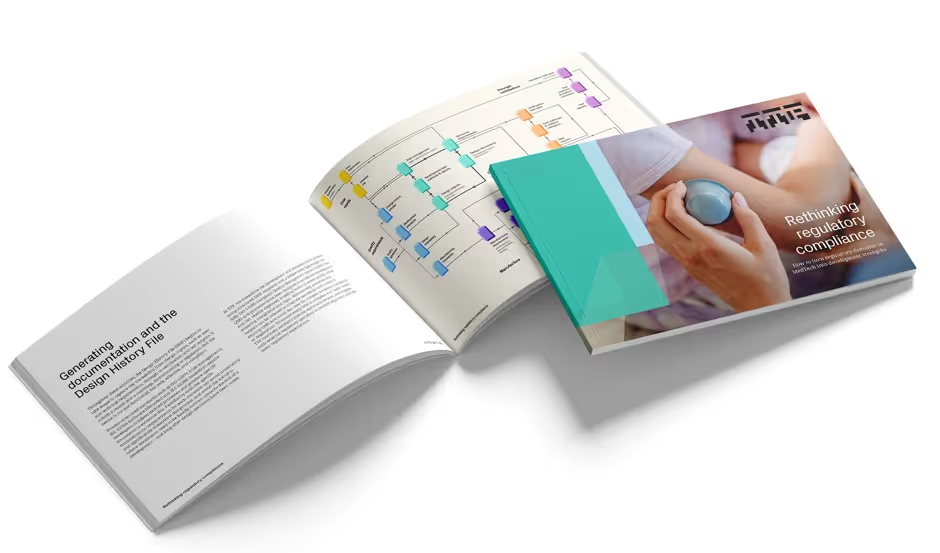
Get the e-book: Rethinking regulatory compliance
Learn how to turn regulatory demands in MedTech into development strengths - get your free copy of the e-book here.
About TTP's MedTech team
TTP’s MedTech team specialises in wearable and implantable technologies, including active implantable devices, bringing deep multidisciplinary expertise and regulatory familiarity to support end-to-end development.
With scientific and engineering rigour, combined with well-established quality and risk management processes, we anticipate and resolve risks early, ensuring robust and high-performance solutions.
By flexing around your internal team, we provide the bandwidth and specialist expertise needed to build confidence in your product and produce the evidence required to demonstrate performance and medical device safety. This approach delivers tailored results that meet the quality and regulatory requirements for your stage of development.
The result: compliance becomes an active enabler of product success - reducing uncertainty, accelerating development, and strengthening confidence in every regulatory submission.
.avif)