If you strip back a healthcare system to its bare essentials, it consists of a workflow that looks something like:
- Patient presents with a complaint.
- Diagnostic tests are performed to find the cause.
- The cause is managed.
A critical decision – on which patient outcomes and the efficiency of the system depend – is which tests to pick. Doctors must be able to answer, “Given what I know about this patient, what is the best next test to administer?”
The problem is that choosing the best next test often requires super-human powers, with doctors asked to balance informativeness with cost, turnaround time, and capacity limitations. We believe it is in making this choice that AI could have the largest impact on diagnostics.
We can already see small steps in this direction. NHS 111 Online can triage and give simple advice based on clearly defined algorithms. This is already widely used.
The next generation of technologies are also beginning to make in-roads. Many companies are releasing LLM wrappers to act as symptom checkers, combining rules-based retrieval augmented generation (RAG) architectures with the internal thinking of the models themselves. The AI companies are also releasing models fine-tuned to handle medical queries, with their thinking better tuned to practicing medicine.
But while foundation models are undoubtedly transformative in many ways, they are also known for unreliable outputs and opaque decision-making.
How can we best fix these failings? Can we employ the big data and AI systems to deliver something reliable and explainable that achieves the goals of fast, low cost, low effort diagnosis?
To contribute to the discussion of how robust and trustworthy systems may be built, we have sketched the architecture for an AI-enabled diagnostic system that can be built test by test.
We call her Dr DAIsy.
Although our Dr DAIsy is a thought experiment (for now), we discuss how such a system may be built with existing technology, how its anatomy makes its decisions explainable and actionable, and how it could be rolled out as a series of low-risk steps.
Crucially, the system architecture offers scope to capitalise on the power of AI to controllably learn from healthcare data to uncover new, more efficient testing strategies.
And having outlined what such a system might look like, we use it to think about the changes ahead; in diagnostics, an acceleration of the shift from creating value by producing data to interpreting and extracting value from diagnostic data.
The diagnostics challenge
First, we must support our assertion that deploying diagnostics efficiently requires almost super-human powers. (If you are au fait with Bayesian inference in diagnostics you can probably safely skip this section.)
Imagine a disease with a ~1% prevalence rate. You have an extremely good test for this disease: the sensitivity is 100%, meaning that it will never give a false negative; and it is 99% specific, meaning that it will give false positives only 1% of the time.
The test seems good, so you use it to screen a population of 1000 patients. A patient receives a positive result. How likely is it that this patient has the disease?
Many people will assume that, with such good sensitivity and specificity, the odds of having the disease are high. Perhaps close to 99%. Patient and doctor are now faced with worry and uncertainty associated with having been diagnosed. Patients are scheduled in for more invasive testing and procedures to treat the disease that they almost certainly have.
Except it is not at all certain that they have it. It is a coin toss. The odds of a patient who has received a positive result having the disease in this scenario is 50%. For most, this is extremely unintuitive, yet the maths is clear: all 10 (1% of 1000) who have the disease are positively identified, as are 10 random others who have succumbed to the 1% false positive rate.
If, on the other hand, the pre-test likelihood of the disease, based on history and symptoms, had been 10%, then a positive result has a 90% chance of being correct. This is likely sufficient to start treatment.
The upshot is that the value of a test depends in part on the population it is used in.

By not understanding the interaction of pre-test probabilities with test properties, we have taken the wrong conclusion from the test result.
This is hardly news for diagnostics insiders, but in this case we’ve only considered one test for one disease. Real doctors have to consider multiple diseases and tests. What’s more, they have to balance the likely information gain with test cost, turnaround time, and other factors.
That’s where a suitably structured AI-based system to support diagnostic workflows that takes account of pre-test and post-test probabilities could add significant value.
[cta:lets-play-diagnose-who]
The solution: meet Dr DAIsy
Dr DAIsy is the future solution: an AI-enabled system that can take into account a patient’s history to identify the best next test(s) while balancing information gain and test cost, turnaround time, and other factors physicians must consider.
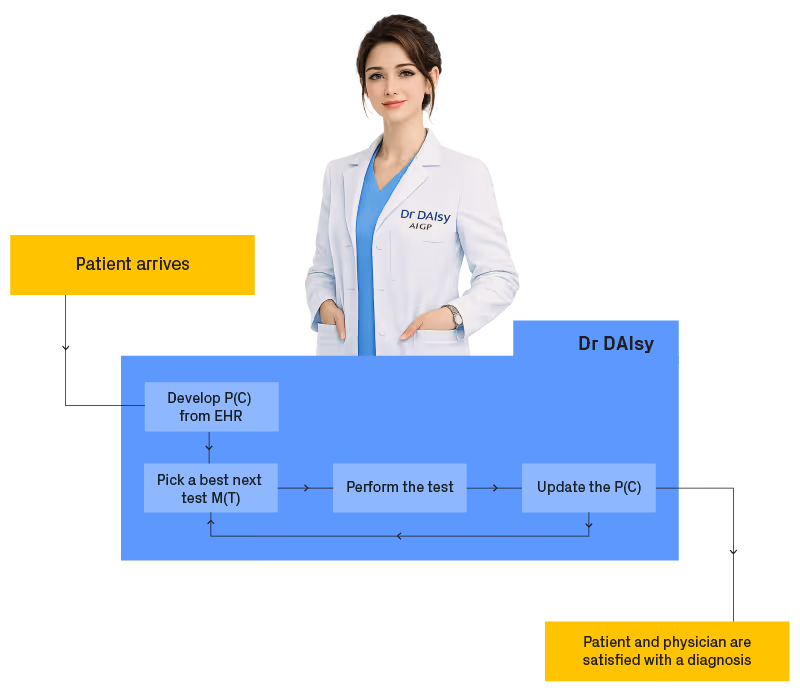
Dr DAIsy works with a list of possible conditions and the associated probability of the patient having each condition P(C). The list is initialised (potentially with the help of AI) from known health records when the patient presents and is updated through repeated diagnostic testing. Recommendations for the best next test(s) are based on the expected information gain they offer (potentially estimated with the help of AI). Eventually, we reach a satisfactory level of confidence in a diagnosis, at which point Dr DAIsy’s job is done.
The structure of Dr DAIsy enables a number of advantages:
- It allows the entire healthcare workflow to exist in a single working loop.
- It can be deployed slowly under supervision, allowing capabilities to grow alongside trust.
- It can handle arbitrarily complex tests.
- It is agnostic to diagnostic test providers; only needing to know how a test result affects the probabilities of conditions.
- It enables system level sensitivity analysis for changes to best practice.
- It enables healthcare systems to prioritise factors such as cost, sustainability, and convenience for patients.
Implications for the diagnostics industry
Systems like Dr DAIsy bring benefits to healthcare but also mean that the diagnostics industry will have to operate in a changed ecosystem.
Healthcare systems will see first order savings from more efficient testing. Patients are diagnosed more efficiently, leading to earlier treatment where appropriate. With less time spent on the diagnostic process, doctors would have more time for other aspects of care.
Second order savings would arise from the reduced risk of complications and missed treatment.
Diagnostics may evolve further into a business of extracting more information, and more value, from each test. As such, the industry may see new markets in algorithms for extracting information from common tests, and in algorithms for deploying more specialised tests in line with the preferences of the healthcare system.
Dr DAIsy may also pinpoint opportunities for the development of novel diagnostics by identifying gaps where the uncertainty about patients’ conditions is high and the information-gain offered by existing tests is low.
It has been well over a decade since the idea of Big Data became popular, but it is perhaps the modern AI wave that will enable us to properly make use of it. The impacts on the diagnostics industry will be substantial. Even if Dr DAIsy is never built in full, we are confident that the industry needs to prepare for a world that she would bring about.
Want to explore the thinking behind Dr DAIsy in more detail?
Our white paper, Dr DAIsy - Anatomy of an artificial doctor, sets out how AI could guide diagnostic pathways by identifying the most informative next step for each patient.
Or put yourself in the doctor’s seat with Diagnose Who?, our interactive game that challenges you to navigate uncertainty and choose the best tests.
Working with the TTP Diagnostics Team
When developing next-generation in vitro diagnostic (IVD) systems, whether for point-of-care or distributed testing, success depends on delivering a product that works in practice, not just in concept.
We bring decades of experience in designing and delivering complex, regulated diagnostic systems. By integrating assay, hardware, software, and manufacturing from the outset, we take responsibility for the system working as a whole. This reduces risk, avoids rework, and accelerates the delivery of a deployable product.
Whether the priority is securing investment, meeting internal milestones, or hitting a market window, we focus on what it takes to deliver. Working with clarity, urgency, and technical depth to create diagnostics that succeed in the real world.
Get in touch with the team today.