
Low-volume molecular synthesis: scaling innovation without scaling cost
Why molecular synthesis is becoming the limiting factor in innovation
Historically, innovation was limited by our ability to understand biology.
Today, many organisations face a different challenge.
AI models can generate millions of candidate molecules. Advanced sequencing platforms can create vast datasets. Design-build-test cycles are accelerating across the life sciences.
Yet the ability to physically create those molecules has not kept pace.
For organisations developing next-generation therapeutics, diagnostics and synthetic biology platforms, the ability to physically create molecular libraries is increasingly becoming the rate-limiting step.
In many applications, the challenge is no longer designing millions of variants. It's producing them at a commercially viable cost.


Why conventional synthesis economics break down
As organisations move from thousands to millions of variants, traditional synthesis approaches become increasingly difficult to scale.
The challenge is simple economics.
Reagent consumption, consumables, laboratory infrastructure and operational complexity all increase with reaction volume. Long before technical limits are reached, costs can become prohibitive.
For applications such as:
- AI-enabled drug discovery
- CRISPR screening libraries
- Directed evolution
- DNA data storage
- Synthetic biology
- High-complexity diagnostics
Success increasingly depends on generating huge numbers of unique molecular variants without proportionally increasing cost.
The question is no longer whether synthesis can scale.
It's whether it can scale economically.
Discover why traditional approaches struggle to scale.
Why miniaturisation changes everything
Reducing reaction volume is not simply a cost-saving exercise.
Moving from microlitre-scale reactions to nanolitre, picolitre and even femtolitre volumes fundamentally changes what becomes commercially possible.
Reaction density increases dramatically while reagent requirements fall.
This creates a pathway to synthesis architectures capable of supporting millions of reaction sites within practical manufacturing environments.
However, molecular synthesis does not simply scale down.
At ultralow volumes, entirely new engineering and chemistry challenges emerge.
See how reaction miniaturisation changes the economics.
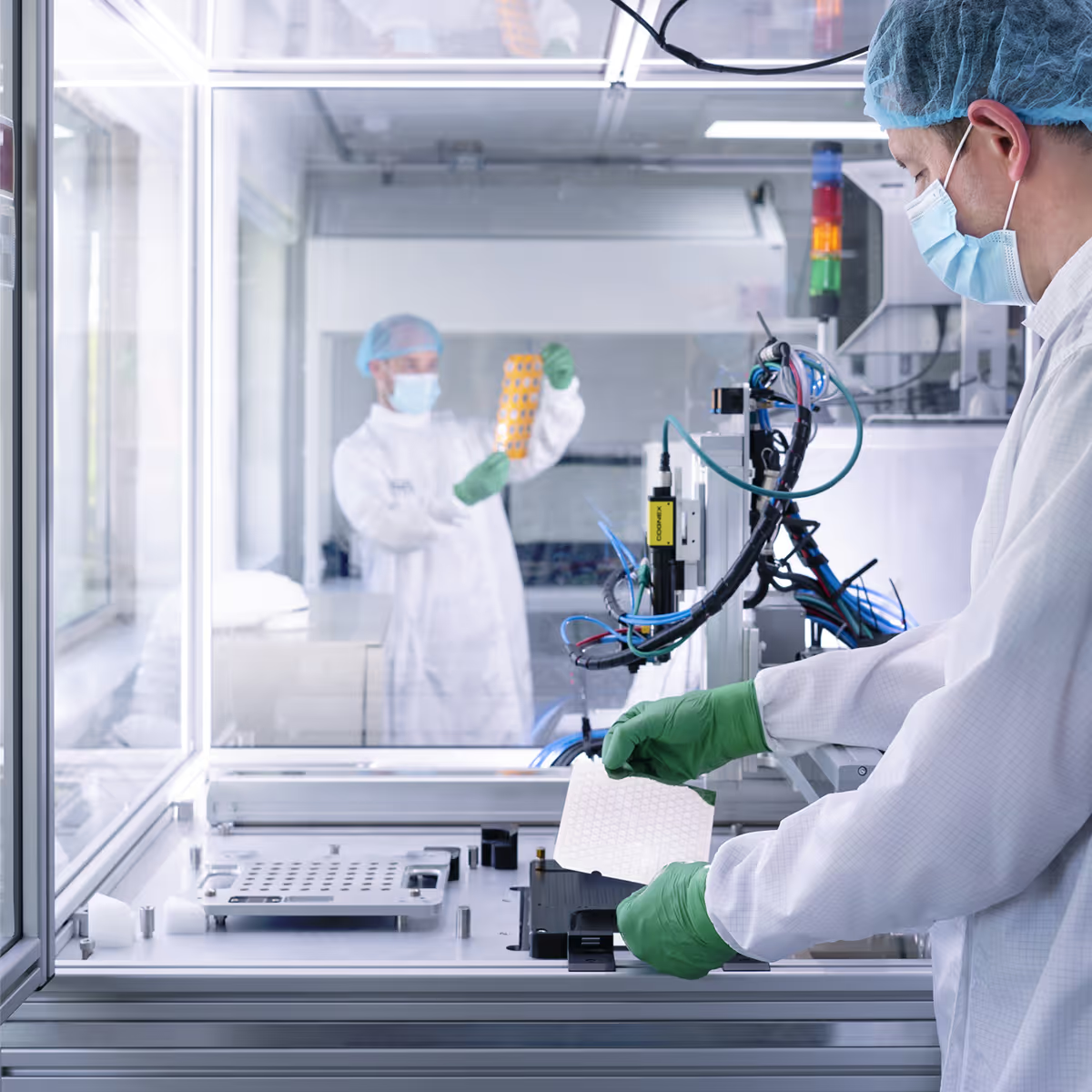
The next industrial revolution in biotech is density
Historically, scale in biotechnology came from building bigger systems.
- Bigger facilities
- Bigger automation platforms
- Bigger production infrastructure
The next wave of innovation is different.
Success increasingly depends on fitting more reactions into less space, using less reagent and less capital.
The organisations that master reaction density gain advantages in:
- Lower cost per molecule
- Faster design-build-test cycles
- Greater throughput
- Improved capital efficiency
- Smaller manufacturing footprints
For many emerging applications, competitive advantage will come not from scaling up, but from scaling out.
Discover how reaction density is reshaping molecular synthesis.
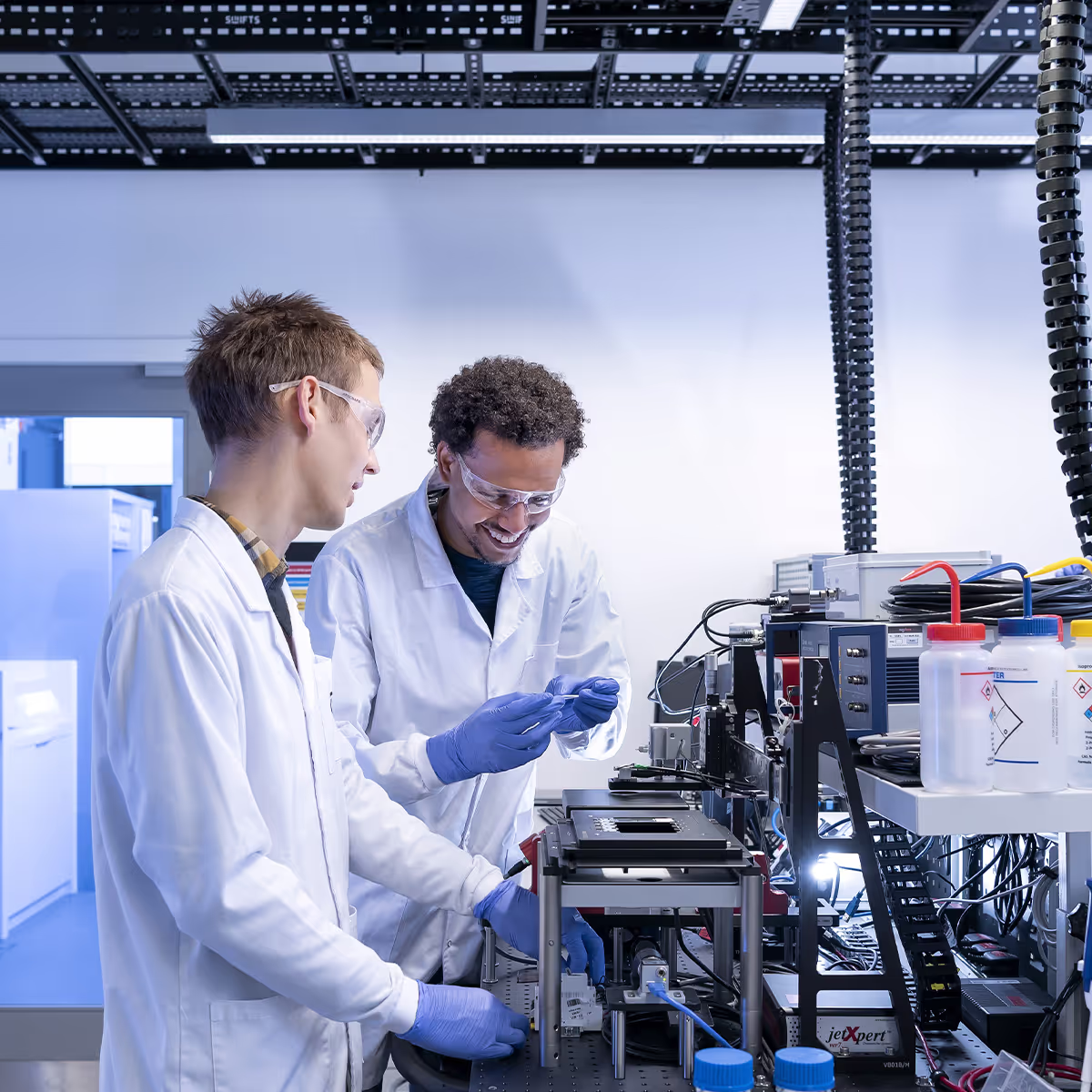
Commercial success requires more than miniaturisation
One of the biggest misconceptions is that low-volume synthesis is primarily a liquid handling challenge.
In reality, success depends on co-design.
Decisions made to control evaporation influence reaction chemistry. Chemistry choices affect yield. Yield affects recovery, quality control and downstream processing.
The most successful low-volume synthesis platforms are built through the co-design of chemistry, hardware, reaction formats and downstream processing.
Commercial viability emerges when all of these elements are engineered together.
Explore the economics of molecular scale-out.

Is low-volume synthesis right for your application?
Low-volume synthesis is not the answer to every molecular manufacturing challenge.
It becomes most valuable when organisations need to generate large numbers of unique variants while maintaining commercial viability.
You may benefit from a low-volume synthesis approach if you need to:
- Generate thousands to millions of molecular variants
- Reduce reagent consumption and operating costs
- Increase reaction density without expanding infrastructure
- Accelerate design-build-test cycles
- Improve scalability for high-complexity libraries
- Enable commercially viable synthesis at unprecedented throughput
These challenges are emerging across the life sciences. From AI-enabled drug discovery and CRISPR screening to synthetic biology, diagnostics and DNA data storage, organisations are under increasing pressure to generate more molecular diversity while controlling cost and accelerating development timelines.
Explore the technical and commercial considerations in the guide.






Our areas of focus:
Life Sciences
Our approach and capabilities
We deliver across the entire life of a project, from opportunity discovery to production engineering. Discover how our interdisciplinary teams of experts collaborate to tackle the toughest product development challenges.

Our campus and facilities
Our award-winning campus has been designed with a clear vision. To create space which can suport our people and our clients as we develop and deliver the very best technology solution.

Software capability at TTP
Engaged in all stages of software and product development, our software capability at TTP covers the full spectrum—from in-depth analysis and system architecture to prototype design, implementation, and test development.

Manufacturing capability at TTP
Working seamlessly with our development teams, we take clients' products through prototype builds, clinical trials, pilot manufacture and more. Using TTP Manufacturing reduces uncertainty, risk and time to market for our clients.
Meet some of the team

Sebastian Rammensee

Simon Lesbirel

Greta Sneideriene
Talk to us about your next project
We help clients with all stages of their most complex and challenging technology and product development projects.
If you're considering the next steps along your innovation journey, why not get in touch?