A sudden increase in demand can expose a dangerous gap in even the strongest defence startup - the technology is promising, the opportunity is real, but the team does not have the capacity to turn a breakthrough into a credible system fast enough.
You may have developed a genuinely valuable core capability: a novel sensor, next generation connectivity system, autonomy stack or other piece of differentiated IP. Then the context changes. A customer wants a trial sooner than expected. A programme moves faster. A new operational need creates urgency. What looked like a sensible development timeline suddenly feels too slow. The opportunity is clear, but your team does not have the capacity to accelerate every part of the product at once.
For the CTO or chief engineer, that creates a familiar tension. The founding team needs to stay focused on the core technology, the customer problem and the decisions that will shape the long-term business. But reaching the next milestone often depends on a much broader set of engineering tasks that are urgent, complex and impossible to ignore.
Systems Engineering for technical founders
Many defence startups begin with a breakthrough, not a complete product. Early progress comes from proving that the central idea works.
Later, the challenges change, as the company moves from TRL 2 towards TRL 6. At that point, the question is no longer whether the technology works in principle. It is whether it can become part of a system that is robust, testable, manufacturable and credible in front of a demanding customer. The core ‘inventive leap’ and the team that produced it needs to evolve. Systems Engineering becomes essential.
For a technical founder, Systems Engineering should provide a practical way to make good decisions early. It helps define what must be demonstrated at the next milestone, what constraints really matter, which interfaces need to be fixed, and what sits on the critical path.
It also helps answer a more fundamental question:
are you building the right thing in the right way?
That matters in defence, where success depends on more than novelty. Reliability, integration, operator use, manufacturability and readiness for trial all matter. A prototype that proves the science is valuable is not the same as a product that can survive field evaluation and support a procurement decision.
Founders and chief engineers need to shape the wider system around the core IP, so progress can continue without losing sight of what the customer needs. It can be tempting to focus on the technology alone, but remember that your investors care most about your customers’ buying signals, and your customers care most about the commercial benefits you are delivering to them.
Let your team focus on the core IP
Here is a simple way to decide what should stay in-house, what can be staged, and where external support can accelerate progress. The matrix below separates engineering tasks by urgency and long-term operational value, helping founders protect focus while still moving quickly.
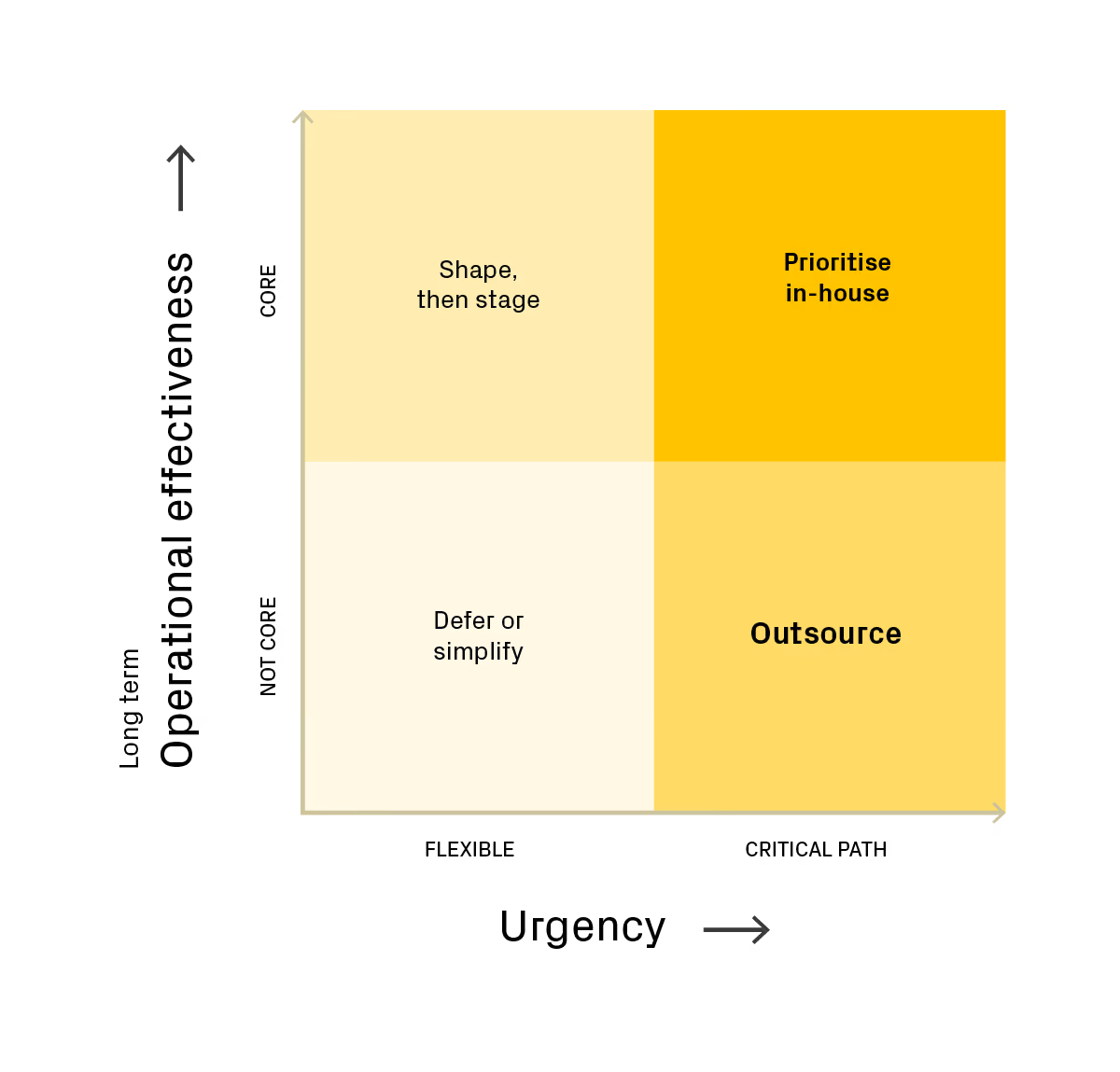
The founding team is usually best placed to develop the innovation that makes the company valuable. They understand the technology, the mission need and the long-term operating service better than anyone. Their time should be spent where they add the most value. In our matrix, these tasks sit in the upper right corner. Even at the expense of time to market, building this expertise in-house is the right choice.
There are other, similarly vital tasks that the in-house team must do, but where the timing is more flexible. Here we recommend a policy of shaping early, with the anticipated architecture blocked out and defined, but then staging the development to fit around business needs – shown in the upper left side of the matrix.
Once these priorities have been set, the difficulty is that the surrounding engineering cannot wait. A promising capability still needs architecture, integration, electronics, communications, software, packaging, verification and early manufacturing thinking. For a startup under time pressure, that work can easily consume the same people who should be advancing the company’s differentiating technology.
Solving the critical-path work around the core IP
The decision is not simply whether to outsource. It is whether a given engineering challenge needs to become part of the company’s permanent operating model. For many defence startups, the most urgent bottlenecks sit around the core IP: system architecture, integration, electronics, communications, software, packaging, verification and early manufacturing thinking. These areas can determine whether the next milestone is credible, but they do not always need to define the business in the long term.
This is where TTP can work with start-ups to take on that heavy lifting – we specialise in the tough-tech, mission-critical developments that are shown in the lower right-hand quadrant of the decision matrix. In all cases, we collaborate with our clients to accelerate their ambitions to market.
From customer urgency to qualified product in twelve months
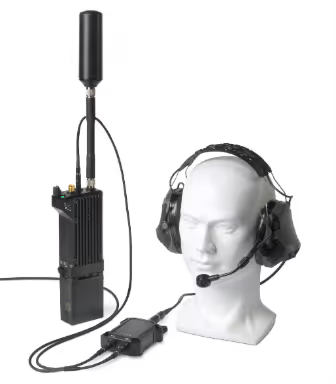
Spectra Group faced a familiar challenge: customer demand was shifting towards more data-centric tactical communications, and its Slingshot platform needed to evolve quickly while remaining compatible with its leased-spectrum model.
TTP began with feasibility studies but rapidly progressed to an intensive development program to create a platform for soldier-worn and vehicle-mounted satellite communications. The platform combined the latest integrated radio ICs with a fully integrated System-on-Chip, ARM cores and FPGA-based hardware acceleration.
The result was a flexible software-defined radio platform able to work with different RF front ends across satellite or terrestrial bands. Within twelve months, the programme had moved from a “blank sheet of paper” to a fully working product, with a supporting manufacturing supply chain in place, ready for demonstrations and trials with customers.
Spectra publicly announced the GENSSTM family in 2024 after successful live trials over leased satellite channels, and its CEO credited the collaboration with TTP for delivering a step-change in capability at exceptional speed.
This example highlights a useful model for startups. Spectra retained its market understanding, customer insight and product ambition, while TTP provided broad multidisciplinary engineering and deep satcom modem expertise to accelerate delivery.
Partner to solve what is mission-critical, but not core to your future business
A useful test for any growing defence startup is to ask:
What problems are critical to success now, but should not define the long-term shape of the company?
If your project plan starts with “recruit team” then you have a recipe for missed milestones or for repeated phases of work in pursuit of specification. In some cases, the work that cannot wait is system integration. In others, it the technology itself. These elements may be essential to reaching the next milestone, but they are not necessarily capabilities that the company needs to build permanently in house.
This is the right point to bring in external support. Outsourcing may look more expensive on paper, but when your internal team is maxed out, the difference in time can be an order of magnitude: tasks that should take a month get delayed by a year as the team fights the most urgent fires. Ten times the delivery rate for twice the burn rate. That is the force-multiplier advantage TTP can offer, and when the work is done, the spending stops.
We solve critical path engineering problems, without requiring your startup to create a large internal team around every adjacent discipline. This reduces risk, maintains momentum and keeps your organisation focused what will matter most in the long term.
For defence startups and scaleups facing a sudden shift in demand, that can make the difference between missing the moment and being ready for it.
If your next milestone depends on engineering that is mission-critical but not core to your long-term business, TTP can help you move faster.
Talk to us about accelerating your path to TRL 6 while keeping your team focused on what makes the company valuable.
.avif)