Complex challenges need shared understanding
As far as we know, human beings can’t read each other’s minds. If you are responsible for decision-making in an organisation, creating meaningful change requires more than presentations and predefined agendas. It involves self-reflection, prompting others to do the same, brokering understanding, communicating effectively – oh, and actually coming up with creative ideas to address complicated (a.k.a ‘wicked’) problems (see footnote1).
Businesses across the medical, surgical, and pharmaceutical sectors are constantly faced with difficult questions and shifting market realities. What should we prioritise over the next 5–10 years? How do we best serve clinicians, customers and patients in an evolving healthcare landscape? Where should we invest, adapt, or rethink our approach?
These questions rarely have simple answers - and they often require more than conventional workshops or procedural slide decks to work through effectively.
Whether you’re working on a business strategy, a service redesign, or a complex healthcare challenge, Lego Serious Play® offers a practical question: what if the best next step isn’t another document, but a conversation that everyone can be a part of - and shape?
Lego had this exact problem in the mid-1990s. Play behaviours were changing, and Lego found their strategy was misaligned with the types of play children engaged in (and parents purchased). The CEO recognised that the answers lay within the company, but to collaboratively address them and come up with solutions… they had to play together.
Why Lego built a strategy tool in the first place
One phrase that captured the anxiety of that era was that children were “growing older younger.” I.e., moving on to different interests earlier than previous generations. For a company built around long-lasting, open-ended play, those signals could not be ignored.
Lego needed better ways to understand changing behaviours, respond to market shifts, and get the whole organisation to pull in the same direction. The company recognised that the answers already existed within the business - but uncovering them required people to think, explore, and problem-solve together differently.
From a document on a shelf to a strategy people can share
Lego’s then CEO, Kjeld Kirk Kristiansen (the founder’s grandson), believed that people (and not just plans) drive company success. Around this time, he met two business school professors who both shared a similar view, that strategy shouldn’t be something that exists only in a binder on a shelf. If strategy is going to work, it has to be understood, owned, and “lived” by the people doing the work every day.
To turn those ideas into something practical, Kjeld started a subsidiary focused on building internal strategy tools based on their theories. The group, called Executive Discovery, became the environment in which Lego Serious Play was developed.
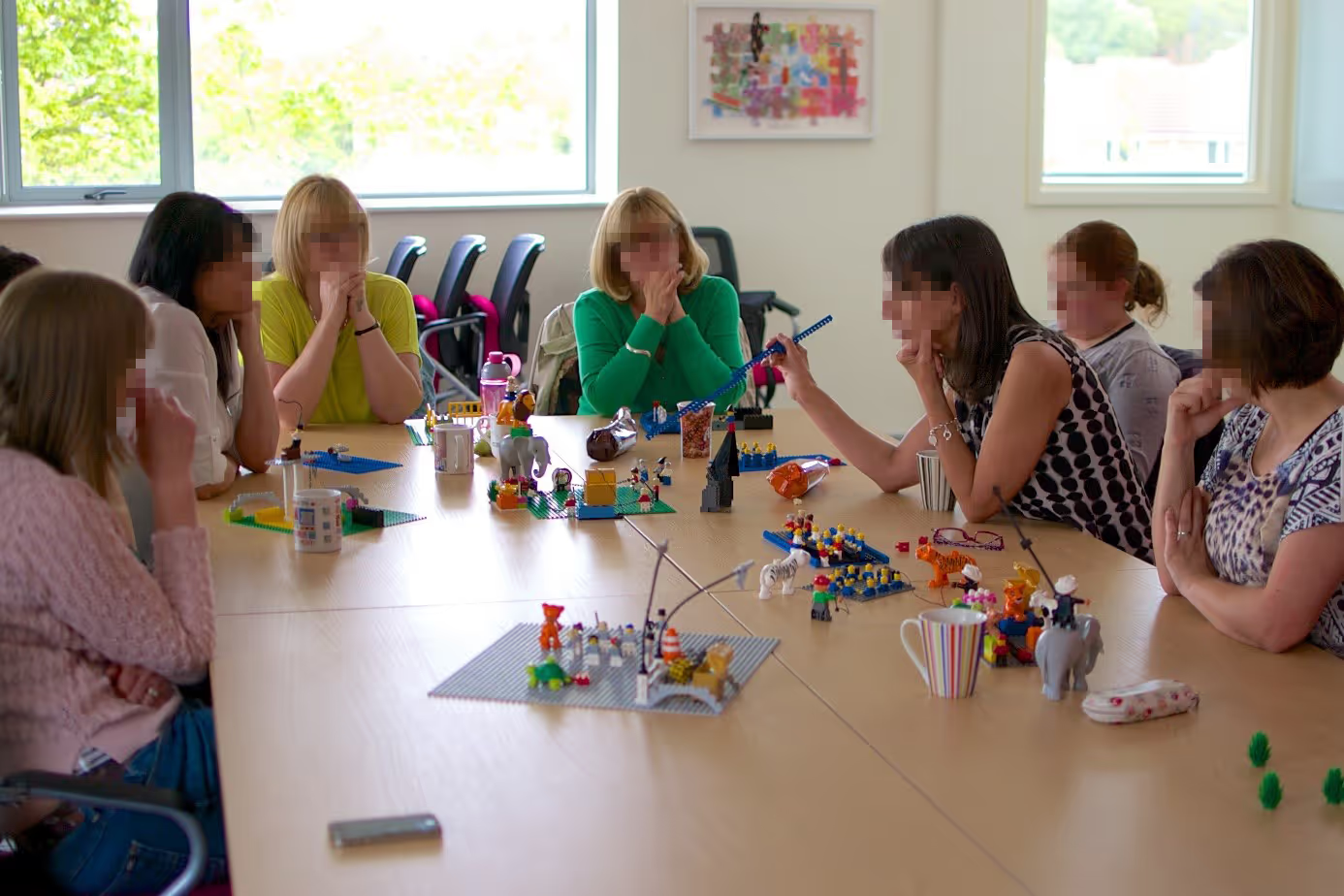
Lego Serious Play was designed as a structured, facilitated method for exploring complex challenges collaboratively. Participants build individual models, explaining the meaning behind what they have built, and then combine models into a shared picture of a system, challenge, or future direction. Because the models are shaped and interpreted by the participants, it creates a more accessible way to talk about complex topics, spot differences in perspective, and co-create next steps.
Although Lego Serious Play began as an internal Lego tool, today facilitators can be trained to deliver Lego Serious Play sessions. This brings structure to the process and ensures the “play” remains purposeful.
Why Lego Serious Play works well in MedTech and Pharma
In practice, Lego Serious Play is still used most often in business settings… strategy offsites, leadership development, team alignment, organisational change, and culture work. It’s less prevalent (though by no means absent) in areas like product development, healthcare and education.
That gap can appear surprising, because the underlying challenges in those fields - multiple stakeholders, competing priorities, complex systems, and the need for shared understanding - are exactly the kind of problems Lego Serious Play was designed to tame.
For regulated industries such as MedTech and Pharma, those challenges are ideal for exploring via Lego Serious Play. Product, clinical, regulatory, commercial, and patient considerations are often deeply interconnected; with decisions in one area creating unintended consequences in another. There are often conflicting challenges, or interactions between disciplines that might have latent implications. Lego Serious Play provides a structured way for cross-functional teams to self-reflect, explore those relationships collaboratively, surface hidden assumptions, and build shared understanding around complex problems.
How Lego Serious Play actually works – a Pharma case study
TTP was asked to assist a large pharmaceutical company facing organisational challenges related to a complicated software development. Teams were spread across three continents, with several groups feeling unheard or misunderstood, while tensions had also developed between project leadership and the software engineers reporting into them.
The client convened an in-person workshop; TTP recognised that for the programme to be successful, the wider team needed a shared vision of the strategy – and each individual’s role within it.
Lego Serious Play was used, and the stages looked like this:
• Individuals built models representing their vision of the product. Why did it matter from their perspective? How did it have an impact? How did they value their work?
• Small groups then built shared models that incorporated important aspects of the individual models. This involved negotiation and collaboration – it is the moderator’s job to make sure everyone has the space to join in and participate.
• The smaller groups shared their models with the wider team – helping to reach consensus around shared aspects of the overall vision and individual roles.
• The remaining areas of disagreement or uncertainty were explored in subsequent sessions throughout the workshop. The shared trust and understanding developed through the Lego Serious Play method created a stronger foundation for more efficient and effective (genuine) collaboration.
A note on facilitation
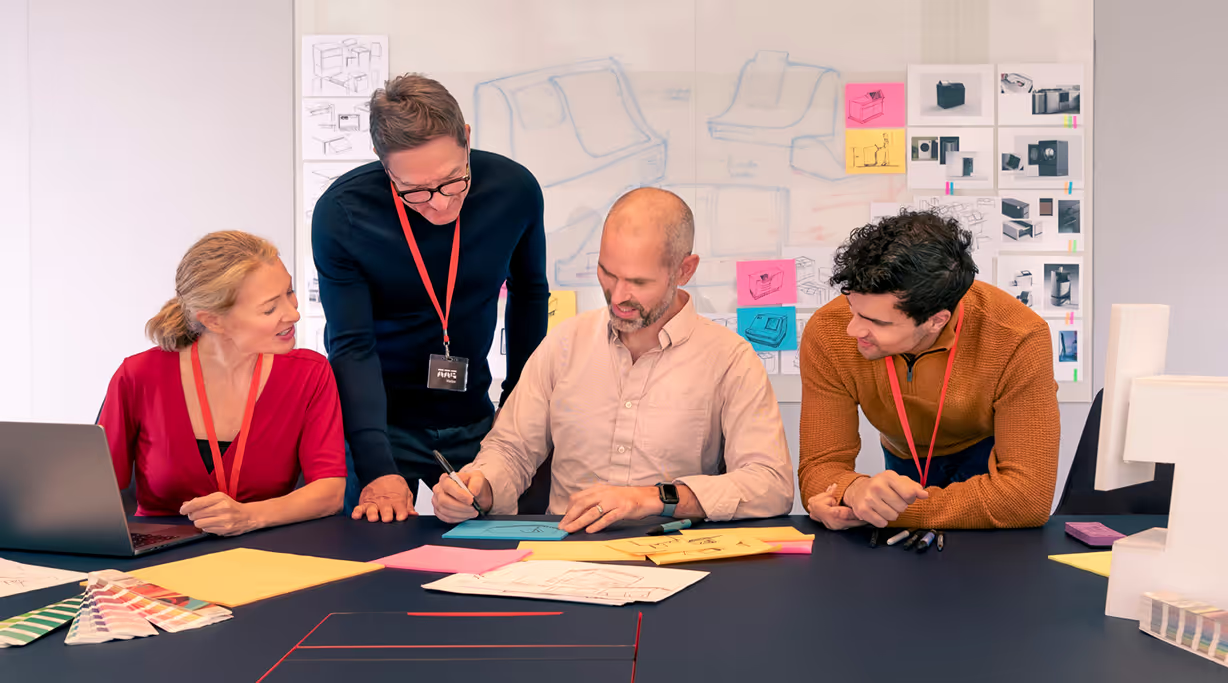
Careful moderation is extremely important throughout the process. Warm-up exercises, inclusive facilitation and ensuring that everyone is heard and involved are all crucial parts of the process and require specialist facilitation skills. The Lego bricks themselves are not “magic” and simply including them in a workshop doesn’t automatically make the workshop inclusive, collaborative or creative.
The outcome
For this client, the process helped reduce friction, improve understanding between teams, and create stronger alignment around the overall project vision. The client was genuinely delighted with the outcome.
Lego Serious Play can help deflate conflict, build trust and create a shared vision - especially for difficult, multifaceted challenges. By creating a space for more constructive conversations early, we helped the client go further, faster – and in the optimal direction.
Lego Serious Play at TTP
Matt Dexter from TTP's Human Factors Consulting team, was trained by Robert Rasmussen, who developed the original Lego Serious Play facilitator programme at Lego. He has since used Lego Serious Play extensively as part of his PhD research and academic work with healthcare practitioners, patients, and payers/health policymakers.
Matt’s experience highlights how Lego Serious Play can translate far beyond the boardroom. In those contexts, the “serious” part becomes especially clear: building models can help people describe lived experience, map out a system that feels invisible when it’s only discussed abstractly, and create a safer way to surface disagreement or uncertainty.
When participants can point to a model rather than a person, conversations often become more constructive, open and honest.
At TTP, Matt has facilitated Lego Serious Play workshops for individual clients, and within broader multi-stakeholder sessions involving Pharma and MedTech organisations, HCPs, policymakers, patient representatives and third sector at the Royal Society of Medicine.
[cta:about-ttps-human-factors-team]
In summary – building shared meaning in a changing world
The origin story of Lego Serious Play is a reminder that good strategy isn’t just dry analysis… it’s building shared meaning. Lego didn’t develop Lego Serious Play because it wanted a fun workshop gimmick; it built it because it needed a way to get people thinking together when the world is changing quickly.
About TTP's Medical Device Design Consultancy
From the earliest concept, the decisions you make shape everything that follows. As a medical device design consultancy, TTP supports ambitious start-ups and established players across the full product development lifecycle. With over 38 years’ experience, we help you navigate the critical design and development decisions - balancing performance, usability, manufacturability and risk - to ensure your device performs reliably, scales effectively and succeeds beyond the prototype.
Footnote
1Information scientists Kunz & Rittel (1972) defined complicated,multifaceted, and dynamic problems as Wicked Problems…
Wicked Problems are theopposite of Tame Problems; a Wicked Problem defies absoluteformulation; there is no stopping rule (you could keep working on itindefinitely); solutions are ‘good’ or ‘bad’ (rather than ‘correct’ or‘incorrect’); and ‘solving’ (or more accurately, taming) the Wicked Problem meansthe ‘tamers’ are intimately connected to the solution… the ‘answer’ is oftendistributed amongst the team.
Systems involving people are often indicative of Wicked Problems; e.g.,optimising an innovation pipeline for medical devices, designing a new PatientSupport Program around a new drug, etc.)
Deciding on your business strategy is an exercise in taming a WickedProblem.