Rethinking the device in 6G - architecture, constraints, and the case for disruption
Why NTN exposes the limits of the smartphone and points towards a more flexible, role-based approach to 6G device design
Whitepapers
Rethinking the device in 6G - architecture, constraints, and the case for disruption
Why NTN exposes the limits of the smartphone and points towards a more flexible, role-based approach to 6G device design
Executive summary
6G promises ubiquitous connectivity through closer integration of terrestrial and non-terrestrial networks, but this vision exposes a growing device problem. Modern smartphones are increasingly compromised as radios, with thin form factors, limited antenna performance, crowded RF front-ends and regulatory constraints reducing link efficiency. In NTN, every lost decibel at the device must be recovered elsewhere in the system, adding cost and complexity.
This paper argues that 6G needs a more flexible, role-based device ecosystem, where smartphones are complemented by specialised devices, wearables, vehicles and relays with stronger RF performance. Achieving this will require renewed investment in antenna systems, more adaptable RF architectures and programmable PHY processing, enabling 6G to deliver greater ubiquity, efficiency and resilience.
Introduction
The vision for 6G is bold: ubiquitous coverage, extreme throughput, ultra-low latency, and seamless integration of terrestrial and non-terrestrial networks. Yet, the very device that anchors this vision, the smartphone, is increasingly mismatched to the task. Driven by consumer expectations of thinness, portability, and long battery life, smartphones have steadily deprioritised their role as radios.
The result is a widening handset gap. Antennas are smaller and less efficient, coexistence between multiple bands is harder, and regulatory limits constrain transmit power. Meanwhile, the number of bands and modes continues to grow. This design philosophy has succeeded in terrestrial contexts, where dense networks and short link distances can compensate for weak devices. But in the NTN context, where satellites are hundreds to tens of thousands of kilometres away, every lost decibel at the handset translates into satellite infrastructure cost.
Here, we explore how the smartphone became the weakest link in the 6G vision, why current trajectories are unsustainable, and how a new architectural approach, grounded in modularity, specialised devices, and disaggregated processing, can realign the system.
Satellites are far away - the physics of link budgets
Satellite systems are unforgiving of weak devices. A terrestrial macro-cell may sit just a kilometre from a user, a LEO satellite is typically 500 to 1,200 km away, while GEO satellites are 35786 km from the earth. The free-space path loss at these distances is orders of magnitude greater.
Figure 1. A comparison of terrestrial, LEO and GEO NTN link budgets
To close the NTN link and provide useful services, devices with superior antenna and RF performance are required (Figure 1). In practice, the opposite has happened. Handsets have grown weaker as radios, even as the demands for NTN have grown stronger. The consequence is a simple equation: weak devices place greater demands on the network, especially satellites in NTN networks, increasing capital and operating costs.
The decline of antenna performance
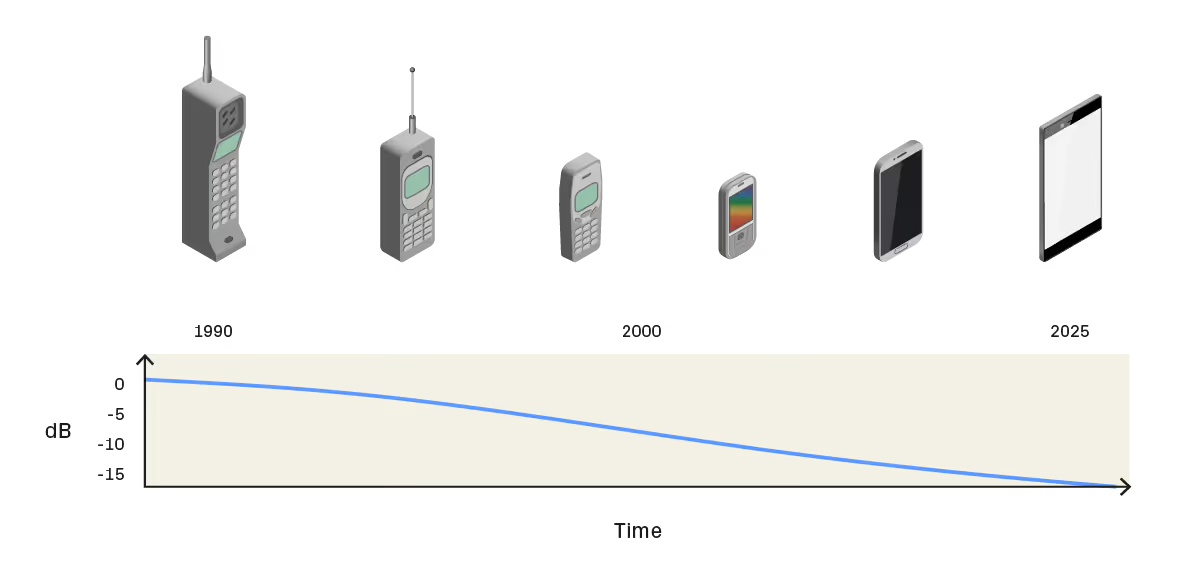
Early 2G devices typically used a large single band antennae or external stub that offered relatively good RF efficiency (Figure 2). By contrast, today’s smartphones feature multiple, miniaturised multiband antennae jammed into a very tight space with proximity to batteries, displays, and metal structures. This relentless focus on form factor forces a reduction in the antenna’s RF performance, reported to be around 15dB.
Figure 2. A decline in antenna performance has followed changes in device form factor since the introduction of mobile phone handsets.
Continue reading...
6G NTN performance starts at the device. Gain deeper insights into the RF, antenna, and system-level challenges affecting deployment. Complete the form to access the full article.
Form unavailable due to browser restrictions.
Your current browser or privacy settings may prevent this form from appearing.
Please enable third-party scripts or submit your details through
[email protected].
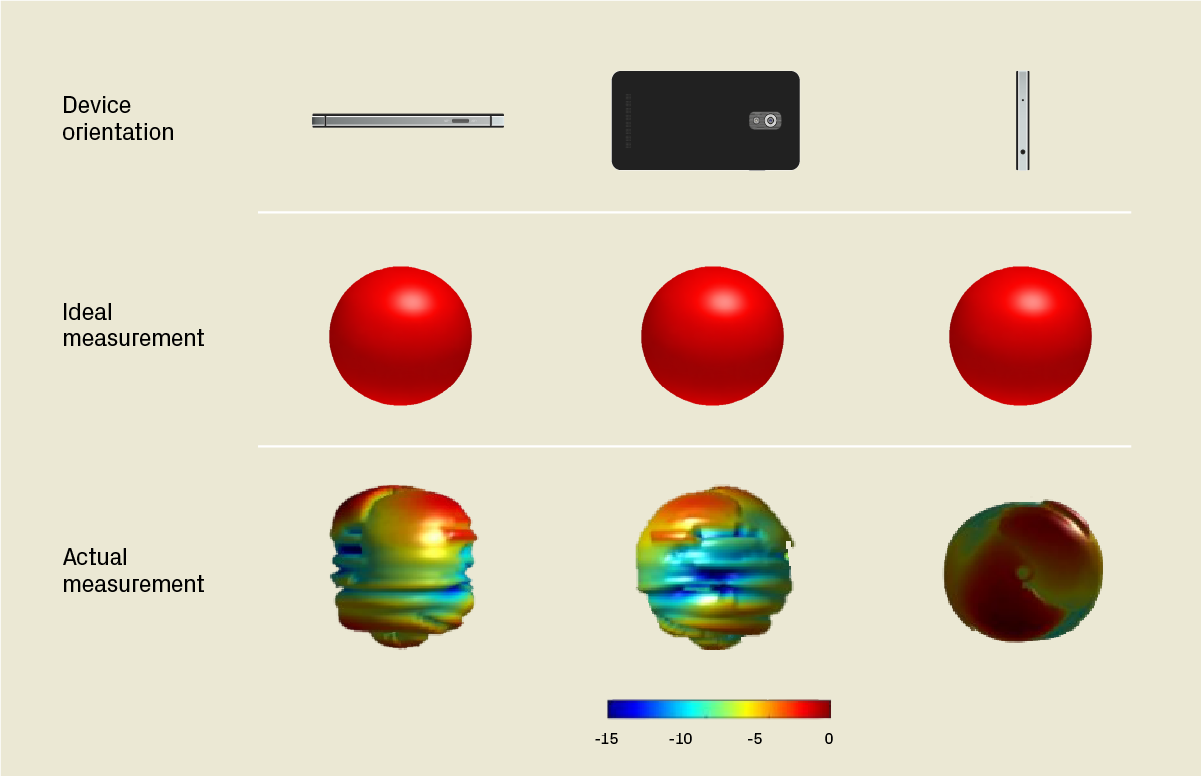
Device performance is evident when tested in TTP’s antenna chamber. Based on the conservation of energy principle, link budgets typically start from the assumption that devices have an omni directional pattern with 0dBi gain in all directions. When measured, it can be seen that not all the energy is radiated, the antenna isn’t 100% efficient. The peak of the device’s antenna pattern may just achieve 0dBi, much of the pattern is substantially lower (Figure 3) making the device’s performance sensitive to orientation. This effect is only compounded by the user’s hand and body.
Figure 3. Measured performance of a device compared with ideal omni directional performance
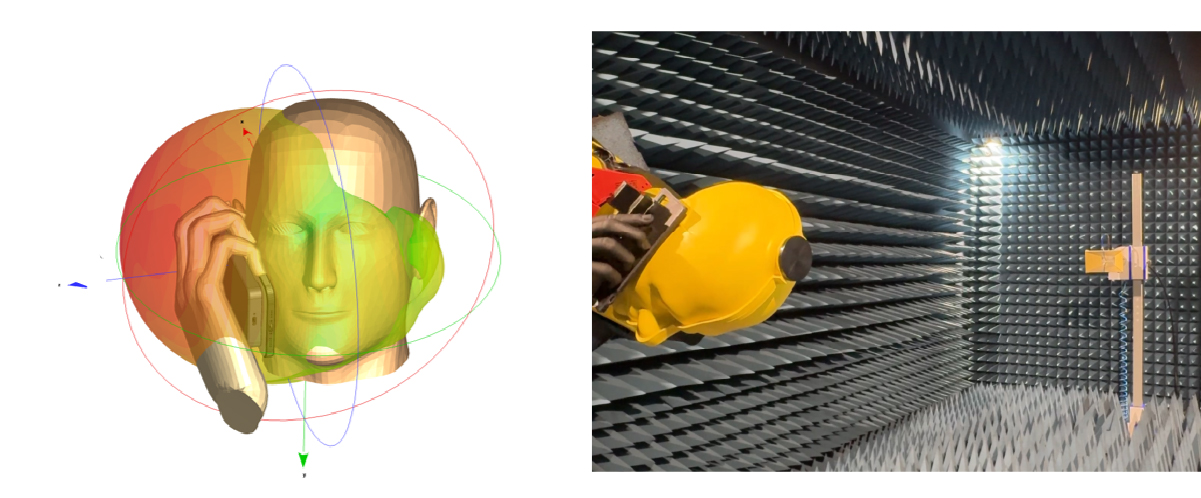
Device limitations go beyond the antenna pattern – Specific Absorption Rate (SAR) regulatory limits are set to protect the user from absorbing too much RF energy. This limits the amount of transmit power that can be directed from the device towards the user’s head, practically limiting the amount of RF power from the device’s power amplifiers that can be fed into the antenna.
Figure 4. Measuring SAR in TTP's anechoic chamber
System-level consequences
In terrestrial networks, device antenna limitations are masked by high cell densities and interference. In NTN, they are magnified.
Poor RF causes inefficiency at every level. In terrestrial networks, poor sensitivity requires higher RAN transmit power and denser deployments. In NTN, every dB of device-side loss is compensated in space, whether through very large, expensive to build and launch, high-gain satellite apertures, or ultra-low orbits reducing the distance to the earth requiring many more satellites (Figure 5).
Figure 5. Options for building D2D NTN constellations: a smaller number of very large satellites at high altitudes, or a larger number of smaller satellites closer to the Earth
The asymmetry is clear, handset manufacturers optimise for consumer preference, while operators and space network providers absorb the cost. This model is economically inefficient and unsustainable.
Usage realities - a disproportionate burden
The irony is that most user data does not travel over cellular networks, let alone satellites. More than 80% of smartphone data is consumed over Wi-Fi in the US. Cellular accounts for much of the remainder, but nearly all of it is terrestrial. Direct-to-satellite handset connections, whilst critical to enabling ubiquitous connectivity, are likely to only ever be used when out of touch of a terrestrial network.
Chipset commoditisation and integration
The chipset market has reinforced this trajectory. Modern SoCs integrate baseband, RF transceivers, and support for dozens of band combinations into a tiny device suitable for integrating into a smartphone.
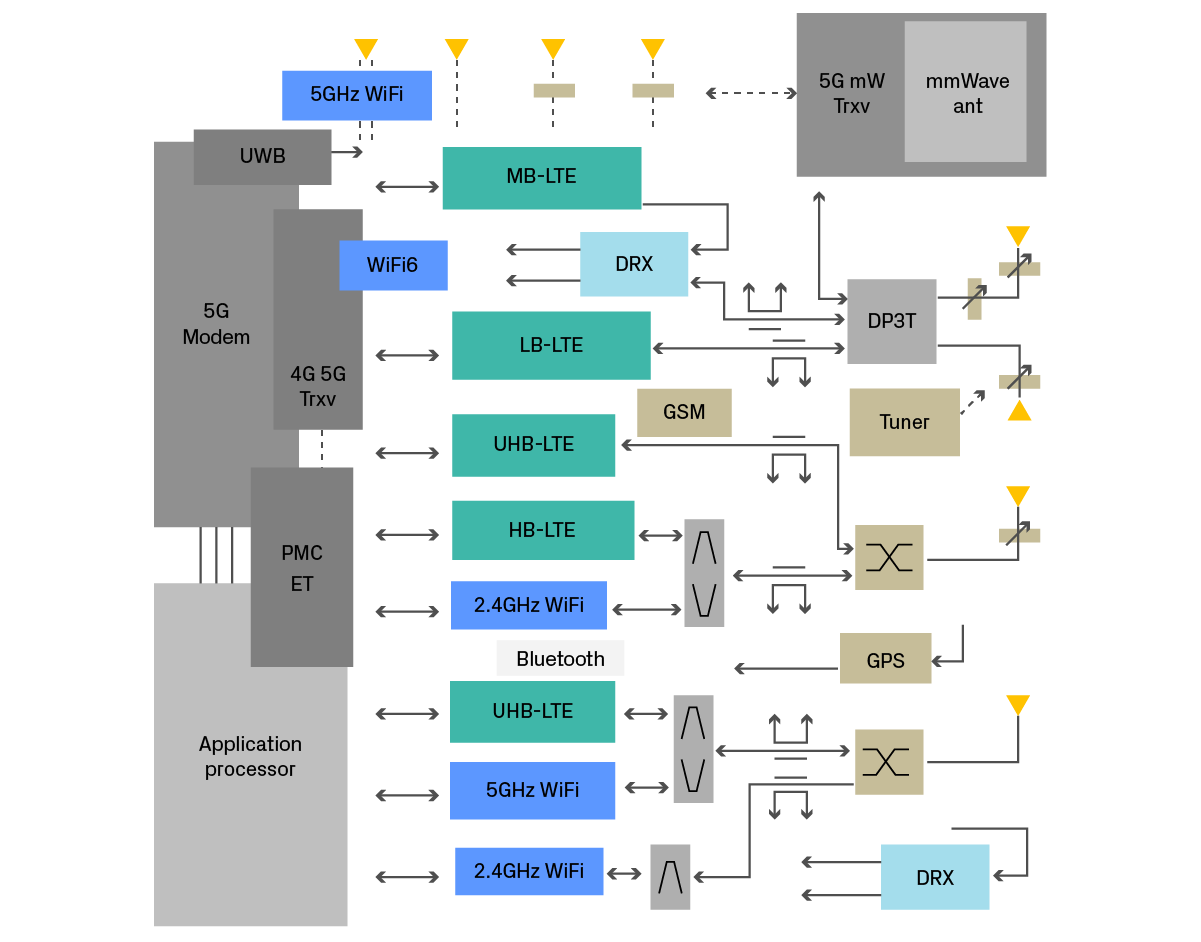
This miniaturisation introduces 2-3dB of cumulative insertion loss added by the multiple switch layers and filtering needed for MIMO, carrier aggregation cross-routing, SAR rerouting, global band support and simultaneous cellular, Wi-Fi and GPS operation.
Figure 6. Typical block diagram for a modern smartphone that demonstrates the complexity of the architecture supporting multiple antennas (yellow triangles)
While this reduces cost and enables global devices, it also locks the industry into a single-device worldview limited by the smartphone form factor and use case. Rugged NTN-capable devices, vehicular relays, or accessories with high-gain antennae remain secondary concerns not well met by today’s chipsets.
The case for better RF and specialised devices
This suggests a new dynamic is required. Chipsets may need to diversify into families optimised for different roles - the chipset product boundary needs to move to allow RF diversification and more flexible antenna options to be introduced. Investments in new antenna materials, reconfigurable arrays, and deployable form factors will also be needed.
Role-based device ecosystems
One solution is to move away from the monolithic handset model towards a role-based ecosystem. In this ecosystem:
Smartphones remain consumer-friendly, optimised for size and usability but not expected to support all RF roles
Wearable RF nodes and other accessory devices add RF performance and NTN capability when needed
Vehicles and drones act as relays, providing large antenna apertures and higher power budgets
6G features and the limits of the smartphone form factor
Although the 6G network vision emphasises convergence, integrating terrestrial and NTN operation, the effect on devices may be divergence. The physics of 6G radio, combined with the long-term direction of smartphone industrial design, push user equipment towards requirements that a thin consumer handset is increasingly unable to meet. The idea of a single universal 6G smartphone, supporting NTN, advanced RF capabilities and flexible physical-layer processing, sits uneasily with practical engineering constraints.
Signs of this tension are already visible. Apple’s recent decision to omit mmWave support in its flagship devices shows how design trade-offs and market dynamics ultimately determine which RF features reach mainstream handsets. With 6G proposing new RF demands and greater PHY flexibility, extending the current smartphone model may prove difficult without reconsidering how and where certain functions are implemented.
NTN provides the clearest example. Direct-to-handset operation at L or S band requires meaningful antenna aperture and stable performance under hand and body interaction. Modern smartphones, which minimise antenna volume to satisfy industrial design, struggle to provide consistent uplink EIRP or predictable radiation patterns. In 6G NTN scenarios, where mobility, blockage and device orientation directly affect the link budget, these constraints become more significant. 6G is also expected to rely more heavily on adaptive and AI-driven PHY processing. Such approaches benefit from architectural flexibility, yet today’s high-volume chipsets evolve more slowly than advances in antennas, RF front-ends and PHY algorithms. Keeping RF and PHY functions tightly bound to smartphone SoCs risks constraining performance at the point where 6G aims to become more dynamic.
Spatial antenna processing reinforces the mismatch. Even modest directional gain using multi-element antenna structures require geometric separation and clean apertures, conditions that the smartphone form factor finds difficult to provide. Thermal and power limits add further pressure. A device already near its operating margins under 5G cannot simply scale to wider bandwidths or more complex uplink schemes without substantial redesign.
The point is not that handsets cannot support 6G NTN, since today’s smartphones already demonstrate that direct-to-device satellite links are feasible. Rather, the issue is that they cannot meet the performance levels that future 6G use cases demand and consumers expect. Higher-rate NTN connectivity, stronger uplink margins, advanced sensing or flexible PHY processing require RF and architectural freedoms that the handset form factor cannot easily offer. A role-based device model, where smartphones are complemented by specialised devices when required, provides a practical way to deliver these capabilities without overloading the handset with requirements it’s not suited for.
Disaggregated RAN and the case for a flexible PHY
RF and antenna challenges in 6G are tightly linked to how the lower layers of the physical layer are architected inside the device. Modern smartphones integrate the RF front-end and the lower PHY in highly optimised, often inflexible silicon. This has delivered low cost and efficiency, but it also assumes stable waveforms and predictable operating conditions.
6G breaks that assumption. More dynamic spectrum use, NTN operation, device-side spatial processing and AI-assisted adaptation all require the PHY to change behaviour according to context.
The RF front-end at the antenna level will require increasing flexibility such as tuneable matching, switchable antenna paths, reconfigurable apertures and support for different terrestrial and NTN modes. These demands must be met with adaptable hardware interfaces capable of configuration and control. But the processing that interprets, adapts and optimises these RF behaviours must remain soft. 6G’s emphasis on adaptive waveforms, richer channel estimation, predictive algorithms and context-aware operation depends on programmability, not fixed pipelines. A hardware-led PHY risks freezing innovation and preventing devices from adapting to new scenarios or experimenting with new techniques.
Emerging compute architectures make a more software-defined PHY practical. Heterogeneous accelerators can handle AI-assisted estimation and prediction, while homogeneous parallel processing arrays (PPAs) offer scalable compute for filtering, combining and spatial processing as antenna counts rise. These engines allow the PHY to evolve in software while still meeting tight power and latency constraints.
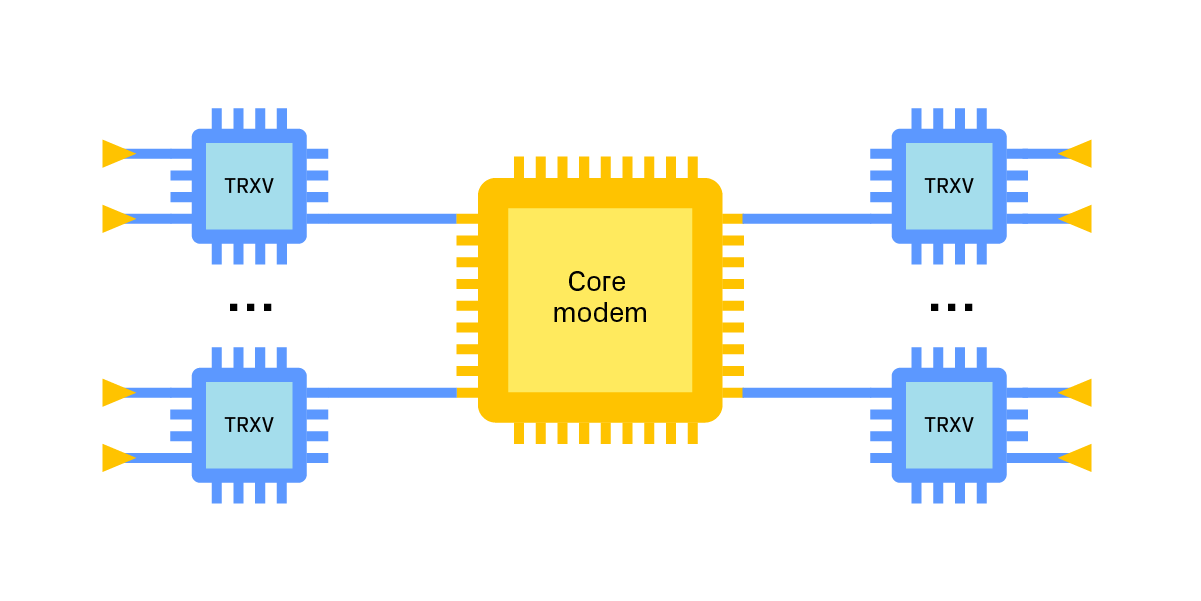
The architectural boundary therefore needs to move, separating flexible RF control and data paths at the front-end from programmable PHY processing above a stable hardware foundation. This is a form of partial disaggregation, not exposing proprietary internals but defining clear interfaces between deterministic low-level functions and a more adaptable processing layer.
Figure 7. A disaggregated PHY and transceiver concept
Several end states remain possible. The industry may converge on a predominantly software-controlled PHY with minimal fixed hardware, or, potentially, a hybrid model where some PHY behaviours remain tightly coupled to the front-end. Alternatively, a chipset-led model may evolve where innovation continues primarily in antennas, filters and RF materials. What matters is that devices retain enough flexibility to meet diverse 6G roles, particularly those involving NTN participation, adaptive sensing or context-driven operation.
Maintaining a soft PHY while enabling a flexible RF front-end strikes a pragmatic balance. It preserves the cost and efficiency advantages of today’s supply chain, while enabling 6G device behaviour to evolve over time rather than being frozen in silicon.
Conclusion
The smartphone has become the bottleneck in the 6G vision. Antenna performance has declined, chipset integration targeted for consumer device form factors has reduced flexibility and has locked all devices into fragile RF performance. The consequence is a costly asymmetry: weak devices drive higher RAN power and greater satellite capex.
The way forward requires two shifts. First, renewed investment in better RF and antenna subsystems, accepting that this means specialised devices and form factor compromises. Second, a move to role-based ecosystems with disaggregated PHY processing, distributing RF and computational tasks across smartphones, wearables, vehicles, and relays.
When combined with the demands of Massive MIMO, THz, and integrated sensing, the conclusion is unavoidable: the slab smartphone alone cannot deliver 6G. If the industry insists on that model, 6G will be compromised and costly. If it embraces diversity, modularity, and flexibility, 6G can deliver ubiquity, efficiency, and resilience.
Build the devices 6G NTN needs
To make 6G NTN practical and commercially viable, the industry needs to rethink the device as much as the network. TTP helps organisations navigate this shift, from RF and antenna design to flexible architectures and system-level trade-offs. To explore how your 6G or NTN device strategy could deliver stronger performance, lower cost and better user experience, get in touch with our team.
Continue reading this article
Complete the form to keep reading and get access to more insights.
We help clients with all stages of their most complex and challenging technology and product development projects.
If you're considering the next steps along your innovation journey, why not get in touch?
Thank you! Your submission has been received!
Oops! Something went wrong while submitting the form.
Form unavailable due to browser restrictions.
Your current browser or privacy settings may prevent this form from appearing. Please enable third-party scripts or submit your details through [email protected]
Get the latest from TTP
Join our community to get the latest news and updates on our work at TTP.
You will occasionally receive expert insights from across our areas of focus and hear directly from our engineers and scientists on the newest developments in the field.
Join our community to get the latest news and updates on our work at TTP.
Form unavailable due to browser restrictions.
Your current browser or privacy settings may prevent this form from appearing. Please enable third-party scripts or submit your details through [email protected]
Lorem ipsum dolor sit amet, consectetur adipiscing elit. Suspendisse varius enim in eros elementum tristique.
Talk to us about your next project
Whether you would like to discuss a project or would like to learn more about our work, get in touch through the form below.
Form unavailable due to browser restrictions.
Your current browser or privacy settings may prevent this form from appearing. Please enable third-party scripts or submit your details through [email protected]