
Resilience has become central to defence and government communications, especially as forces operate in more contested, remote and fast-changing environments. Forces operating in such environments cannot assume that a single satellite network will always provide the right combination of coverage, capacity, availability, security and assurance. They may need to move between sovereign military systems, allied infrastructure and commercial satellite services as operational conditions evolve.
This new reality is reshaping the satellite user terminal.
The terminal model is changing
For decades, terminals were built around a simple assumption: one terminal, one network, one waveform, one frequency band. That model worked when satellite services were dominated by a small number of geostationary systems, stable architectures and long lifecycle expectations. Terminals were effectively extensions of the networks they served.
But that world is disappearing fast.
The rise of LEO and MEO constellations, the growing use of commercial satellite capacity in military and government operations, and the increasing demand for resilient connectivity across land, sea, air and deployed environments are changing what terminals must do. No single network can realistically deliver everything a mission, platform or organisation may need. Coverage, latency, throughput, robustness, cost and assurance all vary by system, orbit, band and operating environment.
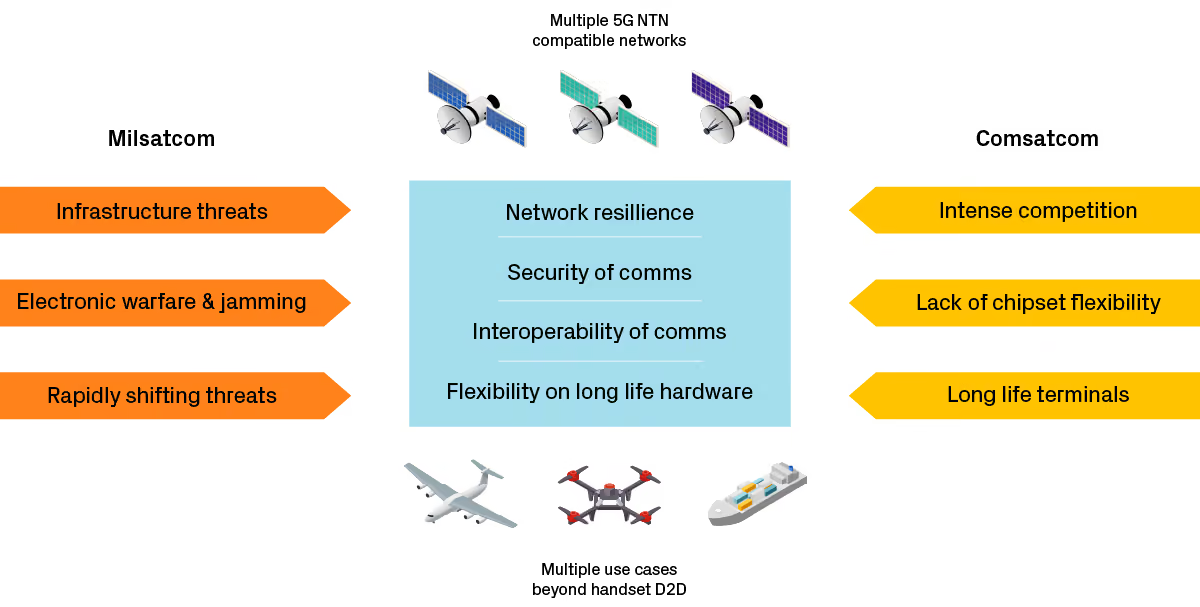
The result is a fundamental shift: satellite user terminals must evolve from single-network appliances into interoperable platforms capable of operating across a wider ecosystem of sovereign, allied and commercial satellite systems. In milsatcom, this shift is being driven by a combination of infrastructure threats, electronic warfare, shifting geopolitics and the need to operate across multiple military domains and allied networks (Figure 1).
Why interoperability matters
Interoperability matters most in defence and government contexts, where assured access, coalition interoperability and operational agility are critical. A terminal locked to one network can limit manoeuvre, increase logistical complexity and create operational risk. By contrast, a terminal able to transition between protected military capacity, allied networks and commercial services can give users more options when conditions change.
The same pressures are also growing in commercial and civil markets. Maritime, aeronautical, enterprise, public safety and disaster response users increasingly expect connectivity that adapts to the available network environment, rather than forcing operations to depend on a single service provider. In crisis scenarios, where terrestrial infrastructure may be damaged or unavailable, the ability to switch between satellite systems can become mission-critical.
The technical challenge behind flexible terminals
Interoperability has deep technical consequences. Future terminals must support multiple waveforms and protocol stacks (incl 5G NTN, DVB-S2X, and custom, including legacy waveforms), operate across different frequency bands, and integrate software-defined architectures that can evolve over time. They must also manage policy-driven network selection, security constraints and service continuity in environments where the “best” network may change by mission phase, geography, weather, congestion, regulation or threat level.
Some of the hardest challenges sit at the RF and antenna level. Software can be updated; physics cannot. A terminal expected to work across multiple satellite systems may need to support widely separated frequency bands, each with different propagation characteristics, antenna dimensions, RF front-end requirements and regulatory constraints. Lower-frequency bands can provide robust, high-availability links, but usually with lower data rates and larger antenna structures. Higher-frequency Ku and Ka-band services can deliver far greater throughput, but are more sensitive to rain fade, blockage, pointing accuracy and atmospheric effects.
Antenna design becomes particularly difficult because performance is shaped by hard physical constraints: aperture size, element spacing, beam steering range, gain, sidelobe behaviour, polarisation purity, thermal limits and power efficiency. A design optimised for one band, orbit or waveform will rarely be optimal for another. Electronically steered antennas can support rapid beam movement and non-GEO tracking, but introduce difficult trade-offs in scan loss, calibration, RF complexity and power consumption.
Multi-band operation adds further complications. Filters, amplifiers, low-noise receivers, frequency conversion chains and power amplifiers must operate efficiently without introducing unacceptable loss, distortion, noise or interference. Element spacing that works well at one frequency may create problems at another. Wide scan angles can reduce effective radiated power. Maintaining clean beams, low sidelobes and reliable link margins becomes even harder when the terminal must also remain compact, rugged and power-efficient.
This is why many future hybrid terminals are likely to adopt multi-aperture or layered RF architectures rather than relying on a single antenna to do everything. Separate apertures may be optimised for assured low-frequency access, protected services and high-throughput commercial capacity, while shared digital, control and baseband functions coordinate how the terminal selects and manages networks. The engineering challenge is to deliver this flexibility without creating a terminal that is too large, power-hungry, costly or complex to deploy.
Security, trust and operational assurance
As hybrid terminals drive the need for a larger and more complex software stack, the risk of a cyber-attack increases. Supporting multiple networks requires a more software defined terminal capable of implementing multiple waveforms and protocols, increasing the overall attack surface. A successful cyber-attack on a terminal could result in denial of service, compromise the integrity of the terminal or expose sensitive user data. Cybersecurity therefore becomes a critical design consideration if the added flexibility that a hybrid terminal provides is to strengthen, rather than weaken, its resilience.
Business Implications
For satellite operators, this shift is both a threat and an opportunity. Traditional terminal lock-in becomes harder to sustain as customers demand resilience across multiple networks. But operators that embrace interoperability can move up the value chain, offering differentiated services based on availability, performance, assurance, orchestration and integration rather than relying on closed terminal ecosystems. Hybrid service models, roaming agreements, multi-orbit packages and mission-specific service tiers all become more compelling when the terminal can support them.
For governments, the opportunity is equally significant. Interoperable terminals can reduce dependence on any single supplier, network or orbital architecture. They can support sovereign capability while still exploiting commercial innovation. They can improve coalition interoperability by making it easier for allied forces to share infrastructure and capacity. They can also extend the useful life of existing programmes by enabling gradual transition from legacy systems to newer standards-based and software-defined architectures, rather than forcing wholesale replacement.
More broadly, this transition could help the wider satellite sector compete in a market increasingly shaped by highly integrated mega-constellation providers. Open standards, configurable terminal platforms and multi-network service models offer a route for operators, governments, manufacturers and perhaps even new categories of value chain players to create resilient alternatives by enabling diverse networks to work together as a trusted whole.
How TTP can help
TTP brings together deep capability in satellite communications, RF engineering, antenna systems, digital signal processing, embedded software, SDR waveform development, modem and PHY/MAC implementation, industrial design and production-ready hardware. Its experience spans commercial and government programmes, with work across L-band, S-band, C-band and higher-frequency systems extending into Ka-band and V/Q-band. That breadth matters because hybrid terminals require close integration between RF, antenna, modem, software, mechanical, thermal, assurance and manufacturing considerations..
TTP is well placed to support organisations at every stage of this transition: from early architecture definition and technical feasibility studies through to waveform development, RF and antenna design, embedded implementation, prototyping, industrialisation and production support. Its ability to combine standards-based approaches with bespoke communications solutions is particularly valuable where customers need interoperability, resilience, sovereign control or mission-specific performance beyond what off-the-shelf systems can provide.
As hybrid satellite terminals become more complex, the greatest value lies in making the whole system work: RF, antenna, waveform, modem, software, security, packaging and production.. TTP’s cross-disciplinary engineering model is designed for exactly this kind of challenge.
The future effectiveness of satellite communications will depend less on any single constellation, operator or frequency band, and more on the ability to integrate multiple networks into a coherent, trusted whole at the terminal level.
To explore the technologies, architectures and market forces shaping the future of hybrid satellite user terminals, or to discuss how TTP can support your satellite communications programme, contact our team.