
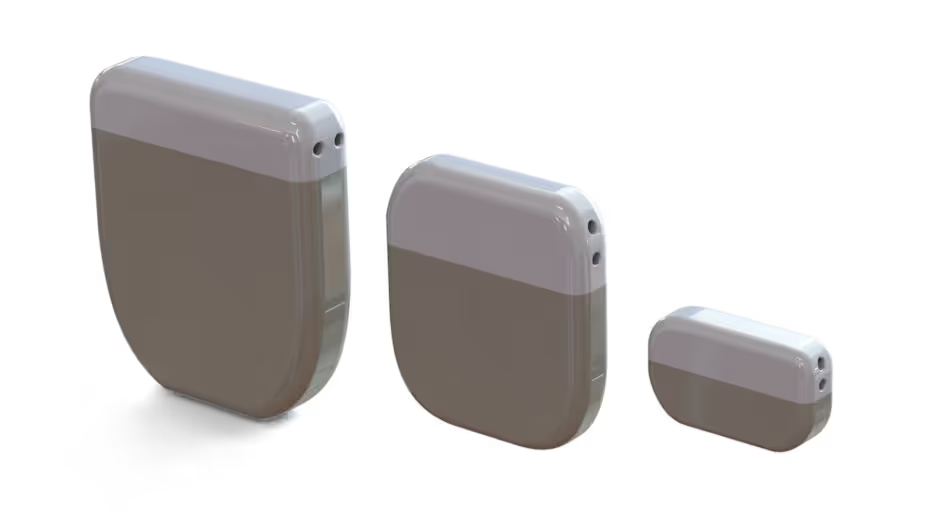
Picture an integrated neurostimulator that weighs a mere 3 grams in a 2.5 cm (1 inch)-long cuff unit, small enough to be implanted next to the vagus nerve on the left side of the neck. This FDA-approved system, which SetPoint Medical started rolling out in the United States in 2025, treats rheumatoid arthritis by stimulating the vagus nerve for only one minute a day. Its small form factor can help reduce the burden of implantation, while the integrated design eliminates the need for separate lead wires.
To understand how this kind of miniaturization is possible, it helps to look under the hood of a neurostimulator to study how its components influence the overall design.
Therapy considerations drive power architecture
At the heart of the neurostimulation system is the implantable pulse generator (IPG),which generates the electrical current needed for stimulation. Leads relay that current to the target site, while electrodes interface with the nerve and deliver the stimulation.
In turn the IPG itself contains a battery and a power module, and a microprocessor that coordinates various functions such as regulation of the pulsing parameters, activation and deactivation etc.
Set Point’s vagus nerve stimulation approach does not require a lot of energy: Current amplitude, which is the strength of the pulse, is up to 2.5 mA (it’s often less) and the pulse width, which is a measure of how long the pulse lasts, is 250 µs.
As a result, the system does not need to store a lot of charge on the IPG itself. It can make do with a small rechargeable battery that needs a recharge session of just 10 minutes per week. This, in turn, helps enable the battery, the rest of the IPG circuitry, and the stim electrodes to be integrated into one small monolithic leadless architecture that can be placed directly on the vagus nerve.
One of the design takeaways from the Set Point system is that the makeup of a neurostimulator system, including the IPG, depends on the stimulation parameters needed to carry out the medical treatment. Form needs to follow function rather than the other way around.
The ease with which the patient population can adopt the system also matters —recharging for ten minutes a week is not as big a burden as having to do so every hour. Permutations and combinations of these considerations can lead to very different form factors.
Balancing power, size and patient needs
Device size is an important consideration in IPG design, and the battery is often one of the primary targets for attention because it can be among the bulkiest components. But miniaturization is only one part of the equation: engineer salso need to balance size against the energy demands of the therapy and the needs of the patient. (The driving electronics for the IPG will also need to be miniaturized but that’s a separate discussion).
Figuring out the kind of battery the IPG will need, in turn depends on how power-hungry the prescribed stimulation is. If the stimulation is of higher amplitude and pulse width, it will exert greater energy demands on the battery and drain it faster. (On-device processing and passive consumption of power by control electronics also add to the energy drain and need to factor into the power architecture).
Closed-loop stimulation adds another dimension to this equation. By sensing the response to therapy and adjusting stimulation accordingly, a closed-loop system can deliver only the level of stimulation needed, potentially reducing unnecessary energy use and extending battery life. However, the sensing and processing required to close the loop also consume power, so these demands need to be considered as part of the overall energy budget.
Understanding the energy budget of the IPG and the medical function it serves helps engineers determine where the unit will derive its energy from: on-board batteries or from external power without need for batteries.
The onboard battery in turn can either be a primary non-rechargeable battery or are chargeable one. (More on these shortly). Battery choices will dictate more than just the extent of miniaturization and final form factor. They might also affect the potential need for antennas, electrode design, and charging and telemetry hardware among other components.
Human usability and adoption by patient populations are key too. Engineers have to balance the quest for miniaturization against energy demands and patients’ needs. It’s a challenging problem but not impossible to solve.
And the consequences extend beyond the engineering: power architecture can also shape the surgical approach, patient follow-up, reimbursement assumptions and, ultimately, the commercial model for the device.
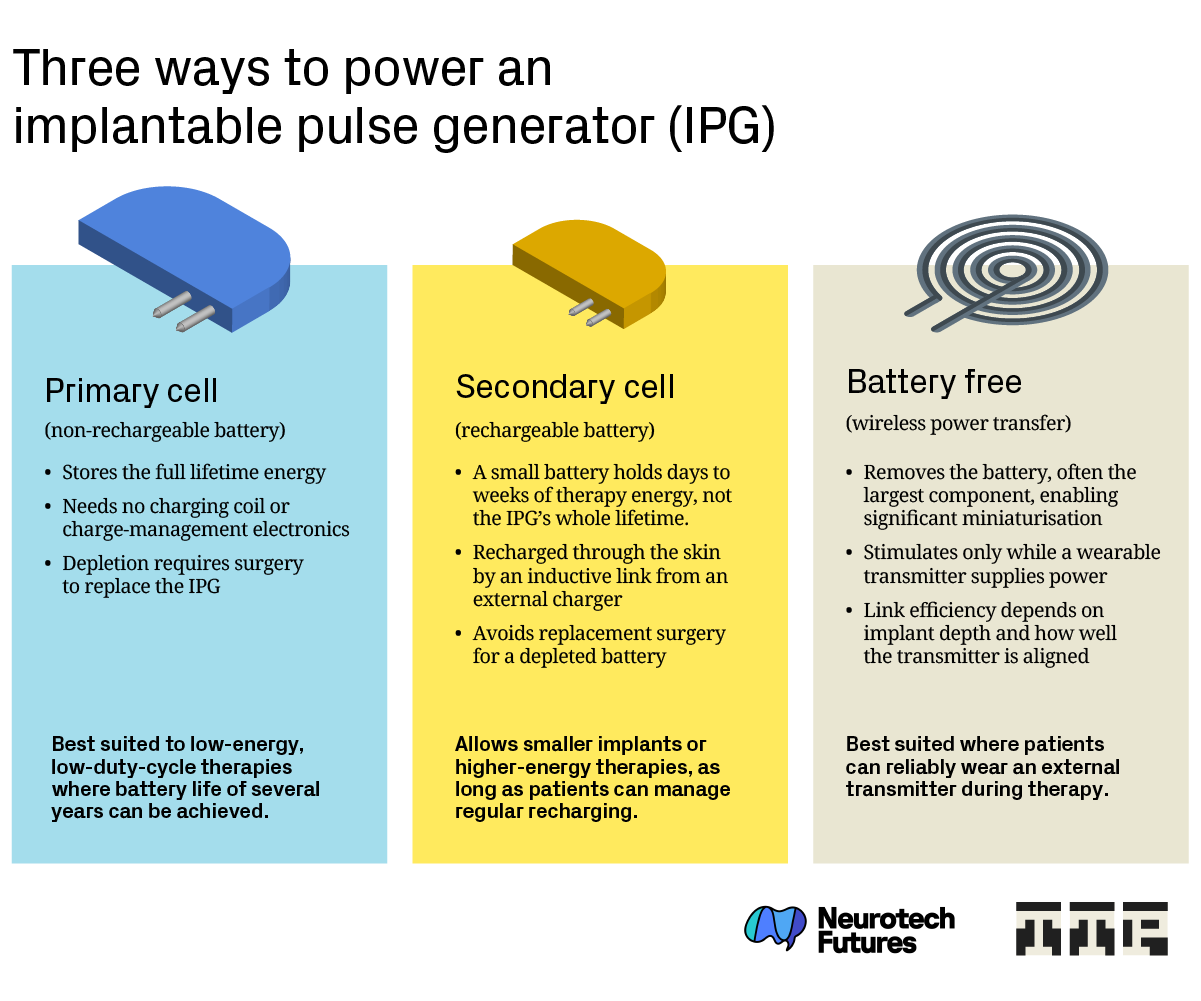
Let’s look at the advantages and disadvantages of the three approaches to powering IPGs, and the different trade-offs they introduce for device size, therapy delivery and patient use.
Primary-cell IPGs
Much like you might power a flashlight with disposable batteries, when the IPG runs on primary cells, it draws all the energy it needs from batteries on the device. Once these are drained, they cannot be recharged, which means patients must undergo a surgical procedure to replace the IPG. The trade-off is that patients don’t need to recharge the devices as part of their home care routines and might appreciate the fix-it-and-forget-it approach.
Exactly how long these batteries might last – and therefore how long a patient might go without needing a replacement procedure - depends on the function of the IPG. Because stimulation parameters such as amplitude, pulse width/shape, and frequency, a low-duty cycle therapy might chug along a long time on the same battery, compared with a more energy-soaking stimulation protocol that is operated almost continuously.
Design engineers have to consider if the luxury of not having to recharge the batteries is worth potentially frequent unit replacements. Such a decision will depend on multiple factors, including patient age and dexterity — batteries might outlive geriatric patients — and the forecasted number of implants needed.
Rechargeable IPGs
As the name implies, the IPG powered byrechargeable batteries does not need to carry all its energy requirements onboard. Instead, an inductive link between an external coil and one in theimplant transfers energy to the on-board battery.
The advantage is that patients don’t need surgery every time the battery runs out of charge. On the other hand, patients do have to bear the burden of recharging the units. That chore can be fussy at times, requiring precise alignment of the two coils, which might frustrate patients with low dexterity.
Rechargeable IPGs can offer advantages where device size is important, because they can afford to carry less charge. But that smaller form factor comes with the need for regular recharging and the additional components needed to enable it.
As the Set Point example illustrates, rechargeable IPGs can be particularly attractive where stimulation demands are relatively modest and regular recharging is manageable for patients. The considerations do not end with the technical architecture: bringing a novel approach like this to market also means establishing a reimbursement pathway that differ from more established neurostimulation approaches.
To further aid miniaturization, engineers might consider packaging the rest of the IPG electronics, such as the stimulation drivers and sensing interfaces, into an even more compact application-specific integrated circuit (ASIC).
Battery-free IPGs
In a battery-free IPG, the unit receives power wirelessly from an external source. contains the circuitry needed to receive external energy and generate the stimulation but does not have a battery.
The neurostimulation system from Nalu Medical, for example, houses a miniature battery-free IPG that generates electric stimulation pulses but receives power wirelessly from a therapy disc that’s worn externally.
While the size of the IPG can decrease significantly when the power component is moved to an external source, the trade-offs change rather than disappear. There are challenges associated with ensuring that the device can be powered through an external transmitter or wearable. The wireless link must be robust and work reliably through tissue, even if the external transmitter or wearable is not positioned perfectly.
Neurostimulation systems in this category are beginning to attract wider commercial interest, as companies explore how externally powered architectures could enable different device form factors and treatment approaches. Neuspera’s externally powered system to treat overactive bladder, for example, replaces the battery with a surgically inserted wireless receiver, while still working within an established reimbursement pathway.
Power architectureshapes commercial strategy
As the examples above illustrate, power architecture has consequences beyond the implant itself. It can influence the surgical procedure, follow-up burden, replacement or recharging model, reimbursement assumptions and the evidence a company may need to support adoption.
In the US, for example, reimbursement for surgically implanting IPG (which houses the battery unit) can be approximately four to six times higher than for the electrode leads themselves - around$20,000 -$35,000 compared with $5,000–$6,000. These economics can influence decisions around investment, regulatory strategy and market access, illustrating why changes to the power architecture can have implications well beyond the engineering.
These considerations become even more important as neurostimulation systems evolve. Increasing channel counts, multiple electrode arrays, closed-loop capabilities and on-device data processing are changing the energy demands of neurostimulation systems, making the choice of power architecture harder to separate from the wider development and go-to-market strategy.
An effective workflow for the powerarchitecture decision
Despite the temptation to prioritize miniaturization, the IPG power architecture still needs to be therapy-centric. The therapy will guide the stimulation wave form and the duty cycle, which in turn will dictate the energy needed for stimulation.
The key is to make these decisions early. The therapy defines the stimulation requirements; those requirements shape the energy budget; and that energy budget influences everything from battery choice and electronics to implant size, charging, patient use, and ultimately, commercial strategy. Getting the architecture right early can avoid costly redesign later.
How TTP can help
Whether you’re developing an emerging neurotechnology or advancing an established neuromodulation platform, you need to make technical and commercial decisions that will shape the product from proof of concept through to manufacturing scale-up.
TTP brings together expertise in neuroscience, electronics, RF, embedded systems, modelling and human factors to help you connect therapy requirements with decisions around power, implant design, connectivity and usability. This systems-level approach helps you balance device performance and patient experience with the practical demands of developing a commercially viable product.