
Modelling MRI RF heating in implantable leads
How transfer-function modelling can accelerate MRI safety assessment for active implantable medical devices
Full-body MRI compatibility is rapidly becoming a baseline expectation for active implantable medical devices. Clinicians want broader imaging access, regulators expect clear evidence of safety, and active implant (AIMD) manufacturers face increasing pressure to extend MRI access across their portfolios.
For devices with long conductive leads, assessing RF-induced heating can involve extensive prototype-and-test cycles.
TTP’s Neurotechnology team has developed a faster modelling approach based on ISO 10974 transfer-function methods, enabling RF-induced heating to be evaluated earlier and reducing reliance on repeated physical prototyping.


The MRI compatibility challenge: rising expectations, complex constraints
Most implant recipients will require at least one MRI scan during the lifetime of their device. As a result, AIMD manufacturers are seeking to expand the conditions under which patients can safely undergo MRI, with full-body MRI access increasingly expected.
Achieving MRI labelling requires addressing multiple hazards: magnetic forces, artefacts, and electronic integrity.
For systems with long leads, RF-induced heating is often the critical bottleneck to achieving broader MRI access.

A faster route: ISO-aligned modelling to reduce prototyping burden
ISO 10974 provides a widely accepted Tier 3 pathway for evaluating RF-induced heating using transfer-function methods. These assessments have traditionally relied heavily on physical prototyping and phantom testing.
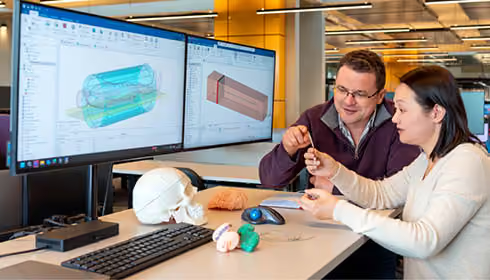
Using an efficient computational modelling approach, we can support the assessment of RF heating with far less experimental overhead, resulting in faster design cycles, more informed decisions, and targeted validation.
TTP’s Neurotechnology team has developed an efficient computational modelling approach that enables assessment of RF heating with far less experimental overhead, supporting faster design cycles, more informed decisions, and targeted validation.
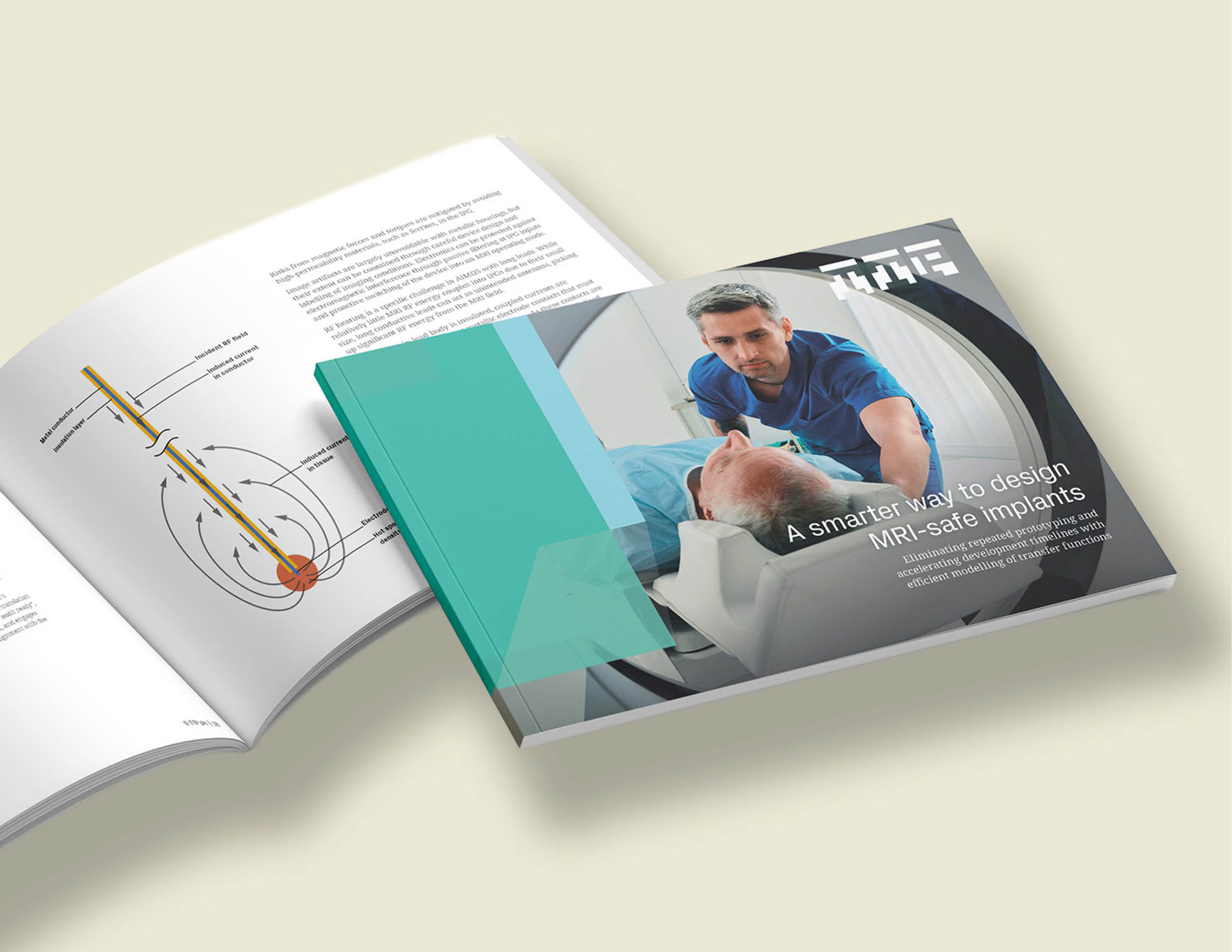
Explore the full methodology
See how transfer functions can be modelled in minutes per case, enabling earlier design exploration and reducing reliance on repeated physical testing.
Download the technical paper to explore the ISO 10974 Tier 3 methodology, including the FEM-based modelling workflow, benchmarking and practical implications for MRI-compatible implant development.
The paper explains the MRI safety challenges facing AIMD developers, how ISO 10974 transfer-function methods evaluate RF-induced heating, how modelling can reduce the experimental burden of testing and how to integrate MRI compatibility earlier in the development process.


Meet us at

Our areas of focus:
Medical Devices & Drug Delivery
Our approach and capabilities
We deliver across the entire life of a project, from opportunity discovery to production engineering. Discover how our interdisciplinary teams of experts collaborate to tackle the toughest product development challenges.

Our campus and facilities
Our award-winning campus has been designed with a clear vision. To create space which can suport our people and our clients as we develop and deliver the very best technology solution.

Software capability at TTP
Engaged in all stages of software and product development, our software capability at TTP covers the full spectrum—from in-depth analysis and system architecture to prototype design, implementation, and test development.

Manufacturing capability at TTP
Working seamlessly with our development teams, we take clients' products through prototype builds, clinical trials, pilot manufacture and more. Using TTP Manufacturing reduces uncertainty, risk and time to market for our clients.

Meet some of the team

Qing Liu

Simon Calcutt

Chris Dawson
Talk to us about your next project
We help clients with all stages of their most complex and challenging technology and product development projects.
If you're considering the next steps along your innovation journey, why not get in touch?