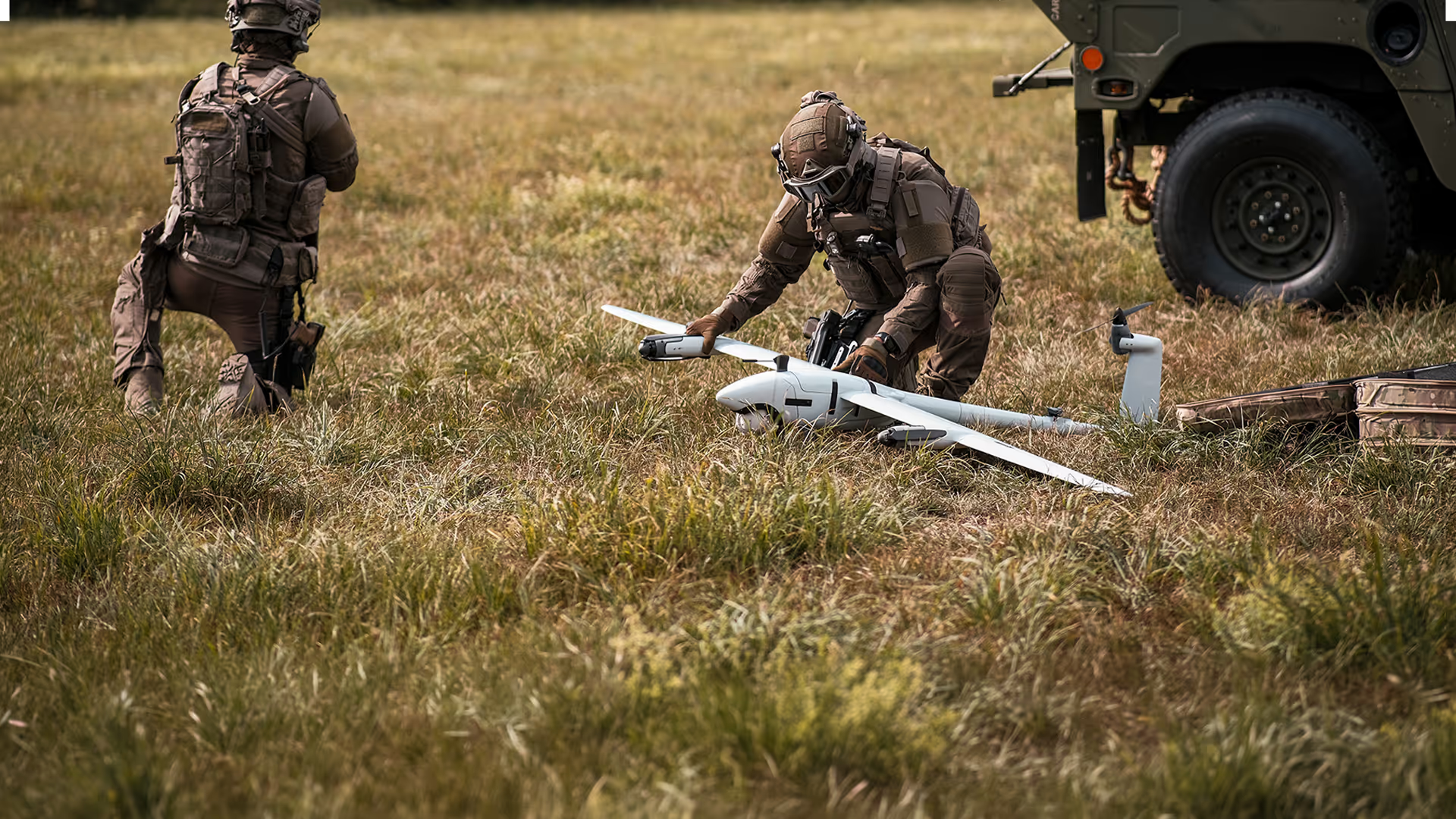
Communications are the backbone of multi-domain operations. Soldiers and commanders always want an up-to-date picture of the world around them. They want to integrate data from drones, missiles, and manned platforms and be able to send back taskings. They could be operating in a contested EM environment, beyond visual line of sight, and with the need to avoid detection and interception. As more new and exciting technology is rapidly deployed onto the battlefield, you need to establish and integrate communications with the users on the ground so they can make the best use of the new capabilities and effects. When the platform is specialist and optimised to do its main job, there is no one-size-fits-all approach and off-the-shelf radio hardware isn't going to give you what you need.
At TTP, we specialise in synthesising the best of the off-the-shelf solutions with the adaptations and customisation needed to make a communications system that is the right SWaP-C and performance for the job that needs to be done. In this article we will discuss three different hypothetical platforms and the trade-offs that should be made to get communications through to them. In each case, best is the enemy of good enough and the hard part is determining what is good enough.
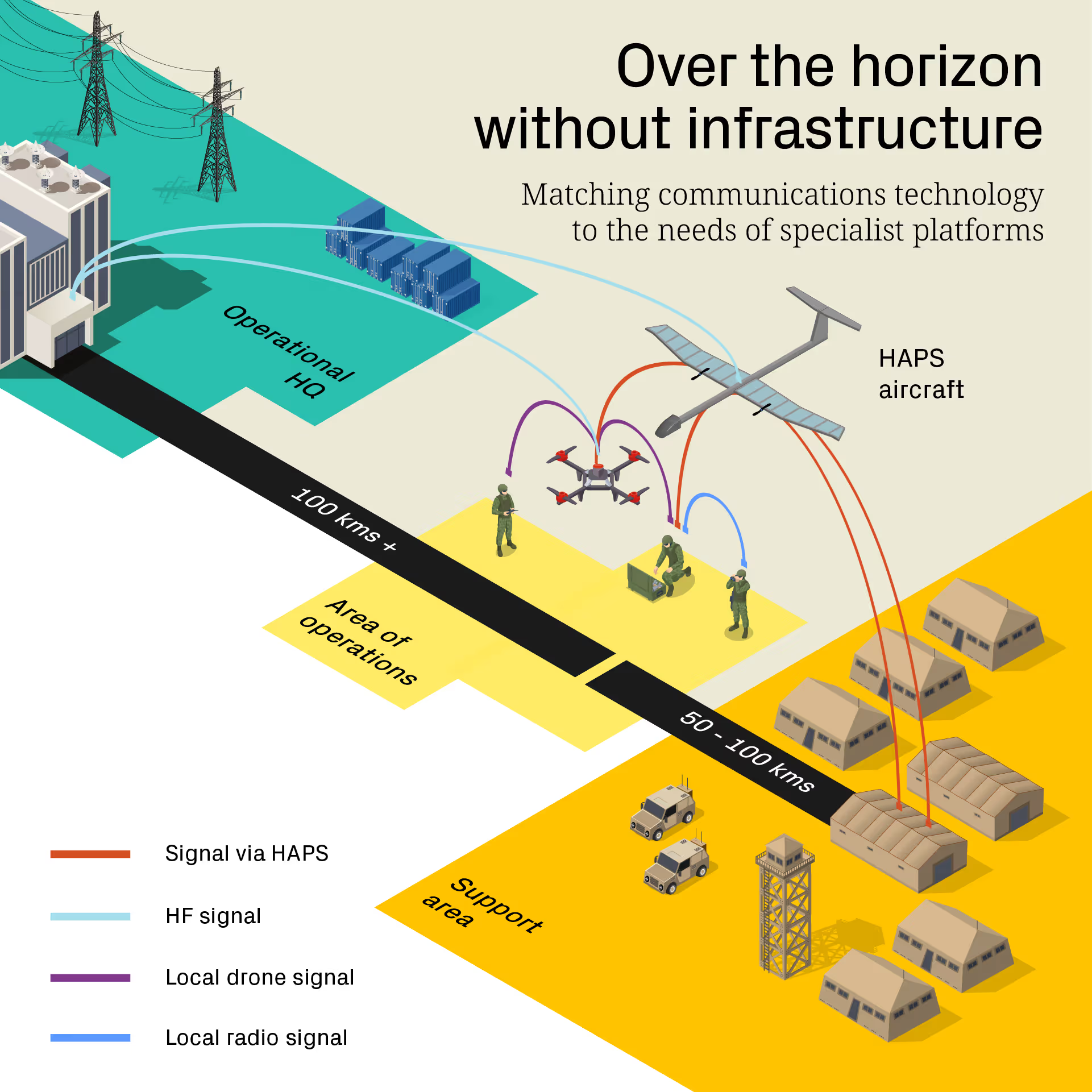
Over the horizon without infrastructure
When you need to send signals 100s of km without relying on infrastructure like repeaters or satellites, it's time to look to the technology principles of the mid-20th century. Satellites have been this century's communications panacea, but satellites look increasingly vulnerable to attack and interception.
HF communications (which are, due to a counterintuitive legacy definition of frequency bands and despite standing for High Frequency, the lowest frequency band used for communications at 3-30 MHz) provide long propagation distances and low path losses, but the low frequency means large antennas are needed for efficiency. And the losses might generally be low but they depend on the weather in the ionosphere and the time of day. They are a lot more exotic than the line-of-sight links discussed in the other sections of this article.
Another "old-fashioned" infrastructure-less communication system is Troposcatter. This uses higher frequencies and can reach even longer distances but needs very high transmitter powers to do so as the scattering process is so inefficient, it is impractical for most mobile platforms.
With modern electronics and SDR techniques, it is possible to make an HF link that works well enough for low-rate data. Here, 'low' means 100s of bits per second, but that's enough to send course corrections from the operational HQ to an autonomous ISTAR drone recording images deep behind enemy lines, or to determine if the drone is still flying or has been shot down. It is also plenty of bandwidth to control a HAPS aircraft, like the one described later in this article.
A group 2 or 3 UAV can trail an HF antenna wire as it flies or mount an inverted "V" wire antenna. With frequency selection based on the time of day for best propagation, and a decently sized antenna on the ground side, the transmit power from the UAV can be modest.
Example 1: Low-rate HF links for infrastructure-free BLOS Control
A UAV with an electrically short, ten metre long, trailing wire antenna, operating at 4 MHz with a 10 W transmitter, could reliably achieve 300 bit/s over 200-500 km in almost all propagation conditions and times of day by using a modern OFDM physical layer in 500 Hz bandwidth
Direct to soldier UAV telemetry
The HF link has amazing range but very low bandwidth. It works for a UAV that is recording ISTAR data or is an effect in its own right, but not for a live view of the battlefield. Its operator is behind the lines, rather than at the sharp end. Flip that around, and ask for high bandwidth to send Mbps of telemetry back from a UAV to soldiers in the area of operations. This a domain where off-the-shelf radios are a strong candidate (and there is lots of dual use technology based on 2.4 GHz ISM bands), but there are cases when platform CONOPs can make a custom solution more appealing, for example, when pushing out from 1 to 10 km.
It's not always straightforward to mount a high gain antenna on the platform, and even then it's challenging to keep it pointed in the right direction. Mechanically steered antennas are hard to make reliable, and electronic steering adds expense. Some interceptors only need to send their telemetry behind them, but ISR drones could be orbiting a target with the receiver in any direction.
The power budget of some platforms is quite high (interceptors do not have to stay airborne for long and can use thermal batteries) but for others (ISR drones) every watt saved means more endurance. To close the link you might need to be cleverer than just throwing power at it. You might end up with an asymmetric link, where it's easier for the UAV to hear the ground than for the ground to hear the UAV. This is great for command and control but not so good for telemetry.
Example 2: S band UAV telemetry for tactical line-of-sight links
A 1 MHz channel at S band, a 100 mW transmitter, and low-gain near-omnidirectional antennas could allow 3 Mbit/s of data transmission over 10 km. Reduce the transmitter power to 10 mW, for example if the drone is SWaP-constrained, and only 800 kbit/s is getting through on the downlink. If the range expands to 100 km, downlink throughput falls to 10 kbit/s.
Another potential complication is the number of platforms in the air. As UAVs get cheaper and CONOPs more innovative, swarming is becoming more common. Does this mean you can run a mesh network, piggybacking off other platforms to increase range, or does it mean your drones all interfere with each other fighting over the same bandwidth? Saturation attacks are the new normal, so the comms system needs to be able to scale up to match this.
By combining a custom antenna with gain in the right directions, a waveform and physical layer based on established technology but tuned to the right operating bandwidth, and a custom MAC and protocol optimised for the use case, the SWaP-C of the mobile terminal can be substantially reduced from the cost of COTS options. There will be a development cost, but this will easily pay for itself as volumes scale up. You also get the benefit of ownership, control, and if needed, sovereignty.
High altitude pseudo-satellites (HAPS)
HAPS (lighter or heavier than air) offer a tantalising prospect for communications relays from the area of operations to the support area. Operating much closer to the surface than even LEO satellites, link budgets get easier and latencies get shorter. They can loiter over a single spot, and be much cheaper than satellites, especially when you factor in the cost of the constellation required to get short revisit times (or constant coverage, as Starlink has achieved).
However, when you put a solar powered glider into the stratosphere, the SWaP constraints are punishing. The extra kg of payload or 10 W of load that takes 100 m off the range of a UAV interceptor might mean the HAPS batteries no longer last long enough to get through the night. Link budgets are easier than LEO but not a walk in the park, especially if using higher frequencies for backhaul to the ground where high performance equipment is expensive and the weather makes a real difference to losses.
When every Watt and gram counts, you have to engineer a custom solution that is exactly the right size for the use case. Efficient amplifiers and beamforming antennas convert precious battery power into radio energy exactly where you want it. Minimising data transfer with low overhead protocols and pre-compression helps squeeze out the last bit of performance. Industry provides the building blocks for the radio: LNAs, HPAs, frequency converters, beamforming ICs. The art is in creating a system design that combines the right selection of these building blocks into a solution that can be launched into the air as quickly as the HAPS platform it is designed for.
Example 3: Q band backhaul for SWaP-constrained HAPS relays
A 100 MHz channel at Q band needs a 36 dBi antenna on the ground (say a 24-inch Cassegrain dish) and 1 W transmitter to achieve 100 Mbit/s throughput. HAPS can't afford the SWaP budget for a steerable Q band antenna, so the ground antenna's 1°-wide beam needs to be pointed carefully at the HAPS at all times to keep the link alive.
Making the right comms choices for your defence platform
COTS solutions are designed for broad applicability (or at least the cost-effective ones are): just look at the price/performance of the 5G radio in a smartphone. But when the platform is niche, you have to make compromises to make a COTS radio work. If you don't like those compromises, then TTP is here to help design the custom solution you really want, picking exactly the right point on the price/performance curve that is just good enough to get the job done.
Unsure where the trade-offs sit for your platform? Explore a communications architecture that fits the mission. Talk to our team.