Planning for MedTech success: turning regulatory complexity into clarity
The most common pitfall in medical device development is not technology – it’s surprise.
Late-stage discoveries of overlooked standards and unexpected requirements can push projects over time and budget. The solution is to seek expert guidance early and clearly define your regulatory goals from day one. This requires addressing the following strategic, engineering-focused questions early in development.
Insights
Planning for MedTech success: turning regulatory complexity into clarity
The most common pitfall in medical device development is not technology – it’s surprise.
Late-stage discoveries of overlooked standards and unexpected requirements can push projects over time and budget. The solution is to seek expert guidance early and clearly define your regulatory goals from day one. This requires addressing the following strategic, engineering-focused questions early in development.
What is clinical risk and device classification?
The level of clinical risk and device classification defines the depth of design controls, verification workload, and documentation required. Recognising these implications early enables teams to communicate credible development plans to stakeholders and investors, and allocate funding and resources realistically.
For example, a team developing a wearable biosensor may initially plan for a Class II classification and structure their development activities around that assumption. However, if the device also provides diagnostic or decision-support functions, it could be reclassified as a higher-risk device, triggering the need for more stringent software lifecycle controls, additional failure-mode redundancies, and significantly expanded verification activities.
Similarly, a company developing a biosensor may decide to expand the device’s functionality or broaden its intended user population; for example, from Type 1 to both Type 1 and Type 2 diabetic patients for a continuous glucose monitoring (CGM) system. While these enhancements may seem incremental, they can introduce new clinical hazards and lead to a higher regulatory classification. Such scope changes may result in a large shift incompliance requirements, which can easily overburden a development if not considered strategically. Understanding the consequences of these decisions can allow developers to focus on what matters most and keep the compliance effort lean.
Identifying these regulatory implications early allows teams to plan accordingly, build realistic timelines, and maintain development momentum. With clear compliance objectives established from the start, programmes stay focused on measurable outcomes and progress with confidence.
What is the regulatory pathway for similar devices?
The FDA Devices and De Novo databases are publicly available resources that offer invaluable insight into comparable regulatory strategies and verification approaches for similar medical devices. Together, these databases contain all 510(k) and PMA submissions since 1976, and all De Novo classifications since 2012.
These databases provide real-world examples for the devices and associated test data that has been previously accepted by the regulator, to help inform a robust regulatory and testing strategy.
FDA submissions typically include the device description, the device classification (Class I, II or III) and the standards applied by the manufacturer. These details can help identify which regulations and classifications are likely to apply to a new device. Submissions also frequently outline additional verification tests beyond the core standards, that have been deemed necessary to verify a design requirement or to mitigate a safety risk, as well as indications and contraindications for use, and potential hazards that may arise from using the device. This information provides practical insights into the safety risks identified by seasoned manufacturers of similar devices and can highlight design controls that may need to be planned for and implemented.
TTP has developed an implantable pulse generator.
FDA submissions also describe the clinical studies conducted for design validation, including the number of patients enrolled and devices tested. These data points provide evidence of the scale and scope of manufacturing activities needed to support future clinical studies. When accounting for all devices required for both design verification and clinical validation, the total quantity can easily reach the thousands. Any robust product development plan should include a clear strategy for manufacturing at the necessary scale to enable those studies.
For developers, leveraging FDA submission data early allow steams to refine their regulatory strategy, anticipate testing requirements, and plan for future manufacturing capacity with confidence. By learning from the pathways of comparable devices, it becomes possible to avoid unexpected testing demands, minimise costly rework, and to be more confident in the success of a chosen regulatory approach.
What are the applicable standards?
In addition to the FDA databases, engaging regulatory advisors and technology experts with market-focused experience can help developers identify the key standards relevant to their device. Understanding these early can reduce the overall development effort and increase the likelihood of success when ultimately submitting design evidence to a regulatory body.
For example, an electronic engineer familiar with ISO 14708will recognise the requirement to manage heat generated by power dissipation in implantable medical devices to prevent tissue damage. Identifying this requirement early on allows teams to plan for and evaluate the thermal performance of the first prototypes in a considered way and avoids a costly redesign later when verification testing exposes a gap.
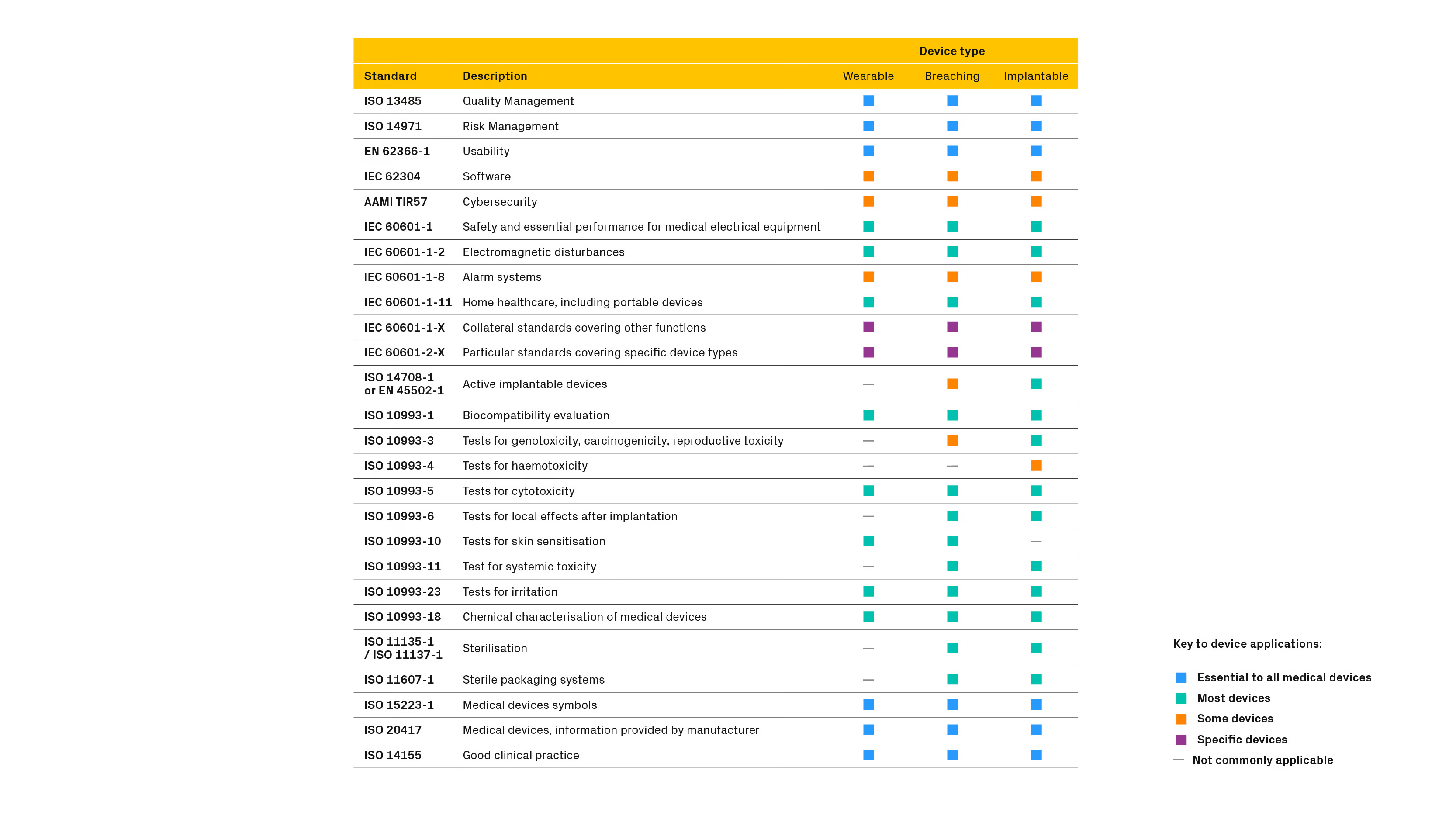
Based on 15+ years of experience at TTP in implantable devices, the core standards to consider for a development are shown below.
To see the full table more clearly, please click through to the full whitepaper.
Compliance patterns in predicate devices
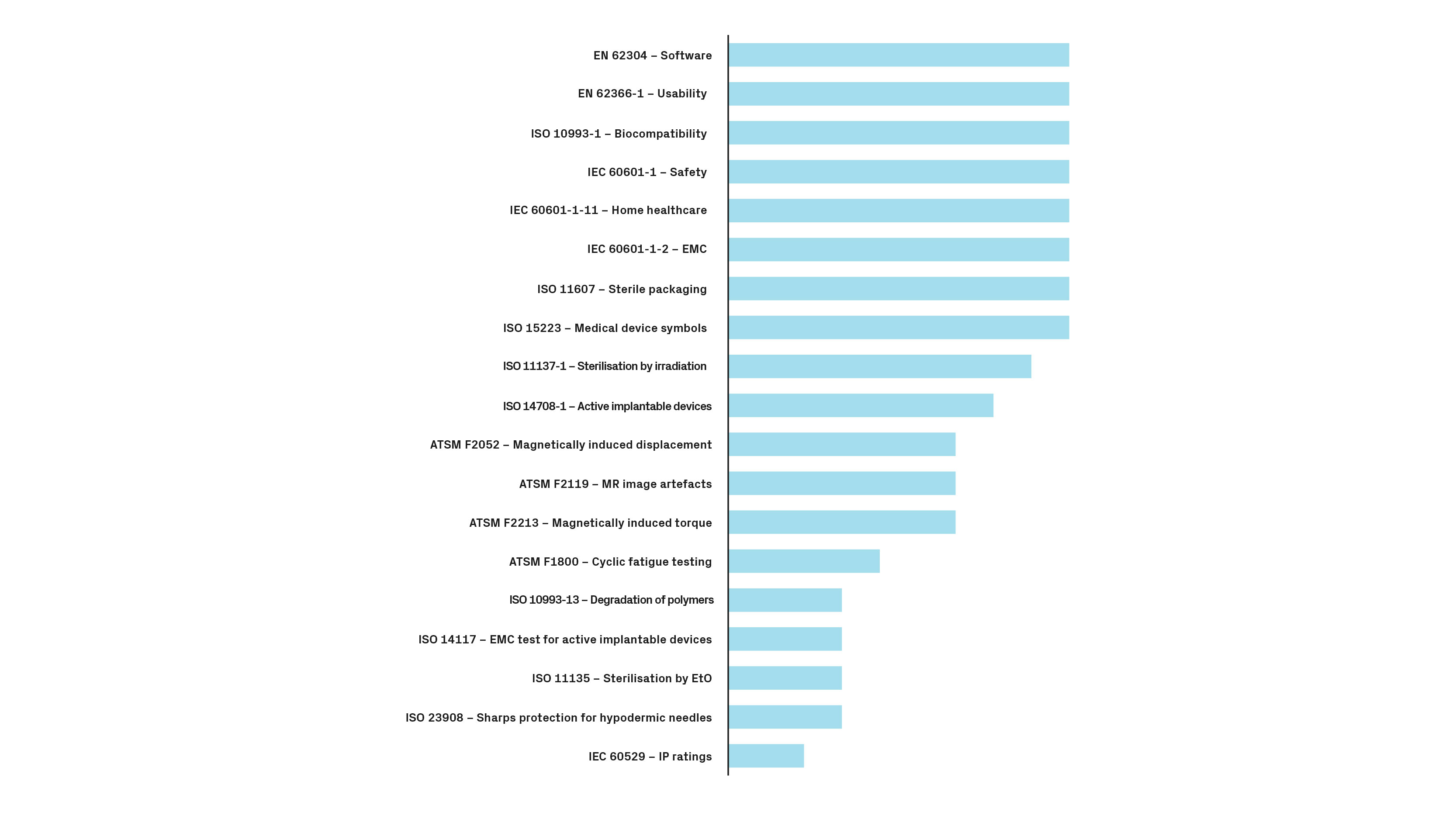
TTP conducted an analysis of FDA submissions from multiple implantable medical devices, spanning neurostimulators, CGMs, Pacemakers and Smart Orthopaedics, to identify the standards that are referenced with the highest frequency.
To see the full diagram more clearly, please click through to the full whitepaper.
Addressing regulatory considerations early can help turn complexity into a clearer, more manageable development path. By understanding clinical risk and device classification, learning from the regulatory pathways of comparable devices, and identifying applicable standards from the outset, teams can anticipate requirements, focus development effort where it matters most and reduce the risk of costly surprises later.
For further insight into how regulatory demands can be considered strategically throughout medical device development, read and download our free whitepaper:
We help clients with all stages of their most complex and challenging technology and product development projects.
If you're considering the next steps along your innovation journey, why not get in touch?
Thank you! Your submission has been received!
Oops! Something went wrong while submitting the form.
Form unavailable due to browser restrictions.
Your current browser or privacy settings may prevent this form from appearing. Please enable third-party scripts or submit your details through [email protected]
Get the latest from TTP
Join our community to get the latest news and updates on our work at TTP.
You will occasionally receive expert insights from across our areas of focus and hear directly from our engineers and scientists on the newest developments in the field.
Join our community to get the latest news and updates on our work at TTP.
Form unavailable due to browser restrictions.
Your current browser or privacy settings may prevent this form from appearing. Please enable third-party scripts or submit your details through [email protected]
Lorem ipsum dolor sit amet, consectetur adipiscing elit. Suspendisse varius enim in eros elementum tristique.
Talk to us about your next project
Whether you would like to discuss a project or would like to learn more about our work, get in touch through the form below.
Form unavailable due to browser restrictions.
Your current browser or privacy settings may prevent this form from appearing. Please enable third-party scripts or submit your details through [email protected]



.avif)