

TTP helped a major pharma company identify and resolve production risks across four injection devices in advanced development. By combining structured risk management, first-principles analysis and targeted testing, TTP enabled all four devices to progress confidently into manufacture.
Context:
TTP partnered with a major pharmaceutical company to investigate risks and known problems across four different injection devices which were in advanced stages of development. The client wanted to understand and resolve the issues that could affect reliable production, so the devices could progress confidently into manufacture.
Solution:
We combined formal risk management techniques such as FMEAs with a deep understanding of the mechanisms. Across the four devices, this included first-principles mechanism modelling, targeted experiments, and multi-physics tolerance analysis. This enabled the team to identify the root causes of known issues, assess wider risks, and recommend practical solutions in all cases.
Result:
TTP’s work helped the client take all four of the devices into production, where they continue to enable successful products.
Find options and fix fast
One of the devices TTP analysed was a variant on an existing, very successful design. However, changes to the design had led to the mechanical components of the system interacting differently, creating a risk of inaccurate dosing, as well as a reduction in user-perceived quality. TTP's client had a proposed solution approach; the project task was to analyse that approach, and to identify alternatives which had fewer manufacturing challenges.
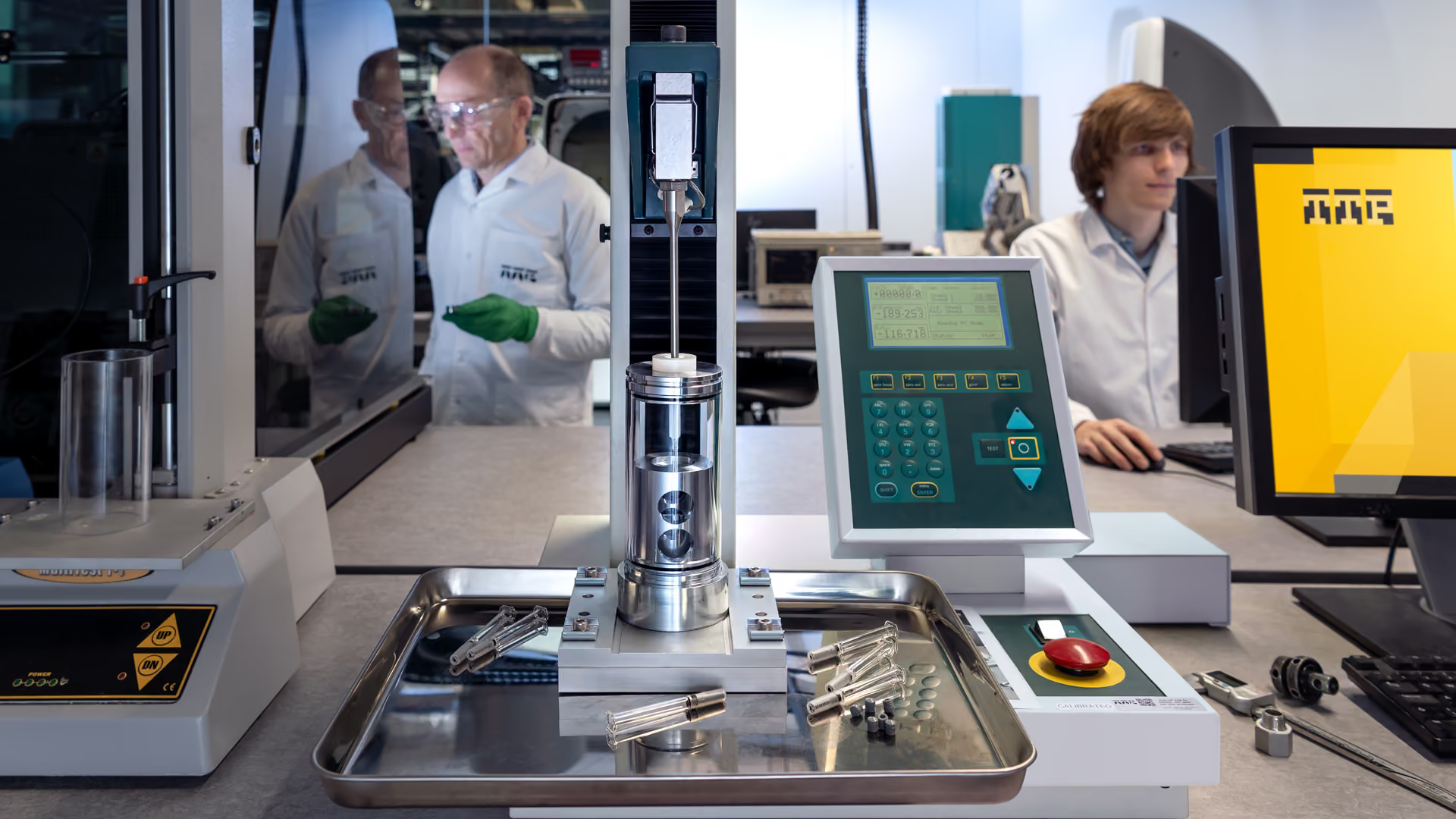
After rapidly building an understanding of how the device worked, TTP’s mechanical engineers produced an efficient model of how the parts of the system interacted. This not only indicated where the issue in the device variant truly lay, but also allowed evidence from a few relatively simple experiments on prototypes to be translated directly into outcome predictions.
With the root cause confirmed, the mechanical requirements for the client’s proposed solution to work became clear. TTP also devised an alternative approach. Contributions from manufacturing experts enabled the team to provide the client with two ways forward: a detailed description of how to make their own solution work in practice, and a backup approach in case it was needed.
Low variability by design
In another case within the same device portfolio, the client had created a reusable injector design which developed an issue through its planned lifetime, as the features which it relied upon suffered from mechanical wear. TTP was tasked with finding easily implemented solutions. Minor variations were naturally preferred, but alternative approaches were also within scope.
The team quickly determined that several independent mechanisms made similar nominal contributions to the function, but had quite different amounts of variation. This suggested two possible approaches: either improve the variability of the less-controlled mechanisms, or remove them entirely in favour of an enhancing the more consistent ones.
Through a combination of experiment, finite-element analysis, and analytical modelling, the team found ways to reduce stresses compared to yield with minor design changes, significantly reducing the variability of the device function over its planned lifetime. The team also identified another approach which involved minor changes to a few additional parts and replacing a bought-in component with a similar model, offering a complete solution to the issue. Between these options, the client was able to proceed with confidence.
Systematic, evidenced, and efficient risk analysis
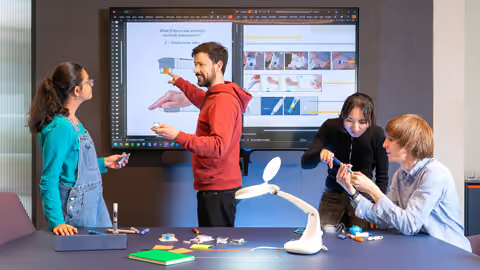
In another case, the client’s request was for a holistic - yet efficient - risk review rather than root cause analysis for a known failure mode. TTP assembled a highly multi-disciplinary team, all feeding into an FMEA framework. Harms and scoring approaches were harmonised with the client’s QMS, making best use of the client’s expertise and supporting smooth incorporation of TTP’s outputs into the overall design history file.
Various issues related to misuse or misunderstanding were addressed through a targeted human factors study, both to evidence occurrence and detection scorings and to identify design variants which could reduce risk.
The study also identified a small number of unforeseen misuse modes which were fed back into the process. In addition to user-related failure modes, several tolerance and manufacturing cases were found in which the mechanism could hang, leaving the device in an unplanned state. Finally, some cases were identified in which a combination of accidental misuse and limited design margin crossed over to create a hazardous situation. The TTP team identified solutions for all of the material hazardous situations, enabling the client to move ahead with manufacture.
Conclusion
Across the portfolio, TTP helped the client move from known issues and production risks to clear, evidence-based routes forward. The work combined structured risk management with deep technical analysis, targeted testing, and practical manufacturing insight, enabling the client to resolve critical challenges efficiently and progress the devices into reliable production.