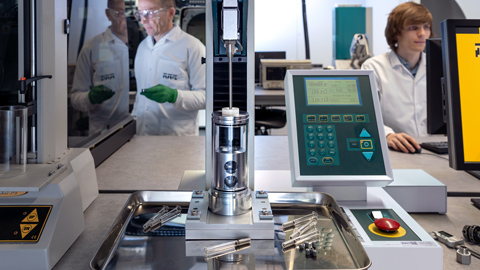


Ripple Therapeutics and TTP have worked together on a series of projects to advance intraocular drug delivery.
Context
Ripple Therapeutics is developing novel sustained-release drug implants to reduce the number of drug injections into the eye and asked TTP to de-risk a key part of the delivery process.
Solution
TTP’s ophthalmology and drug delivery experts rapidly developed and evaluated several concepts for securing, and safely releasing, delicate drug implants in Ripple’s solid dose delivery devices.
Result
In a market where intraocular injections have quickly grown from thousands to millions per year, TTP provided Ripple Therapeutics with robust options and the ability to make informed decisions about them early in the medical device development process.
The growing demand for intraocular drug delivery
Intravitreal and intracameral injections - where a fluid or an implant is injected into the eye - have become a cornerstone in the treatment of many eye diseases.
On the back of this progress, the number of injections carried out by ophthalmologists has rapidly grown from thousands to many millions per year [1]. The range of diseases which can be addressed in this way continues to increase, as does the prevalence of diabetic and age-associated eye diseases [2].
Ripple Therapeutics is developing extended-release drug delivery solutions to address these challenges and take advantage of future growth in the intraocular drug delivery market. Specially formulated pro-drug implants release the active ingredient very predictably and over a period of months, without the need for drug carriers or other substances to improve the formulation.
For patients, this promises fewer injections into the eye, a better quality of life and better outcomes. Less frequent injections also benefit healthcare systems: enabling a fast injection process with very low incidence of adverse events increases the number of patients which a clinician can treat in a day.
All of these benefits depend on Ripple having a delivery device which is able to retain and insert its implants reliably and intuitively.
Designing a reliable delivery mechanism
Ripple Therapeutics and TTP have collaborated on a series of projects to advance Ripple’s intraocular drug delivery tools, exploring how to retain solid implants of varying dimensions reliably within the delivery device and de-risking the operation of the actuation mechanism.
Ripple’s focus throughout the engagement was on enabling the next development step quickly and with minimal risk. To support this, TTP evaluated all concepts using Kano categories to prioritise what mattered most to the project.
For example, the time and effort required to de-risk any given solution was treated as a “performance” criterion – quicker and easier was better – whereas technical performance was a “basic" need: once it was good enough, improving it further brought little additional benefit.
This degree of clarity enabled TTP to refine and prioritise solutions to give Ripple exactly what was needed, very quickly and economically.
The speed of the de-risking process was enabled by a structured approach to identifying mechanism states and requirements for successful transitions between states. Mapping out positions and interactions of the mechanism components in each state – including quantitative requirements – made areas of potential risk clear, providing strong guidance on which state transitions needed further analysis, and the type of analysis that was needed.
In this way, TTP defined tolerances that ensured reliable operation without being unnecessarily tight, while also producing a range of design improvement options prioritised using Kano categories and backed by confidence in their performance.
Together, these approaches gave Ripple solid design options to enable clinical work, and the confidence that future design modifications would meet anticipated future needs.

We approached TTP to help us de-risk several of our delivery device concepts. The analysis and concepts generated were well thought out and detailed, allowing us to make risk-based decisions to guide the projects. In one instance, their analysis steered us away from a concept that would have been quite costly to prove reliability. TTP’s expert approach to problem solving is evident as the team was able to meet all deliverables within the agreed budget and timeline. The service we received exceeded expectations and we plan to work with TTP on future projects.
Ian Parrag,
VP R&D
About TTP's Drug Delivery team
From concept to clinic, TTP's Drug Delivery Device Development team delivers innovative solutions to the most demanding drug delivery challenges. With deep-rooted expertise spanning engineering, human factors, and the sciences, we guide clients through the entire development journey — from early-stage discovery to manufacturing and final launch. Backed by a strong track record, we work within real-world constraints to design robust, efficient, and scalable devices that bring transformative therapies to life and enhance patient care.
Find out how we can help you with your ocular drug delivery needs.
About TTP's Ophthalmology and Optometry team
Building on 30 years of pioneering advancements in ophthalmology, we have collaborated with the industry’s top companies to create sector-defining products. Our deep domain expertise, paired with our unrivalled agility in execution, ensures we consistently deliver high-impact results for our clients. From novel optics for contact lenses and IOLs, to innovative drug delivery and surgical systems, we are always looking for ways to address patient, healthcare professional and industry needs. Find out how our team of ophthalmology technology experts can help you.
TTP's Drug Delivery and Eyecare teams form part of our broader Medical Device Design Consultancy team, consisting of 300+ engineers, scientists, and human factors specialists. For nearly four decades we've partnered with clients to develop impactful solutions, helping them achieve commercial success.
See our approach to medical device design and development.
References
[1] https://www.karger.com/Article/FullText/486145#ref3
[2] https://pubmed.ncbi.nlm.nih.gov/34172943/