Tackling bottlenecks in drug discovery
Small molecule drug discovery is undergoing a resurgence, driven by advances in AI and automation that are rapidly expanding accessible chemical space. Compared to biologics, small molecules retain key advantages: they are easier to administer, cheaper to manufacture, and offer better patient compliance. This is reflected in recent FDA approvals1, where small molecules continue to play a central role.
AI is also reshaping how molecules are designed and made. Moving beyond traditional retrosynthesis, data-driven approaches are enabling more practical and experimentally realistic routes to synthesis. Today, around 10⁶ catalogue molecules are accessible globally, but this could expand toward 10⁸ or more as AI identifies new routes and leverages simpler, scalable chemistries. This expansion is placing unprecedented pressure on downstream workflows.
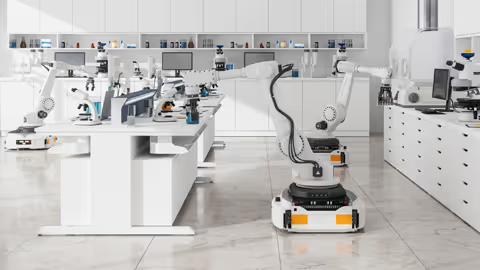
While AI-driven design, high-throughput experimentation and data analysis have advanced rapidly, automated synthesis (“Make”) remains a significant challenge within the DMTA cycle. There are several aspects of Make that are problematic, but purification is particularly stubborn to resolve. Despite advances in synthetic chemistry and the increasing ability of biological assays to tolerate impurities or mixtures, conventional purification is still often required to obtain reliable and reproducible results.
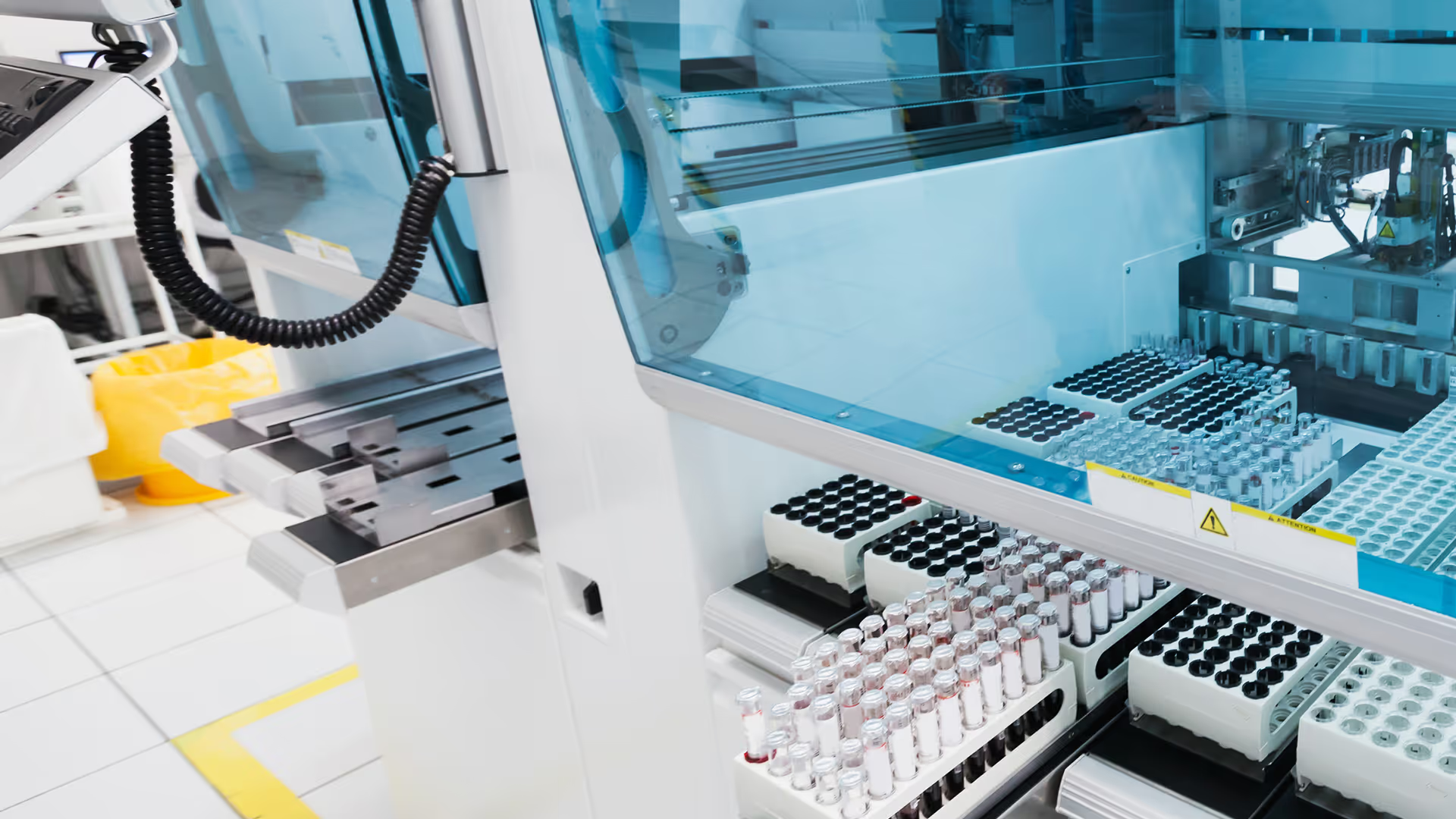
At industrial scale, purification relies on robust, scalable methods such as distillation, crystallisation and liquid–liquid extraction. In contrast, medicinal chemistry operates at milligram and gram scale, where purification typically relies on two approaches: solid-phase extraction (SPE) for crude clean-up and flash chromatography for high-resolution separation. In both cases, the separation itself is already highly automated. SPE is straightforward enough to be readily integrated into robotic workflows, while modern flash chromatography systems can optimise solvent gradients and fraction collection to achieve efficient separations with minimal user input.
Automating the difficult steps in purification
So, where is the challenge?
The limitation is no longer the separation itself. From a workflow perspective, purification remains a largely discrete operation that sits between synthesis and testing, rather than forming part of a seamless automated process.
This distinction is increasingly apparent in modern medicinal chemistry laboratories. Automated flash chromatography systems can often complete separations with minimal operator input, yet chemists may still spend significant time preparing samples, drying fractions and transferring materials between instruments. As a result, the bottleneck frequently lies not in the chromatography itself, but in the manual handling steps surrounding it.
Crude reaction mixtures must be transferred, concentrated, adsorbed onto silica and loaded onto columns—steps that appear deceptively simple but become critically sensitive at small scale. These operations are difficult to standardise and often rely on tacit knowledge from experienced chemists. Small inefficiencies, such as material loss during transfer or inconsistent drying, can have a disproportionate impact on yield and data quality.
As a result, even in otherwise automated workflows, human intervention is frequently required, breaking the continuity of the system. This creates a fundamental imbalance: synthesis can often be parallelised and completed within hours, whereas purification and drying may take days, requiring dedicated equipment, operator time and specialist expertise. The bottleneck is therefore increasingly one of materials handling and system integration rather than molecular separation.
Every manual intervention introduces delays, variability and resource requirements that become more significant as DMTA throughput increases. As organisations seek to evaluate thousands rather than hundreds of compounds, purification can become a disproportionate constraint on cycle time, limiting the value that AI-driven design and automated synthesis can deliver.
Rethinking purification
The future of purification will not be defined by better chromatography alone, but by rethinking how compounds are prepared, moved, and, in some cases, whether purification is needed at all.
One immediate opportunity is automating the preparation of dry-loaded samples for flash chromatography. This involves generating a dried, silica-bound form of the crude product that can be directly introduced onto a column without manual intervention. Achieving this requires integrating three steps: mixing of crude product with silica, drying the mixture, and loading the dried material into flash chromatography system.
There is potential to draw inspiration from adjacent industries. Techniques such as spray drying2, encapsulation and powder processing3, widely used in API manufacturing and the food industry, demonstrate how liquids can be converted into solid, handleable forms. However, these approaches are typically designed for industrial-scale production and would need to be adapted for medicinal chemistry, where even small material losses can become significant.
For example, spray drying is routinely used in pharmaceutical manufacturing to convert liquid formulations into stable powders at industrial scale. While medicinal chemistry operates at vastly smaller scales, the underlying principle—transforming difficult-to-handle liquids into standardised, transferable solid forms—could help automate sample preparation for purification workflows.
This points to a more fundamental question: is loose solid necessary at all? An alternative could be to absorb and dry crude products onto structured solid matrices, such as silica wool, sponges, or other inert materials, that are easier to handle and can be directly loaded into a column. Similarly, approaches like centrifugal drying may enable controlled solvent removal, although efficient recovery and transfer of the resulting dried material remains a challenge.
Beyond improving transfer, there is a broader shift away from traditional batch workflows. Flow chemistry with in-line purification4,5,6, such as membrane-based separations, offers a route to integrate synthesis and purification into continuous processes, eliminating discrete handling steps altogether. In this model, purification becomes part of the reaction stream rather than a separate operation.
Similar principles are already being demonstrated in highly parallel discovery platforms. DNA-encoded library technologies, for example, enable millions of compounds to be generated and screened while maintaining compound identity through DNA tags rather than traditional isolation and purification. Although these approaches are not direct replacements for medicinal chemistry workflows, they illustrate how future DMTA systems may rely less on discrete purification steps and more on integrated, information-rich processes.
More disruptive approaches go further still. Solid-phase and encoded chemistries, along with droplet-based systems, enable synthesis and testing to be tightly coupled, often without the need for isolation.
In some contexts, particularly during early-stage discovery, there may even be a case for no purification at all. With highly efficient one-pot reactions and well-understood chemistry7, it may be possible to move directly from synthesis to biological validation. As long as reaction conditions and components are known, outcomes can be deconvoluted retrospectively, reducing the need for upfront purification.
The future of purification in DMTA
The industry has largely solved how to separate molecules. The next challenge is how to handle, transfer and integrate them seamlessly within increasingly automated discovery systems. As AI expands the number of compounds entering the DMTA cycle, the inefficiencies surrounding purification risk becoming an increasingly significant constraint on throughput and productivity.
Solving this challenge is not simply about improving chromatography workflows. It is about enabling tighter integration between synthesis and biological testing. As purification becomes more automated, more selective, or in some cases unnecessary, the traditional boundary between Make and Test begins to dissolve. Instead of operating as discrete stages connected by manual handovers, future DMTA workflows are likely to become more continuous, with compounds moving rapidly from synthesis into biological evaluation and data generation.
This shift will require fresh thinking about materials handling, workflow design and the role purification plays within discovery programmes. In some cases, purification will remain essential. In others, it may be deferred until activity has been demonstrated, or replaced by alternative approaches that allow chemistry and biology to operate more closely together.
Organisations that solve these challenges will do more than remove a laboratory bottleneck. They will unlock higher-velocity DMTA workflows, generate larger volumes of high-quality experimental data, and create the operational foundations needed to realise the full potential of AI-driven drug discovery. Purification will no longer be an efficiency-sapping constraint, but an integrated part of a high-velocity discovery engine capable of turning ideas into data faster than ever before.
Is purification limiting your DMTA throughput?
As compound volumes increase, manual purification workflows can quickly become a major constraint on productivity.
TTP works with pharmaceutical and biotechnology companies to develop automated chemistry, purification and workflow integration technologies that reduce manual intervention and accelerate the journey from synthesis to biological insight.
Contact our team to discuss how purification and sample-handling bottlenecks could be removed from your discovery workflow.
About TTP's Drug Discovery Tools Team
TTP helps pharmaceutical and biotechnology companies accelerate drug discovery by removing bottlenecks across the Design-Make-Test-Analyse (DMTA) cycle.
Our Drug Discovery Tools team develops bespoke technologies that enable faster experimentation, higher-quality data and more efficient decision-making. Combining expertise in biology, chemistry, automation, microfluidics, software and instrumentation, we help clients solve complex challenges spanning synthesis, purification, screening, organoid systems, assay development and integrated laboratory workflows.
From targeted workflow improvements to entirely new discovery platforms, we work with clients to increase DMTA iteration velocity and unlock the full potential of AI-enabled drug discovery.
References
- https://pmc.ncbi.nlm.nih.gov/articles/PMC12898419/
- https://www.buchi.com/en/products/instruments/spray-dryer-s300
- https://www.sciencedirect.com/science/chapter/edited-volume/pii/B978044334156400025X
- https://www.biotage.com/products/v-10-touch-evaporation-system
- https://www.thermofisher.com/uk/en/home/life-science/lab-equipment/speedvac-vacuum-concentrators.html
- https://onlinelibrary.wiley.com/doi/abs/10.1002/anie.201004637
- https://www.ttp.com/insights/only-a-click-away-click-chemistry-transforms-life-science-applications