Why organoids could be at the heart of future drug discovery workflows
Organoids are gradually becoming more established as a testing methodology in the cycle of Design, Make, Test and Analyse that is at the core of drug discovery. By bridging the gap between the structural complexity and cost of spheroids and in vivo models, and thanks to their ability to generate data that is more human-relevant than 2D cell cultures and many animal models, they are highly relevant for lead optimisation, where drug efficacy must be balanced against toxicity.

For example, liver organoids could help identify hepatotoxicity earlier in the discovery process, before significant time and resource has been invested in a lead series. Tumour organoids, particularly patient-derived models, could provide more predictive insight into treatment response in oncology. Intestinal or gut organoids may also help assess absorption, barrier function and gastrointestinal toxicity in a more human-relevant system than conventional 2D assays.
Organoids are also becoming more complex, with advances being made in terms of 3D tissue architecture, use of multiple cell types, inclusion of physiological structures, and replication of more life-realistic cell behaviours. There is also the potential to use organoids towards the goal of personalised medicine, by using patient-derived organoids to reflect individual variabilities in disease and drug response. In the last 15 years, organ-on-chip systems have also attracted attention, because of the added possibility of being able to control and monitor important physiological features such as fluid flow, mechanical forces and tissue interfaces.
With the growing support of regulatory and funding agencies following the FDA Modernization Act 2.0 in 2022, organoids are therefore taking their place amongst the ‘new approach methodologies’ (NAMs) for reducing the use of animal testing in drug discovery and development.
But only using organoids in later cycles of DMTA underplays their potential importance. With their deeper insights into organ response, translational biomarkers and drug toxicity, organoids have the potential to weed out leads earlier in the testing cycle, before moving to more expensive stages – fitting the ‘fail fast, fail cheap’ paradigm. It could also result in lower rates of false negatives, which is a risk when using insufficiently robust assays.
A candidate that appears promising in a conventional cell assay but shows early signs of liver toxicity or poor efficacy in a human-relevant organoid model, could be deprioritised before progressing into costly animal studies and advanced development programmes.
But there is a fundamental challenge. Future DMTA systems will require organoids in volumes, at speeds and with levels of consistency that today's manufacturing approaches cannot deliver. If organoids are to become a routine part of drug discovery workflows, they must transition from bespoke biological models into industrially produced testing platforms.
Transforming production from artisanal to industrial
Currently, organoids are manufactured in small batches by skilled biologists, with outcomes often dependent on individual expertise and laboratory-specific practices. While this approach is suitable for exploratory research, it is fundamentally difficult to scale. Future DMTA workflows may require thousands of highly comparable organoids generated on demand, something that artisanal manufacturing methods were never designed to support. While this approach is suitable for exploratory research, it is fundamentally difficult to scale. Future DMTA workflows may require thousands of highly comparable organoids generated on demand, something that artisanal manufacturing methods were never designed to support.
But as well as limiting throughput, the lack of automation contributes towards another challenge – that of consistency. Significant batch-to-batch variation in organoid quality can be attributed partly to variability in the starting materials, but also due to differences in the way that individual biologists work, exacerbated by the use of protocols and QC standards that are often lab-specific.
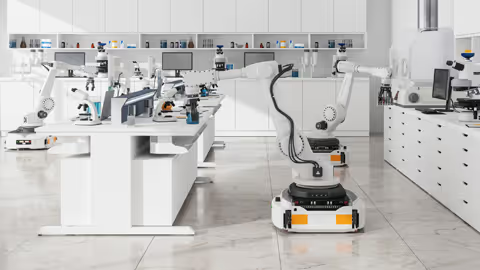
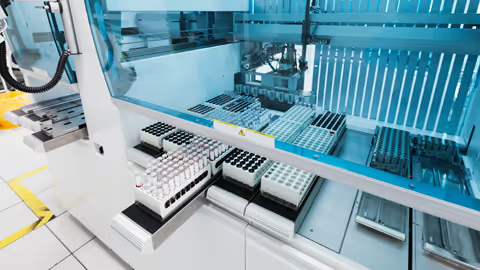
These problems of scale and consistency could be addressed by implementing automation of organoid manufacture. The challenge is similar to one that the biologics industry faced decades ago. Just as biologics moved from small-scale laboratory production to highly controlled industrial manufacturing, organoids may need a comparable transition if they are to become reliable tools within mainstream drug discovery. This could enable workflows where hundreds or thousands of genetically matched liver, gut or tumour organoids are produced to a common specification and deployed across multiple screening campaigns, generating datasets that are far more consistent than today's largely manual approaches. For example, microfluidic systems could be used in combination with robotics or other automated liquid handling methods to reduce labour intensity and operator variability in the early stages of organoid manufacture. Greater use of AI-enabled imaging protocols and other automated functional assays could then be employed to circumvent the need for routine deployment of human judgement and decision-making during in-process and final QC. More importantly, automation transforms organoid production from a process dependent on individual judgement into one governed by repeatable manufacturing controls. This shift may ultimately be more valuable than the labour savings it creates.
The benefits extend beyond manufacturing efficiency. Future DMTA workflows will increasingly rely on AI models to identify patterns in biological data and guide decision-making. However, AI systems are only as reliable as the data used to train them. By creating more standardised organoids and reducing batch-to-batch variability, automated manufacturing could generate the consistent, high-quality datasets needed to improve the predictive power of AI-enabled drug discovery.
Automation would also necessitate tighter definition of inputs and controlling processes. One way of achieving this is to use purely synthetic extracellular matrices instead of currently biologically-derived matrices, to reduce inherent variability in the starting materials. This could be complemented by use of bioreactors to culture cells in bulk and so enable the production of large, consistent batches. The development of an industry standard for organoid manufacture is currently underway by ISOi, and this should ultimately further reduce lab-to-lab variation.
And finally, we should consider the vessels in which organoids are cultured. Microplate formats are long-established in biochemistry, but the process of pipetting materials in and out is not so relevant for organoid culture, and there is the issue of well size too. Designing a new plate format suited to the needs of growing organoids might overcome these restrictions, and could aid scale-up of the technology. New assay formats could also allow in situ testing – for example by AI-powered imaging tools– to enable faster assessment of organoid growth stage and quality.
Using organoid storage to achieve agile workflows
But scaling-up organoid use won’t be solved entirely by industrialising output. That’s because organoids take weeks or even months to grow and often have a limited viable lifetime.
One solution is to attempt to predict months in advance the demand for testing, but this is hardly compatible with a responsive, agile DMTA workflow. Industrial-scale organoid manufacture also creates a new challenge: matching supply with demand. As with any mature manufacturing ecosystem, production and consumption must be decoupled. Storage therefore becomes a critical enabling technology, allowing organoids to be manufactured in bulk, quality controlled, and deployed when required.
In principle, a discovery team could order a qualified batch of liver or kidney organoids in much the same way they currently source cell lines or assay reagents, removing weeks of preparation time from a screening programme.
Currently, the most common approach to biological storage is controlled-rate freezing, using cryoprotectants such as DMSO to avoid damage from ice crystals. However, because mature organoids are large, complex 3D tissues, freezing damage is harder to control than for single cells. Different cell types within the same organoid may respond differently to freezing and thawing, and a period of post-thaw recovery is often needed before use. Fortunately, there remains plenty of scope to optimise these processes, as well as identifying improved cryoprotectants. An extension to this technique, termed vitrification, uses higher concentrations of cryoprotectants and ultra-fast freezing rates to completely prevent ice crystal formation, but this needs further work to overcome issues around osmosis-induced damage and the risk of cell toxicity.
The long-term goal is for organoids to be treated less like bespoke biological experiments and more like standardised laboratory reagents: manufactured, qualified, stored and deployed whenever required.
Striking a balance between quality, quantity and consistency
In conclusion, organoids – and by extension organ-on-chip technologies – offer exciting opportunities for DMTA because of their potential to refine leads in early cycles, reducing costs in later stages of testing. However, this will only happen if we can move away from small-scale ‘artisan’ manufacturing of organoids and towards automated, industrial-scale manufacture, making it more akin to the processes used to make biologics or chemical reagents.
The objective is not necessarily to create the most biologically sophisticated organoid possible. Rather, it is to create organoids that are sufficiently predictive, highly reproducible and available at the scale required by modern DMTA workflows. In many cases, consistency may be more valuable than absolute biological complexity.
The future of organoids will ultimately be determined not by biology alone, but by manufacturing. When organoids can be produced, qualified, stored and distributed with the reliability of other critical laboratory consumables, they will move from niche research tools to core infrastructure within drug discovery. At that point, organoids and organ-on-chip systems will become core components of the DMTA data engine, generating the standardised, high-quality, human-relevant data needed to accelerate decision-making across drug discovery. As AI becomes increasingly embedded within drug discovery workflows, the ability to generate such datasets at scale may prove just as important as the biological models themselves.
Turning organoids into scalable drug discovery tools
The future value of organoids will depend not only on biology, but on the ability to manufacture, qualify and deploy them at the scale required by modern drug discovery.
TTP combines expertise in cell biology, microfluidics, automation, imaging and product development to help organisations develop robust organoid platforms, organ-on-chip systems and automated testing workflows.
Speak with our team to explore how next-generation biological models could strengthen your DMTA strategy.
About TTP's Drug Discovery Tools Team
TTP helps pharmaceutical and biotechnology companies accelerate drug discovery by removing bottlenecks across the Design-Make-Test-Analyse (DMTA) cycle.
Our Drug Discovery Tools team develops bespoke technologies that enable faster experimentation, higher-quality data and more efficient decision-making. Combining expertise in biology, chemistry, automation, microfluidics, software and instrumentation, we help clients solve complex challenges spanning synthesis, purification, screening, organoid systems, assay development and integrated laboratory workflows.
From targeted workflow improvements to entirely new discovery platforms, we work with clients to increase DMTA iteration velocity and unlock the full potential of AI-enabled drug discovery.