As AI expands the number of molecules that can be designed and prioritised for synthesis, the limiting factor increasingly becomes how quickly those molecules can be evaluated. In many organisations, the separation between chemistry and biology now represents one of the largest remaining constraints on DMTA throughput.
For decades, drug discovery has operated under a simple rule: compounds must be purified before they can be tested. This was driven by practical concerns: impurities could interfere with assays, create false positives, or obscure structure-activity relationships. The experience of combinatorial chemistry reinforced this caution, where poorly controlled mixtures often led to unreliable results.
As a result, purification became a mandatory gate between “Make” and “Test”. However, this assumption was formed in a very different technological environment. Chemistry was slower and lower throughput, assays were less sensitive and less specific, and data was far more limited than it is today.
The question is not whether purification remains important, but whether it still needs to occupy the same position in the workflow.
A shift in capability: assays, data, and control
Several developments are making closer integration between Make and Test increasingly practical.
Modern biological assays are far more sophisticated than those available when current workflows were established. Biophysical methods, high-content screening and orthogonal validation approaches can often tolerate or help interpret more complex samples than traditional assays.
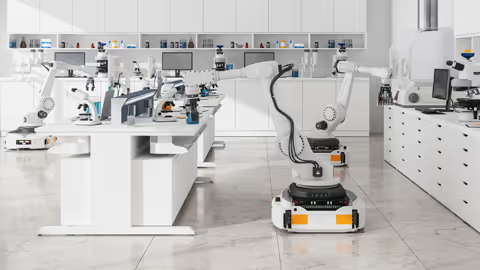
At the same time, AI, automation and data-driven workflows are providing greater visibility into reaction outcomes, making it easier to understand what is present in a sample and distinguish meaningful biological signals from artefacts. Increasingly, these tools are being combined within integrated laboratory workflows that reduce manual intervention and improve the speed of decision-making.
Chemistry itself is also becoming more controlled. High-yielding reactions, one-pot processes and well-understood synthetic transformations reduce uncertainty around crude reaction mixtures and improve confidence in downstream testing.
Together, these advances do not eliminate the need for purification. Rather, they allow it to be applied more selectively.
Instead of purifying everything by default, Discovery workflows can prioritise biological insight first while retaining purification where it adds the greatest value.
Technologies bringing Make and Test closer together
Several emerging approaches are enabling tighter coupling between chemistry and biology, both physically and temporally.
Direct-to-biology synthesis
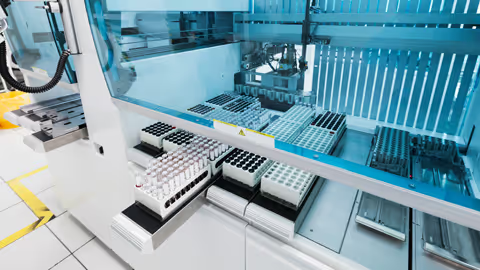
One approach is direct-to-biology (D2B), in which arrays of molecules are synthesised in assay-compatible plate formats and tested with minimal or no intermediate purification.
This strategy has attracted significant attention because it removes a major source of delay between compound generation and biological evaluation. The use of selective building blocks and clean reactions such as click chemistry and C–C or C–H activation makes these workflows increasingly practical1.
DNA-encoded approaches
DNA-encoded libraries (DELs)2 demonstrate another way of decoupling compound identification from traditional purification workflows. By encoding compound identity in DNA, large numbers of molecules can be synthesised and screened while maintaining traceability.
Emerging approaches combine bead-based synthesis, microfluidics and functional biological assays, enabling active compounds to be identified through sequencing rather than conventional isolation and characterisation. These techniques offer exceptional throughput, although challenges remain around droplet handling, sorting rates and assay design.
The growing maturity of DNA-encoded approaches is reflected by their adoption across the pharmaceutical industry. Amgen3 has reported the use of DNA-encoded library screening to identify a clinical candidate targeting PRMT5, demonstrating the potential of these methods to contribute directly to drug discovery programmes. AstraZeneca4 has also expanded its use of encoded library technologies through collaborations with specialist partners, highlighting the industry's growing confidence in highly parallel screening approaches.
Miniaturised screening platforms
Advances in liquid handling are also enabling chemistry and biology to be co-located in nanolitre-scale environments.
Reactions can be performed in nanolitre droplets or printed microarrays and immediately subjected to biological testing without intermediate handling. Increasingly, these platforms can accommodate more complex biological systems, including organoids and other physiologically relevant models, creating opportunities for high-throughput screening with richer biological readouts. Combined with automated liquid handling and imaging systems, these platforms offer a route towards more tightly integrated and scalable discovery workflows. Recent advances in droplet microfluidics and miniaturised cell-based screening have demonstrated the ability to evaluate thousands of biological experiments using only nanolitre volumes, significantly reducing reagent consumption while maintaining rich biological information content.
Beyond co-location: true integration
Some pharmaceutical companies are already addressing DMTA bottlenecks by bringing chemistry and biology activities into closer geographical proximity. Reducing the delays associated with shipping compounds can improve turnaround times and increase experimental agility.
However, the larger opportunity is not simply co-location. It is the removal of unnecessary barriers between synthesis and testing.
Historically, Make and Test have been treated as separate disciplines connected by purification and sample transfer. Future workflows are likely to be much more integrated, with chemistry and biology operating as parts of a continuous experimental system.
In this model, synthesis, sample preparation, biological testing and data capture become part of a continuous experimental loop rather than a sequence of independent activities. Compounds can move directly from generation to evaluation, while assay results are rapidly fed back into decision-making processes. This reduces idle time between stages, shortens the path from hypothesis to insight, and allows teams to explore molecular space more efficiently.
As AI-driven design tools generate increasing numbers of candidate molecules, maintaining discovery productivity will depend not only on making compounds faster, but also on evaluating them faster. Integrated workflows therefore offer a route to increasing DMTA iteration velocity without simply scaling existing processes.
The future DMTA
Realising this vision will not be without challenges. There remains cultural resistance, rooted in past experiences with impure samples and unreliable data, as well as the deeply ingrained separation between how chemistry and biology are performed: chemistry in glassware, biology in microplates. Moving toward more integrated workflows will take time, but the transition is already underway.
Ultimately, the future of DMTA is unlikely to be defined by faster chemistry or better assays alone, but by how effectively these capabilities are connected. As synthesis, screening, automation and data analysis become increasingly integrated, the traditional boundaries between Make and Test will continue to dissolve. The organisations that can build these continuous discovery workflows will be best placed to exploit the full potential of AI-driven drug discovery and accelerate the journey from molecular design to biological insight.
Bringing chemistry and biology closer together
The organisations that gain the greatest advantage from AI-driven drug discovery will be those that can shorten the path between compound synthesis and biological learning.
TTP develops integrated technologies that connect chemistry, screening, automation and data generation, enabling faster iteration across the DMTA cycle.
If you are investigating direct-to-biology workflows, miniaturised screening, microfluidic platforms or integrated discovery automation, we'd be delighted to discuss your goals.
About TTP's Drug Discovery Tools Team
TTP helps pharmaceutical and biotechnology companies accelerate drug discovery by removing bottlenecks across the Design-Make-Test-Analyse (DMTA) cycle.
Our Drug Discovery Tools team develops bespoke technologies that enable faster experimentation, higher-quality data and more efficient decision-making. Combining expertise in biology, chemistry, automation, microfluidics, software and instrumentation, we help clients solve complex challenges spanning synthesis, purification, screening, organoid systems, assay development and integrated laboratory workflows.
From targeted workflow improvements to entirely new discovery platforms, we work with clients to increase DMTA iteration velocity and unlock the full potential of AI-enabled drug discovery.
References
- https://chemistry-europe.onlinelibrary.wiley.com/doi/10.1002/cmdc.202501080
- https://pmc.ncbi.nlm.nih.gov/articles/PMC8369695/
- https://www.amgen.com/stories/2025/04/driving-drug-design-using-dna-encoded-libraries
- https://www.x-chemrx.com/projects/x%E2%80%91chem-enters-expanded-global-drug-discovery-and-technology-transfer-collaboration-with-astrazeneca/