For those accountable for regulated software delivery, success means delivering software that works and can continue to evolve safely, predictably and defensibly as systems, risks, teams and operating environments change over time. In short, to ensure confidence in regulated medical device software.
Regulated software development therefore depends on effective lifecycle delivery and governance. Delivering software that performs as intended must go hand in hand with creating and maintaining confidence in the architecture, risk controls, verification strategy, cybersecurity controls and engineering decisions that support the product throughout its lifetime.
IEC 62304 (medical device software lifecycle process) and ISO 13485 (quality management systems for medical devices) provide the framework for building and maintaining this confidence. Together, they establish the expectation that software development is planned, risk-based, traceable and controlled throughout the product lifecycle. Their value lies in making engineering decisions, risk controls and software behaviour explainable as the product evolves.
When lifecycle discipline is weak, the consequences often appear later in the programme rather than at the point where the weakness is introduced. Ambiguous requirements, untested architectural assumptions, poorly defined interfaces or unclear verification expectations may not cause immediate failure, but they tend to surface later when the system is integrated, changed, reviewed or prepared for release.
In a regulated environment, these issues are more than technical debt because they can affect regulatory confidence, commercial delivery and long-term product risk.
This insight piece explores the engineering leadership questions that determine whether regulated medical software can scale safely
- What must be resolved early to avoid late rework and delay?
- Where does added rigour genuinely improve control?
- Which design choices make the system easier to trust?
- What evidence shows that change has not weakened the software?
- And how do interfaces carry the behaviour and assumptions of the complete system?
Confidence in medical software is built through lifecycle maturity, proportionate rigour, systems thinking and disciplined delivery, with documentation and testing integrated throughout the lifecycle from the outset.
Foundations: IEC 62304 and the regulatory framework
The regulatory framework shapes how medical device software is planned, controlled and justified. In these foundations we explore four important principles: an integrated standards framework, traceability, proportionate rigour, and cybersecurity throughout the lifecycle.
An integrated standards framework
IEC 62304 provides the core lifecycle framework for medical device software. ISO 13485 establishes the quality-management context in which that lifecycle is planned, controlled and maintained. And ISO 14971 provides the corresponding risk-management process, using hazards and risk controls to inform software requirements, architecture, verification and residual-risk evaluation.
Together, these standards establish that regulated software development is not simply the production of working code. It is a controlled, risk-based and traceable process in which requirements, design decisions, implementation, verification, release, maintenance and problem resolution remain explainable throughout the product lifecycle.
Regulatory expectations in both the EU and US reinforce this combined lifecycle-and-risk perspective. Under the EU MDR, manufacturers must demonstrate that devices meet the General Safety and Performance Requirements throughout their intended lifetime, supported by risk management, appropriate design controls and evidence of safe performance. In the US, FDA’s Quality Management System Regulation incorporates ISO 13485 while FDA guidance on premarket submissions for device software functions emphasises the need for software information that supports the assessment of safety and effectiveness.
Traceability and explainable decisions
The practical purpose of the framework is to maintain a defensible connection between intended use, software behaviour, risk controls and verification results.
This connection must remain intact as the product changes. Requirements should support the intended use and risk controls; architecture and implementation should satisfy those requirements; verification should provide evidence that they have been met; and configuration and change management should show what has changed and why.
Proportionate rigour
IEC 62304 supports a proportionate approach to lifecycle control and recognises that not all software failures have the same consequences. Software safety classification therefore helps determine the level of planning, documentation, review, verification and change control required. Software with a higher potential impact on patient or user safety generally requires stronger controls and more extensive evidence. Lower-risk software may be managed with less formality, provided the approach remains justified and controlled.
The objective is not maximum formality in every activity. It is consistent control where the potential consequences of software failure are greatest. Proportionate rigour helps teams focus effort on the decisions and evidence that matter most, while avoiding process overhead that adds little safety or engineering value.
Cybersecurity and lifecycle change
Cybersecurity standards, regulations and guidance extend the lifecycle framework for connected or updateable devices. Security risks can affect safety, performance, availability and trust in the product.
Security requirements, external dependencies, secure update mechanisms, vulnerability management and post-market monitoring therefore need to be addressed through requirements, architecture, verification and maintenance. They should not be treated solely as late-stage testing concerns. Refer to the annexure for these.
This broader framework establishes the basis for confidence in regulated medical software: working functionality, controlled lifecycle processes, risk-based decision-making, traceable requirements and verification, and the ability to maintain control as the product changes over time.
Looking to find out more?
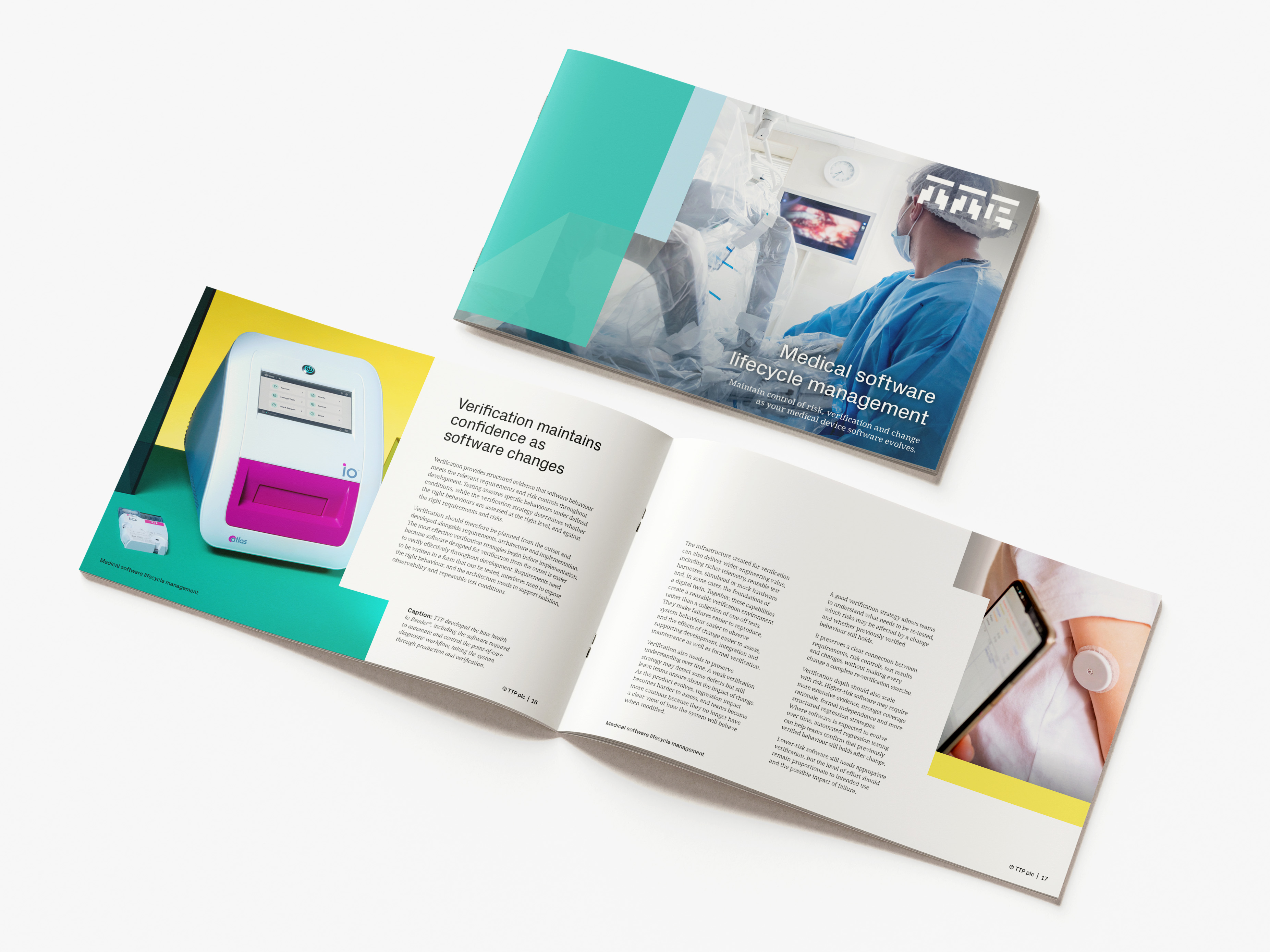
Read or download our medical software lifecycle management e-book to explore more practical insights from TTP, plus explore how to confidently build regulated medical device software that evolves safely, predictably and defensibly over its lifetime. We explore:
- Balancing development speed and lifecycle rigour at different stages of a regulated software programme
- Designing software with verification and traceability in mind from the outset
- Maintaining confidence when requirements, risks and software change
- Addressing engineering risk at the interfaces and system boundaries
- Managing cybersecurity as a lifecycle concern
- Involving external partners in software development