Active implantable medical device development (AIMD)
Engineering active implantables built for long-term performance
Designing active implantable medical devices demands absolute confidence in every decision. With decades of experience developing complex implantable systems, we help teams translate clinical concepts into safe, reliable and commercially viable products.
Clients choose TTP for our ability to navigate the technical, regulatory and human challenges inherent in active implantables to deliver devices that perform reliably over the long term and make a meaningful difference to patients’ lives.

Defining robust system architectures early
Successful active implantable devices are built on strong system-level decisions made early in development. We work closely with you to define architectures that balance performance, power, longevity, and usability from the outset, before design direction becomes costly to change.
By grounding decisions in scientific insight, modelling and deep engineering analysis, we help establish a clear technical direction that guides the entire programme. Early concepts are shaped by an understanding of clinical use and patient interaction, ensuring technical choices remain aligned with real-world constraints.
Key considerations include:
- Power and energy budgets across the intended implant lifetime
- Location, form-factor, biocompatibility and hermeticity
- System partitioning across electronics, software and hardware
- Trade-offs between miniaturisation, performance and manufacturability
- Clinical workflows and usability constraints
This early clarity reduces uncertainty, avoids late-stage redesigns, and accelerates progress.


TTP’s scientific team ‘went the extra mile’ time and again by asking questions, identifying and pursuing pathways, and presenting complete solutions to unforeseen findings.
Dr Paul Goode
Glucotrack, USA

To accelerate the development of our novel neuromodulation system, we wanted to find a partner we could work with dynamically and not just a black box output that some suppliers offered. TTP were able to bring a large team of electronics, mechanical, RF and human factors engineers together to help us realise the system in rapid time ahead of human clinical trials. From patient interviews and mechanical design to power circuits and regulated firmware, TTP delivered high quality outputs that guided the design of the implant, wearable and companion device.
Senior Director of Engineering
Neurotech Startup

TTP played an essential role in assessing the feasibility of an exciting new Continuous Glucose Monitoring (CGM) concept discovered at Carbometrics Limited. The team are hugely experienced, professional and efficient. They are well versed in the immense challenges that pave the way from concept to product and we learned a huge amount working with them.
Andy Chapman
CEO and Co-founder of Carbometrics

Engineering for long-term implant performance
Active implantables must operate reliably inside the body for many years, often within tightly constrained form factors. We bring deep expertise across electronics, embedded systems, RF and materials to engineer devices that deliver predictable, stable performance over time.
Our teams design with long-term reliability in mind, carefully managing interactions between power, heat, communication, and packaging to support safe, sustained operation. In-house RF and electromagnetic test facilities, including an RF anechoic chamber, allow us to validate wireless performance and robustness early, reducing uncertainty before clinical use.
Our experience spans:
- Ultra-low power electronics and energy management
- Embedded processing and firmware for implantable systems
- RF and wireless data communication through tissue
- Validation of wireless performance and power transfer in controlled RF environments
- Biocompatible packaging and system integration
This focus on engineered reliability builds confidence with clinicians, regulators and patients alike.
Read more about our work in Bluetooth Low Energy implants.

Reducing risk through modelling and evidence-led decisions
In active implantable development, early decisions can have long-lasting consequences. We use advanced modelling and targeted experimentation to explore system behaviour early, when changes are still easier and when changes have lower project impact.
By simulating performance over the device lifetime, we help teams balance trade-offs, compare design options, understand limitations and retire critical risks before they impact timelines or cost. Where appropriate, targeted usability evaluation and patient interaction studies are used to validate assumptions that influence critical technical decisions.
Our modelling and analysis support:
- Ultra-low power electronics and energy management
- Embedded processing and firmware for implantable systems
- RF and wireless data communication through tissue
- Validation of wireless performance and power transfer in controlled RF environments
- Biocompatible packaging and system integration
This science-led approach replaces guesswork with confidence and accelerates decision-making.
Read more about our work in predictive sensor characterisation for our client, Carbometrics

Accelerating clinical readiness and long-term success
Progressing an active implantable into human studies and beyond requires careful engineering, rigorous validation and a clear understanding of real-world constraints. We support teams from detailed design and in-house prototyping through to ISO 13485-certified manufacturing and transition to scale.
Clinical readiness is supported by strong technical evidence, robust verification and, where needed, focused human factors input to ensure devices are safe and practical to use. By identifying and retiring risks early, and designing with long-term deployment in mind, we help ensure devices are ready not just for clinical milestones, but for sustained real-world use.
Explore our work in continuous glucose monitors, biosensors, neurotechnology and or learn more about our broader medical device design and development capabilities.
Our support includes:
- Preparing devices for first-in-human studies
- Low-volume ISO 13485 manufacturing and verification
- Preparing Design History File for regulatory submission
- Design for manufacture and scale-up planning
- Supporting post-market improvement and iteration
Together, we help deliver active implantable systems that stand up to real-world demands and deliver lasting value.
Find out how we approach regulatory compliance for our clients

How we can help
Leads and electrodes
Delivery of a new therapy often requires the design of custom leads and electrodes for optimal performance, safety and stability. The interaction between the electrodes and the biological target is impacted by multiple factors including electrode material, electrode shape, and stimulation waveform. With expertise in both traditional leads and thin film electrodes, we transform core technologies into fully-developed, market-ready products.
IPG design
Few engineering challenges are as complex as implantable pulse generators (IPGs) for neuromodulation therapies. Unfortunately, there is no one-size-fits-all solution; only a customized IPG design will allow you to maximise your therapeutic efficacy while simultaneously minimizing the user burden. We have developed both conventional and innovative IPGs to achieve compact form factors, ultra-low power consumption and seamless integration with other system components. Discover our work in IPGs.
Surgical tools
The accurate placement implanted neural interfaces is critical to achieving successful patient outcomes. In addition, long and complex surgeries are expensive and limit accessibility of the therapy and thus market penetration. Bespoke surgical tools can enable faster insertion and more accurate placement while reducing the level of specialised training required. We have a strong track record in developing both single-use and complex electromechanical surgical tools.
Closed loop systems
Because the same neural interface can often be used for both feedback and control, Neurotechnology is uniquely well positioned to provide closed loop therapies. By incorporating sensing data, neuromodulation therapy can be titrated to maximise therapeutic efficacy whilst minimizing physiological side effects and power consumption. The biggest challenge is in the algorithm design and implementation to ensure robust, safe and effective results. We combine deep domain knowledge in electrophysiology and signals control theory to build reliable closed loop systems. Discover our work in closed loop.
Computational modelling
To accelerate the product development process, we apply our deep expertise in biomechanical and electrophysiological modelling to explore wide parameter spaces efficiently. This significantly reduces the number of experiments required to make critical design decisions, and the quantitative outputs provide valuable insights into sensitivity of the therapy to manufacturing tolerances, differences in physiology, and surgical placement. Read one of our case studies on computational modelling.
Regulatory compliance documentation
We have helped hundreds of clients prepare design history files for regulatory submission. Our ISO13485:2015 quality system is audited by BSI every year and several times again by quality auditors from multinational pharma and medical device companies. We speak the language of regulatory and quality teams alongside our deep technical expertise and can help clients bridge the gap between engineering and submission. Discover more about TTP's medtech regulatory compliance expertise.
Sensor technology design and development
We specialise in designing custom sensors that require a comprehensive understanding of the physical properties you will measure, while selecting materials and methods to ensure performance, durability, and accuracy. Integrating sensors demands balancing connectivity, protocols, power management, and efficiency, often requiring extensive prototyping and testing to achieve optimal performance.
Electronics and communications
Designing electronics for wearable and implantable devices requires balancing measurement accuracy, power consumption, device size and operational lifetime. We develop compact, reliable electronics alongside custom wired and wireless communication systems, including antennas and protocols, to ensure secure, real-time data transmission that supports timely analysis and clinical decision-making.
Expertise across sensing modalities
Our expertise spans multiple sensing technologies, including electrochemical, optical, electrical, fluorescence, spectroscopic and ultrasound modalities. Supported by in-house electrochemical test systems for controlled, high-throughput experimentation, we optimise sensor performance to deliver accurate, selective detection of biochemical markers even within challenging power and system constraints.
Human factors and usability
Even the greatest technologies need to be intuitive, simple to use, and integrate well into daily life to be widely adopted. We prioritise human factors engineering, studying how the target audience use the technology, in developing system designs. This ensures our biosensor devices are user-friendly and intuitive, and focus on enhancing user experience, influencing behaviours, reducing errors, and increasing adherence. Discover more about our human factors capabilities.
ISO13485 batch manufacturing
Contract manufacturing organisations prioritise long-term, high-volume contracts and often lack the flexibility to support smaller orders. Recognising the challenges in securing low-volume manufacturing for clinical studies, we established a certified manufacturing facility to support our clients and bridge the gap between R&D and full-scale manufacturing. Our bespoke facility provides agile, small-scale manufacturing solutions ensuring are liable supply of devices for clinical trials.
Discover more about our MedTech manufacturing facilities.
Leads and electrodes
Delivery of a new therapy often requires the design of custom leads and electrodes for optimal performance, safety and stability. The interaction between the electrodes and the biological target is impacted by multiple factors including electrode material, electrode shape, and stimulation waveform. With expertise in both traditional leads and thin film electrodes, we transform core technologies into fully-developed, market-ready products.
IPG design
Few engineering challenges are as complex as implantable pulse generators (IPGs) for neuromodulation therapies. Unfortunately, there is no one-size-fits-all solution; only a customized IPG design will allow you to maximise your therapeutic efficacy while simultaneously minimizing the user burden. We have developed both conventional and innovative IPGs to achieve compact form factors, ultra-low power consumption and seamless integration with other system components. Discover our work in IPGs.
Surgical tools
The accurate placement implanted neural interfaces is critical to achieving successful patient outcomes. In addition, long and complex surgeries are expensive and limit accessibility of the therapy and thus market penetration. Bespoke surgical tools can enable faster insertion and more accurate placement while reducing the level of specialised training required. We have a strong track record in developing both single-use and complex electromechanical surgical tools.
Closed loop systems
Because the same neural interface can often be used for both feedback and control, Neurotechnology is uniquely well positioned to provide closed loop therapies. By incorporating sensing data, neuromodulation therapy can be titrated to maximise therapeutic efficacy whilst minimizing physiological side effects and power consumption. The biggest challenge is in the algorithm design and implementation to ensure robust, safe and effective results. We combine deep domain knowledge in electrophysiology and signals control theory to build reliable closed loop systems. Discover our work in closed loop.
Computational modelling
To accelerate the product development process, we apply our deep expertise in biomechanical and electrophysiological modelling to explore wide parameter spaces efficiently. This significantly reduces the number of experiments required to make critical design decisions, and the quantitative outputs provide valuable insights into sensitivity of the therapy to manufacturing tolerances, differences in physiology, and surgical placement. Read one of our case studies on computational modelling.
Regulatory compliance documentation
We have helped hundreds of clients prepare design history files for regulatory submission. Our ISO13485:2015 quality system is audited by BSI every year and several times again by quality auditors from multinational pharma and medical device companies. We speak the language of regulatory and quality teams alongside our deep technical expertise and can help clients bridge the gap between engineering and submission. Discover more about TTP's medtech regulatory compliance expertise.
Sensor technology design and development
We specialise in designing custom sensors that require a comprehensive understanding of the physical properties you will measure, while selecting materials and methods to ensure performance, durability, and accuracy. Integrating sensors demands balancing connectivity, protocols, power management, and efficiency, often requiring extensive prototyping and testing to achieve optimal performance.
Electronics and communications
Designing electronics for wearable and implantable devices requires balancing measurement accuracy, power consumption, device size and operational lifetime. We develop compact, reliable electronics alongside custom wired and wireless communication systems, including antennas and protocols, to ensure secure, real-time data transmission that supports timely analysis and clinical decision-making.
Expertise across sensing modalities
Our expertise spans multiple sensing technologies, including electrochemical, optical, electrical, fluorescence, spectroscopic and ultrasound modalities. Supported by in-house electrochemical test systems for controlled, high-throughput experimentation, we optimise sensor performance to deliver accurate, selective detection of biochemical markers even within challenging power and system constraints.
Human factors and usability
Even the greatest technologies need to be intuitive, simple to use, and integrate well into daily life to be widely adopted. We prioritise human factors engineering, studying how the target audience use the technology, in developing system designs. This ensures our biosensor devices are user-friendly and intuitive, and focus on enhancing user experience, influencing behaviours, reducing errors, and increasing adherence. Discover more about our human factors capabilities.
ISO13485 batch manufacturing
Contract manufacturing organisations prioritise long-term, high-volume contracts and often lack the flexibility to support smaller orders. Recognising the challenges in securing low-volume manufacturing for clinical studies, we established a certified manufacturing facility to support our clients and bridge the gap between R&D and full-scale manufacturing. Our bespoke facility provides agile, small-scale manufacturing solutions ensuring are liable supply of devices for clinical trials.
Discover more about our MedTech manufacturing facilities.
Speak to one of our experts
Chris Dawson

Chris Dawson leads the Wearables and Implantables team at TTP, bringing deep experience in taking technologies from proof of concept through to scaled production. Holding a PhD in engineering from Brunel University, he collaborates with ambitious clients to develop and commercialise innovative sensing technologies across a wide range of real-time clinical sensing applications, including continuous glucose monitoring (CGM).


James Gooch
James is Head of Business Development for TTP’s Biosensing team. A biochemist with a PhD from King’s College London, he has developed biosensors for health, forensics, and national security applications. At TTP, James aligns clients’ market and technology needs with our expertise in wearable sensors and smart implants, then works with our consultants to design development programs that deliver tangible commercial impact.

Justin Buckland
Justin is the technical lead for multiphysics analysis and sensor development at TTP. He holds a PhD in Surface Physics from the University of Cambridge and has played a pivotal role in the development of a wide range of sensing technologies including microfluidic, electrochemical, acoustic and piezoelectric.

Ilya Tarotin
Ilya is a physicist with a PhD in medical physics and biomedical engineering. Ilya has extensive experience in the computational multi-physics modelling of neurophysiological phenomena and medical devices as well as in conducting ex-vivo and in-vivo experimental studies for the development of neuromodulation systems.
Meet some of the team
Chris Dawson
James Gooch
Justin Buckland
Ilya Tarotin





Medical device manufacturing at TTP
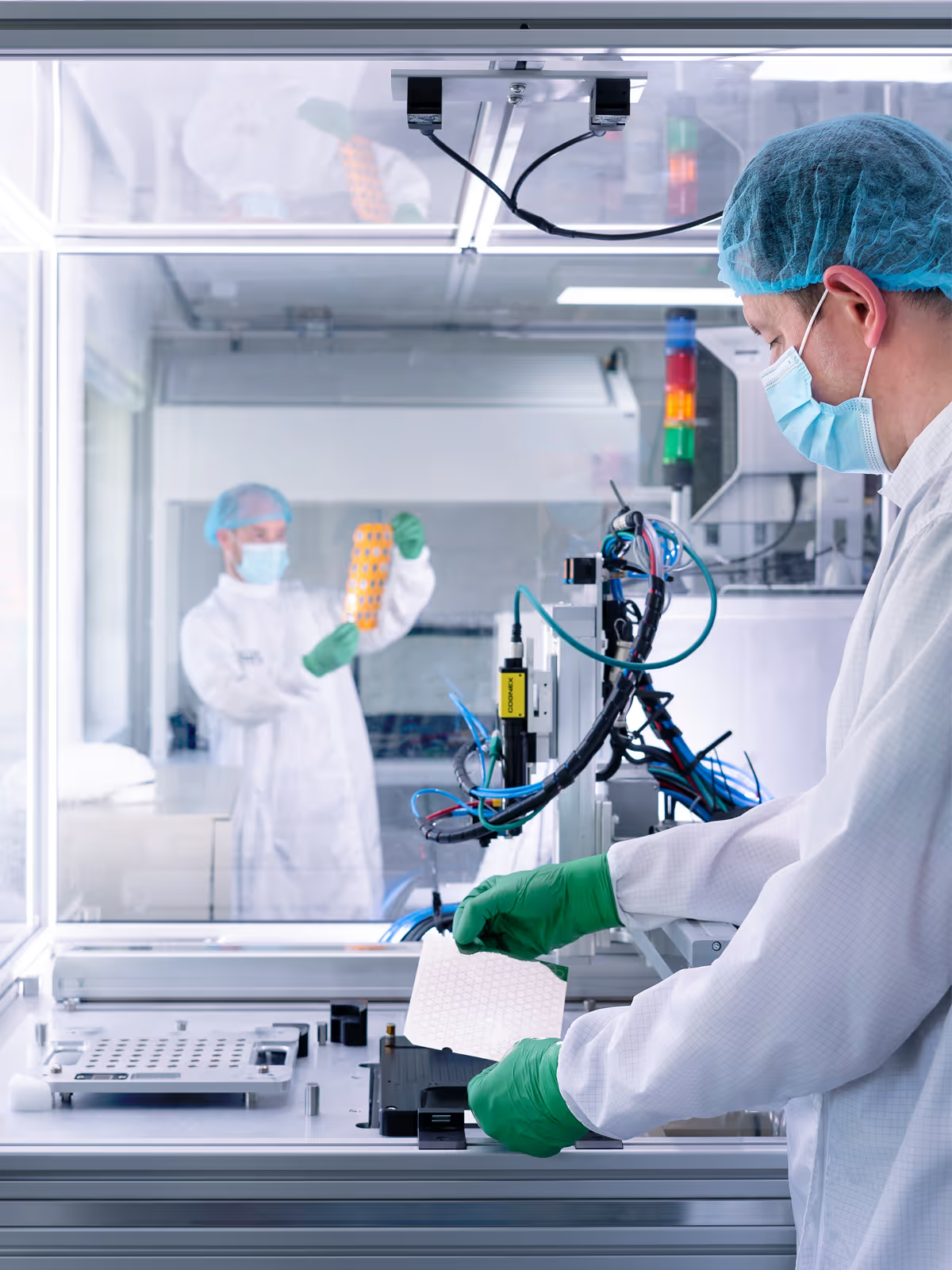
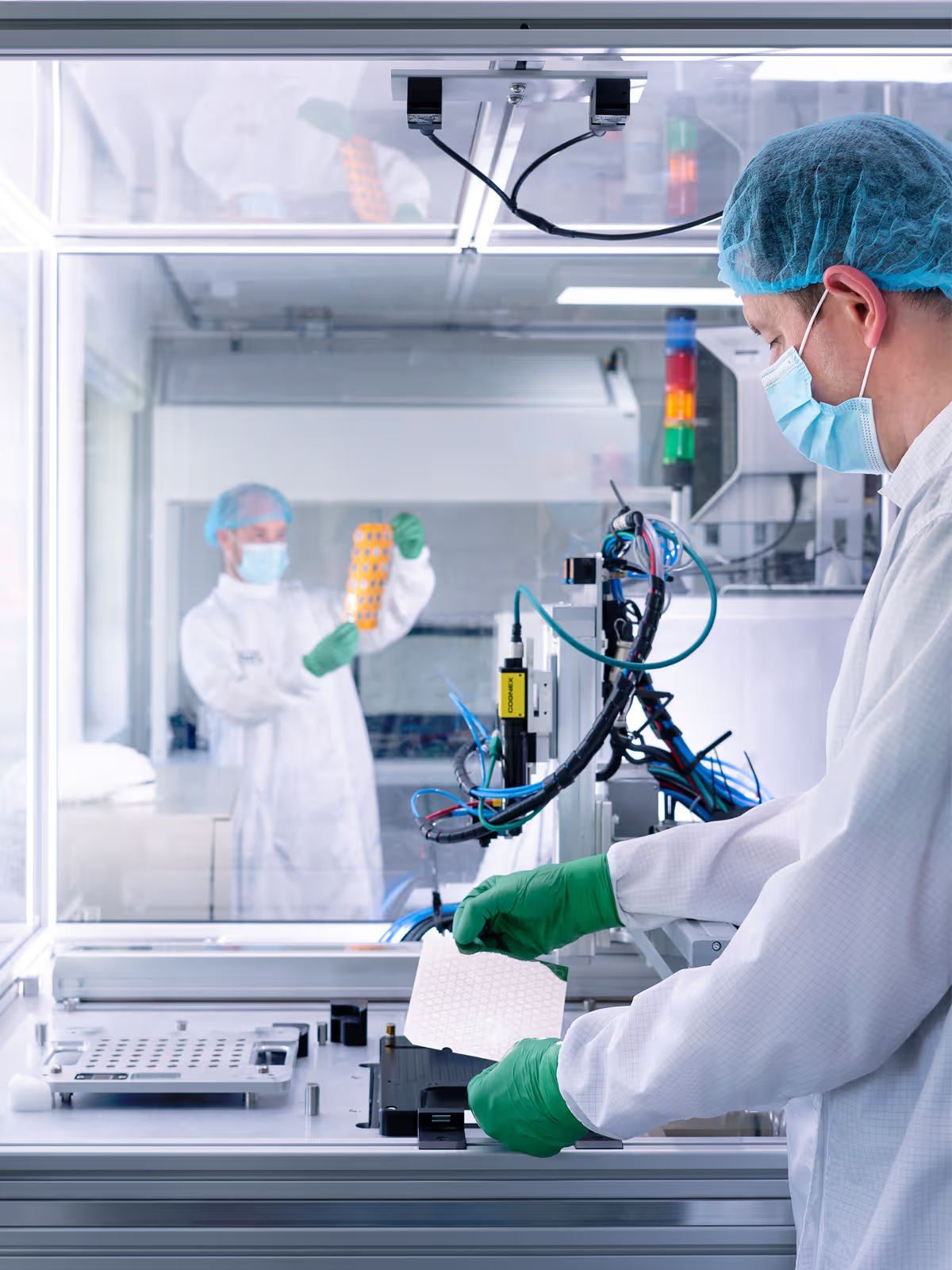
The hardest part of manufacturing isn’t volume, but the transition from design into regulated production. TTP bridges that gap by helping you develop the device and the manufacturing process in parallel, supporting agile clinical and early production builds. With no minimum volumes, no CMO lock-in, and no process IP constraints, you retain control of your product and supply chain.
Software capability at TTP
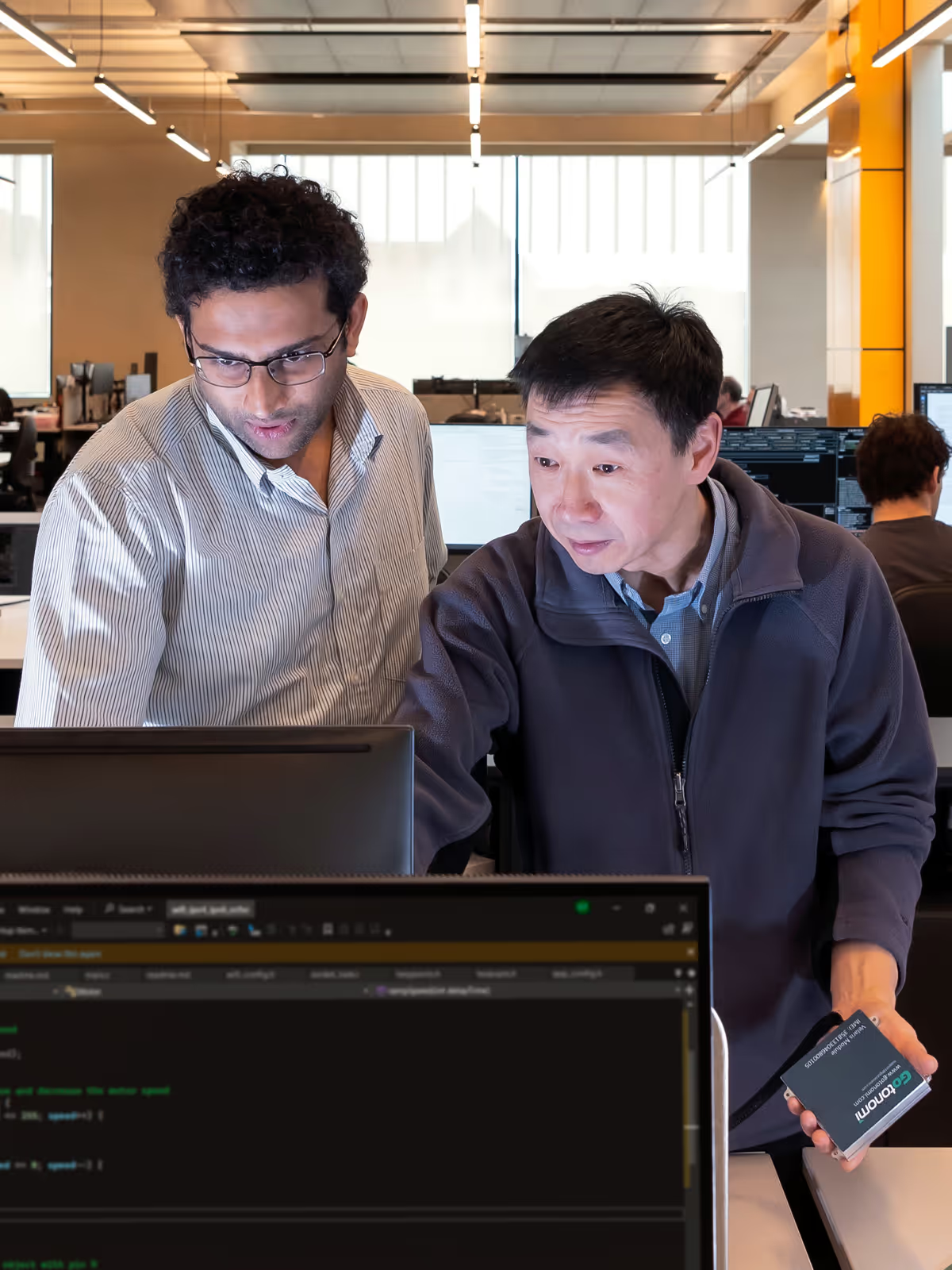
Engages in all stages of software and product development, our software capability at TTP covers the full spectrum–from in-depth analysis and system architecture, to prototype design, implementation and development.
What clients often want to know
We do not provide standalone regulatory consultancy, however, we design and develop medical devices with the relevant regulatory expectations in mind, helping clients build the evidence, traceability and development documentation needed to support future submissions. TTP is also ISO 13485 certified, with certification covering medical device and IVD design, development and contract manufacture, including implantable devices and active implants.
By embedding the right level of regulatory structure early, we help teams gain long-term development efficiency and reduce risk. From concept feasibility through to verification and transfer to manufacture, we design with compliance in mind. Our multidisciplinary teams combine deep technical expertise with strong regulatory fluency, embedding safety and performance considerations at every stage. The result is a more robust product, fewer late-stage surprises, and a clearer, faster route to regulatory submission, turning compliance from a requirement into a genuine development advantage. This regulatory fluency is embedded at every level: within individuals, project teams, and our organisational systems.
Read more about our approach to regulatory compliance
We consider usability from the outset, not as a final check once the device has already been designed. Our dedicated human factors team works alongside engineers and software specialists to understand users, environments, workflows and use-related risks early in development.
This can include user research, behavioural insight, task analysis, prototyping and formative usability testing, with activities tailored to the stage and needs of the project. By designing around real clinical and home-use contexts, we help create devices that are safer, more intuitive and more likely to be adopted in practice.
Read more about our approach to human-centred design and human factors engineering.
We reduce risk by identifying the biggest unknowns early,when there is still flexibility to test assumptions, fail fast and pivot ifneeded. This helps teams make better decisions before significant time andinvestment are committed.
For medical device projects, our approach is grounded in ISO13485 design controls, good engineering practice and effective risk management.Where relevant, we work with the expectations of key standards such as ISO14971 for risk management, IEC 60601 for electrical medical equipment, IEC62304 for medical device software and IEC 62366 for usability engineering.Combined with a systems view of the full product, including technicalperformance, software, human factors, quality, regulatory expectations and manufacturingroute. This helps risks be identified and resolved before they become costlylate-stage problems.
Read more about our approach to navigating risk.
Every project is shaped around the specific challenge and aligned with your own ways of working, governance and decision-making processes. We usually start by agreeing the objectives, scope, risks and key decision points. From there, we work in clear phases, with regular reviews so the project can adapt as understanding develops.
We often work as an extension of our clients’ teams, providing hands-on technical leadership and maintaining continuity throughout development. This avoids handover friction and supports faster, more aligned decision-making.
We support both. TTP can act as an end-to-end product development partner or provide targeted support at specific stages such as feasibility, system design, human factors, verification or manufacturing readiness.
Yes, depending on volumes. TTP has facilities that support prototype, low-volume and selected mid-volume builds, helping bridge the gap between development and transfer to a large-scale manufacturing partner. We do not provide bulk manufacturing, but we can produce quantities suited to activities such as verification, clinical trials or pilot launch — for example, hundreds of instruments/ devices or thousands of consumables, depending on the product and programme needs.
This capability helps clients move beyond prototypes and build consistent, reliable devices while the manufacturing process is still being refined. By developing product and process understanding together, we can make later transfer to a CMO of your choice smoother, better informed and lower risk. TTP is not, however, the legal manufacturer of products.
Read more about our medical device manufacturing capabilities
TTP helps medical technology and pharma companies turn difficult ideas into technologies that can work in the real world - whether the challenge is finding a way forward or moving quickly from an established direction. We combine deep MedTech experience with scientific, engineering and commercialisation expertise to reduce uncertainty, minimise rework and help clients move faster - from early opportunity discovery and concept development through to manufacturing scale-up and transfer to high-volume production.
- When the answer isn’t obvious
We are at our best when the concept is unclear, requirements are changing or the route forward still needs to be worked out. Our scientists and engineers bring deep specialist knowledge, while also challenging assumptions, exploring unfamiliar territory and finding a practical way forward.
We look beyond individual components to understand how the whole system needs to work together - including the product, user, software, manufacturing route, regulatory requirements and commercial objectives.
- Big enough to tackle large and complex challenges, small enough to be agile and responsive
TTP can bring together large, multidisciplinary teams when a challenge demands it, while staying flexible as the programme develops. Our science, engineering, software, human factors, laboratory and manufacturing specialists work together on one campus, as one team around your challenge.
That means fewer handoffs, quicker decisions and the ability to bring in the right expertise when it is needed, without losing the focus and responsiveness of a smaller team.
- Direct access to the people doing the work
Our flat, collaborative structure means you work directly with the technical specialists solving your challenge. They stay involved throughout the programme, helping you make decisions faster, respond effectively as requirements and priorities evolve, and maintain an open technical dialogue from early thinking through to delivery.
- Independent advice, with a focus on practical outcomes
We are not tied to a particular technology, factory or contract manufacturer, so our recommendations are based on what is right for the product, programme and commercial goal.
Our ISO 13485 quality system and extensive on-site labs, extensive small-batch manufacturing and cleanroom facilities mean we can take ideas beyond recommendations and prototypes. We develop the product and manufacturing process together, helping to reduce risk and make the transition to commercial production smoother.
We have also commercialised technology through our own ventures, giving us practical experience of the decisions involved in taking complex products from concept towards market.
- Employee-owned and focused on the long term
As a 100% employee-owned business, TTP is built around the people delivering the work. This supports technical independence, continuity and a long-term focus on what is right for the client, the programme and the outcomes we are working to achieve.
We support a wide range of devices and systems, including (but not limited to) wearable and implantable systems, minimally invasive surgical and robotics, navigation and imaging tools, drug delivery and injection devices, ophthalmic systems and diagnostic platforms. Our experience spans multiple MedTech domains, allowing us to tackle multidisciplinary challenges.
We work with ambitious, well-funded companies across the healthcare landscape, from venture-backed start-ups, scale-ups and biotechs to established global MedTech and pharma leaders developing breakthrough technologies.
Whether expanding established product lines or creating something entirely new, our clients usually share a need to solve complex challenges and turn bold ideas into commercial outcomes.
We agree a communication rhythm at the start of the project, usually including regular update calls, written summaries and clear next actions. We also give visibility of progress, spend and any decisions that could affect budget, raising risks early rather than waiting until the budget is exhausted.
We also believe face-to-face contact is important, particularly at key moments such as early scoping, workshops, major reviews or build phases. Where useful, we travel to meet your team, and clients are always welcome to visit us.
Yes. TTP develops software for regulated medical devices, including Class A, B and C devices under IEC 62304. Our dedicated software team works closely with systems, engineering, human factors and quality specialists, so software is developed as part of the full product architecture, not treated as a separate workstream.
We support embedded software, firmware, connected device software and device-to-cloud ecosystems, building in security, reliability, documentation and traceability from the start. For connected products, we also consider cybersecurity, update pathways, configuration control, SBOMs and long-term lifecycle management, helping software evolve safely within a regulated medical device environment.
Read more about our in-house software team.
We have established product development approaches, procedures and quality processes, but we do not force every project through a rigid, one-size-fits-all stage-gate model. Instead, we adapt the development structure to the client, the technology, the level of risk and the decisions that need to be made.
Where clients already have their own stage-gate process or QMS, we can align with it and provide the documentation, reviews and decision points needed to support it. Where clients need more guidance, we can help define an appropriate development roadmap, breaking the work into clear stages that reduce risk, support investment decisions and build confidence before moving to the next phase.
This means projects remain structured and well controlled, while still being flexible enough to respond as the technology, requirements or commercial priorities evolve.
TTP is ISO 13485 certified, with certification covering medical device and IVD design, development and contract manufacture, including implantable devices and active implants.
Our approach to quality is tailored to the stage, risk and regulatory needs of each project, and is flexible enough to integrate with a client’s own systems.
Because our development and manufacturing teams work closely together, quality, documentation, traceability and process understanding can be built in as the product evolves. This supports smooth transfer of documentation, evidence and decisions throughout the project, and helps clients move from technology demonstrator to clinical trial manufacture, early production and, where needed, transfer to high-volume manufacturing.
Our consultancy work is usually delivered on a fee-for-service basis, with the scope, budget and commercial terms agreed before work begins.
For the complex development projects we typically undertake, success depends on close collaboration between our team and yours. These programmes usually involve technical uncertainty, complex trade-offs and important decisions about risk, cost, performance and route to market. A clear fee-for-service model means we can commit the right team, maintain momentum and make objective recommendations based on what is best for the product and programme - not on future equity value, fundraising outcomes or ownership incentives.
As an employee-owned business, TTP is built around long-term client relationships, shared accountability and a commitment to the quality of our work. In rare circumstances, we can look at alternative funding models.
Our clients work with us because they gain access to decades of accumulated expertise, proven technologies and multidisciplinary know-how.
We recognise that IP is often central to our clients’ commercial strategy, so we agree IP terms at the outset of every project that gives you the rights you need to commercialise your products while making the best use of the capabilities that both organisations bring to the engagement.
In many client-funded programmes, clients own the project outputs within their field of application, with arrangements tailored to reflect background IP, enabling technologies and new developments.
From day one, ownership, licensing and confidentiality are clearly defined and robustly managed, giving both parties the confidence to focus on creating successful products.
Our aim is to make the IP position clear, so you understand how ownership, access rights and use of project outputs will be handled before work begins.
We usually work with clients around the world and are used to running international projects across multiple time zones, cultures and working styles. Because project teams are often spread across different locations, we agree communication rhythms, meeting times and decision points upfront, so collaboration is clear and progress is maintained.
We also believe face-to-face contact is important, particularly at key moments such as early scoping, workshops, major reviews or build phases. Where useful, we will travel to meet your team, and clients are always welcome to visit us.
In many cases, time differences can be an advantage, allowing work to progress across extended hours. With four decades of global client experience, a multinational team and a high level of repeat business, we have a proven model for making international collaboration work well.
We hand-pick the team around the needs of the project, factoring in how those needs are likely to evolve. With more than 300 engineers, scientists and designers under one roof to draw from, we can bring together the right mix of market knowledge, technical expertise and delivery experience.
Depending on the challenge, this can include specialists in areas such as fluidics, sensing, optics, electronics, software, modelling, materials, mechanics, robotics, human factors, industrial design and design for manufacture.
Most teams are multidisciplinary, with specialists brought in where needed, and your initial contact will usually stay involved as the project progresses.
Each project is led by an experienced technical project leader who is actively involved in the work, not by a separate account manager. This gives clients direct access to the people making the technical decisions, while maintaining continuity throughout the programme.
Our teams also have access to extensive on-site facilities, including dedicated manufacturing space, cleanrooms, microfabrication, assembly areas and specialist labs. This means we can move quickly from concept to testing and build, while drawing on trusted suppliers and partners where additional capability or scale is needed.
That depends on how you want to work. We can operate as an extension of your team, working closely with your engineers and stakeholders, or take on a more independent role with agreed review points and decision gates.
We hand-pick the team around the needs of the project, and factor how those needs will evolve during the project, drawing on the right mix of market knowledge, technical expertise and delivery experience. Most teams are multidisciplinary, with specialists brought in where needed, and your initial contact will usually stay involved as the project develops.
Our teams also have access to extensive on-site facilities, including dedicated manufacturing space, cleanrooms, microfabrication, assembly areas and specialist labs. This means we can move quickly from concept to testing and build, while drawing on trusted suppliers and partners where additional capability or scale is needed.
TTP is often the right fit when the technology is complex, multidisciplinary or novel, especially where it needs to work reliably in a heavily regulated environment.
We help clients bring together science, engineering, user needs, commercial goals and regulatory expectations, whether the challenge is defining the right route forward, integrating complex systems, accelerating development or resolving difficult technical trade-offs.
Complexity is not the only reason to involve us. Clients also come to us when they need senior technical judgement, fast mobilisation or the right specialist expertise brought together quickly to keep a critical programme moving.
We are less likely to be the right fit for routine engineering capacity or simple execution-only tasks where the solution, requirements and route to delivery are already fully defined.
We do not have a rigid engagement process, but projects typically start with a non-confidential discussion to understand the opportunity, challenge and potential fit. From there, we can put a confidentiality agreement in place, explore the brief in more detail, involve the right technical people and start shaping the scope together.
This usually develops through outline discussions, team introductions and iterations towards a formal proposal. Once the terms of business and statement of work are agreed, we move into project kick-off. Because we have a broad internal team and a flexible way of working, we can often move quickly, assemble the right expertise and adapt the process around your development goals.
You should engage a medical device design consultancy as early as possible, particularly when defining system architecture, technical feasibility and key design decisions. Early involvement helps identify and retire risks before they escalate, reducing costly redesign and improving confidence as development progresses.
We work with clients around the world, with many based in the US, UK and Europe. Our project model is designed to support collaboration across geographies and time zones, using structured communication, regular project touchpoints and in-person meetings or workshops at client or TTP sites where useful.