
5G non-terrestrial networks are moving from standards work into real equipment, real satellite networks and real procurement choices. For commercial operators, the attraction is easy to see. Satellite companies want the scale of the mobile ecosystem. Mobile network operators want coverage in places where towers are too sparse, too expensive or too vulnerable.
For military communications, the same technology raises a harder question. Does 5G NTN help military users by adding interoperability, path diversity and faster technology refresh? Or does it create a fresh dependency on commercial infrastructure, mass-market chipsets and waveforms that may be too visible in a contested environment?
The practical answer depends on implementation
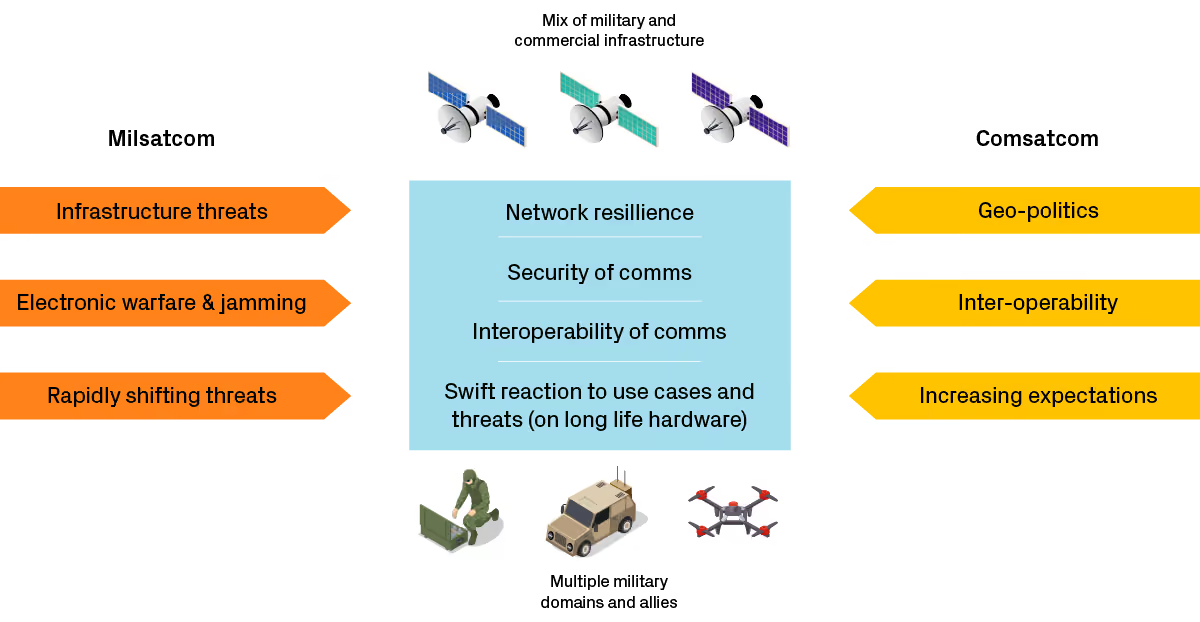
Military satellite communications already sit under pressure from several directions at once. Space assets face physical and cyber threats. Ground terminals must cope with jamming and electronic warfare. Adversaries change tactics quickly, as seen in Ukraine, where assumptions about UAV command links, jamming and countermeasures have shifted repeatedly. At the same time, operational users expect more from satellite. Voice alone is rarely enough. Mapping, position reporting, live video, chat, sensor data and command applications all want dependable links.
There is also the political dimension. Military users may rely on a mix of sovereign, allied and commercial infrastructure. In peacetime that can look efficient. In crisis, access to a network may depend on commercial priorities, national policy, supply chain exposure or the stance of an ally. A communications plan that looks strong on paper can become fragile if it has only one usable path.
A tactical satcom system therefore has to do several jobs. It must provide reliable voice and data. It must protect traffic content and also reduce the risk of giving away metadata, movement patterns or terminal location. It must interoperate with allies and current soldier systems. It must also survive a long service life, often 10 to 15 years, while networks, standards and threats keep changing.
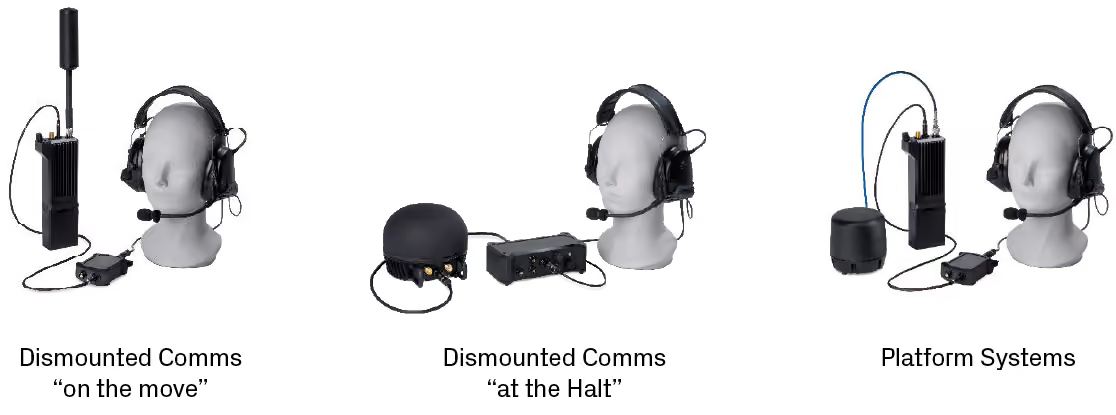
A useful example is a sovereign TACSAT capability built around a flexible core radio module. The equipment needs to support more than one mission shape. A dismounted soldier on the move needs a lightweight, battery-powered radio with a tactical helix antenna. At the halt, the same user may accept a turnstile antenna connected by coax to gain higher throughput. A vehicle, boat or building can take a fixed platform variant with integrated power, antenna and a remote interface.
The shared element is the radio platform underneath. A software-defined, multi-band design can support several terminal types without rebuilding the whole system each time. It can integrate with existing tools such as TAK, ATAK and WinTAK. It can also support custom physical layer behaviours, including low probability of intercept and low probability of detection techniques. In a military setting, that flexibility can matter as much as headline data rate.
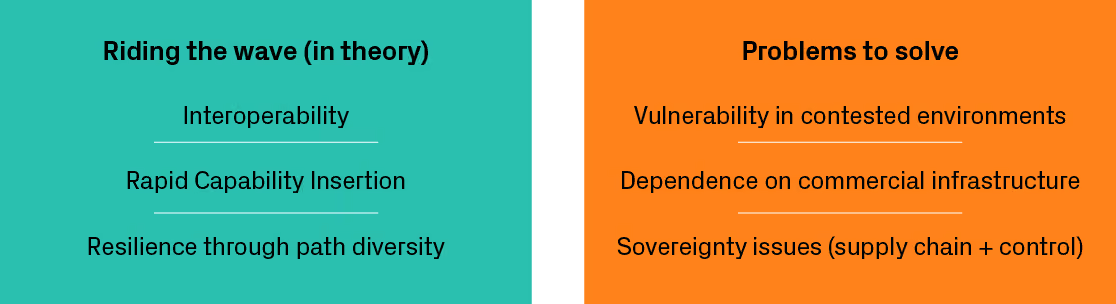
5G NTN adds a new set of possibilities beyond this example working in a present day proprietary network example. Standards-based satellite connectivity can make interoperability easier. Access to multiple networks can improve path diversity. LEO constellations can offer higher throughput and better polar coverage than many legacy options. Commercial investment can bring better silicon, lower unit cost and quicker development cycles.
That makes 5G NTN too significant to ignore. It could give military users access to a much larger technology base, without placing the full development burden on defence budgets. It could also make it easier to build terminals that move between sovereign, allied and commercial bearers as the mission changes.
The risk sits in a narrow view of what 5G NTN should be. A mass-market direct-to-device chipset may be excellent for a handset, tracker or consumer IoT device. It may be small, cheap and power efficient. Yet a fixed, hardware-centric implementation can leave little room for mission adaptation. That matters when the terminal has to work in the presence of jamming, interception attempts or changing rules of engagement.
Encryption remains essential, but military security cannot stop there. A protected message can still reveal useful information through timing, emissions, network attachment behaviour or location patterns. An adversary may not need to read the message if the signal itself shows where a unit is, when it moves and how often it transmits.
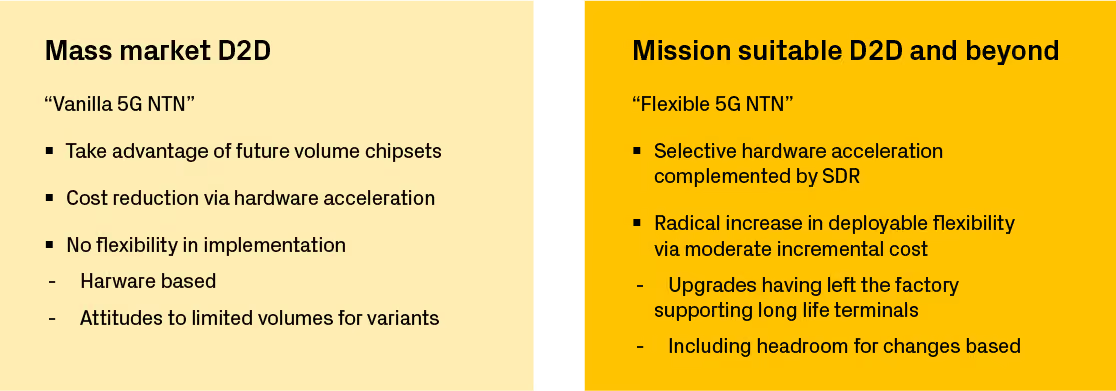
This is where flexible 5G NTN becomes important. A vanilla implementation makes sense for many commercial uses. It takes advantage of volume chipsets and hardware acceleration. A military terminal needs more headroom. It should use hardware acceleration where it helps with power, size and throughput, while keeping enough software-defined capability to support field upgrades, waveform changes, dual connectivity and fallbacks.
A flexible modem can use 5G NTN for routine interoperability, then switch behaviour when the environment becomes contested. It can support custom or derived waveforms below the 5G NTN layer where LPI or LPD behaviour is needed. It can also help a terminal move across more than one satellite service, band or constellation, reducing dependence on a single path.
The differences show up across the measures that matter to military users. LEO-based NTN can improve throughput and polar coverage. MSS band options can help with availability. Multi-constellation support can improve resilience. Flexible waveform support can reduce exposure in a contested environment. A common modem platform can also make it quicker to create mission-specific terminals, from soldier-worn radios to vehicle systems, without forcing a complete redesign.
This makes architecture a strategic choice, rather than an internal engineering detail.
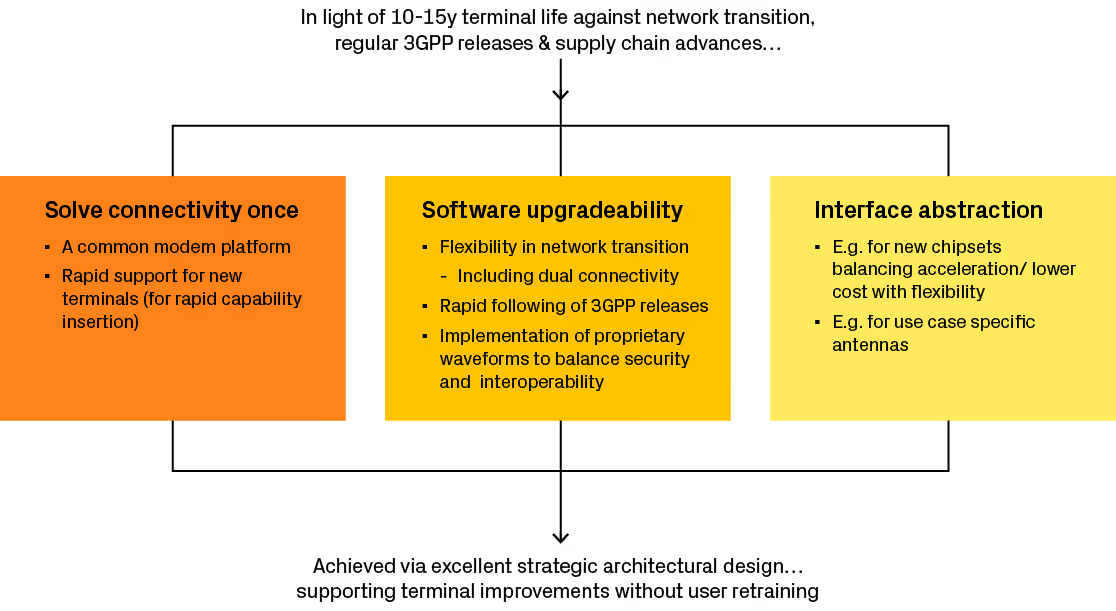
A sound architecture starts with a common modem platform. Solve the shared connectivity problem once, then reuse it across multiple terminals. That allows engineering effort to go into the parts that genuinely differ, such as antenna choice, packaging, power, environmental protection and user interface.
Software upgradeability is equally important. 5G NTN will continue to evolve through 3GPP releases. Satellite operators will change payloads, orbits, bands and service models. Chipsets will improve. Antennas will become more capable. A terminal with a 10-year life cannot be frozen around the assumptions of its first network.
Interface abstraction helps with that. A well-designed modem should be able to work with different antennas for different use cases, and with new acceleration hardware as it becomes available. Users should not need retraining every time the supply chain improves or a new terminal variant appears.
So, friend or foe?
5G NTN can be a friend to military communications when it is built into a flexible, mission-led architecture with choice, upgrade paths and control over contested behaviours. It can bring interoperability, path diversity and access to commercial technology at a scale defence alone would struggle to match.
It can become a foe when treated as a simple commercial substitute for military satcom. A single network path, rigid chipset, limited waveform control or poor treatment of metadata can create operational risk.
The best route is to shape 5G NTN around military needs from the start. That means flexible modem architectures, selective acceleration, software-defined capability, dual connectivity and clear thinking about sovereignty and supply chain exposure.
TTP has recently announced a flexible 5G NTN modem module designed to support this kind of smooth network transition. The module uses a software-defined, multi-band architecture intended to help future satellite terminals remain upgradeable, adaptable and resilient as networks and standards evolve, including for both narrowband and broadband applications. Read more here: TTP satellite modem module targets smooth network transition to 5G NTN