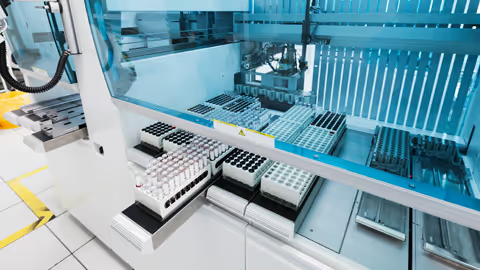
AI, automation, and high-throughput experimentation are fundamentally changing the drug discovery workflow. Advances in computational modelling, robotics, and automated analytics have accelerated every stage of the Design-Make-Test-Analyse (DMTA) cycle, enabling scientists to evaluate more compounds and generate more data than ever before. Yet the “Make” phase still relies heavily on the manual handling of solid materials.
While liquid handling has become highly automated, dispensing solids remains one of the most labour-intensive operations in the laboratory. Addressing this challenge requires more than improving a single piece of equipment. It requires understanding how different materials behave across different dispensing scales and designing automation around that variability inherent in real-world chemistry.
The challenge isn't simply dispensing solids
Solid dispensing is often viewed as a precision weighing problem, but fundamentally it is a materials handling challenge. Unlike liquids, solids can behave in dramatically different ways. Some are free flowing, while others are cohesive, electrostatic, sticky, or moisture sensitive. They may bridge inside containers, adhere to surfaces, compact or discharge unpredictably; other materials may be waxy, oily or paste-like rather than behaving as conventional powders.
These differences matter because automated dispensing systems depend on predictable material behaviour. Particle size, morphology, bulk density, moisture content, electrostatic charge, storage conditions, and container geometry can all influence dispensing performance, making it difficult to apply a single automation strategy across diverse materials.
The challenge extends beyond traditional small molecules. Peptides and other increasingly complex therapeutic modalities introduce additional material handling characteristics that place even greater demands on laboratory automation. As the diversity of drug candidates continues to grow, so too does the need for dispensing systems capable of handling an equally diverse range of materials.
The question is therefore not simply how to automate powder dispensing, but how to automate the handling of highly variable physical materials.
Operating in the space between milligrams and grams
Scale adds another dimension to the challenge. Importantly, low-milligram and gram-scale dispensing present different engineering requirements, and technologies optimised for one regime do not necessarily translate readily to the other.
At one end of the spectrum, dispensing milligram quantities has relied on sophisticated gravimetric systems that use closed-loop feedback to achieve their targeted accuracy. However, these systems often sacrifice throughput for precision, which may not be feasible to implement in an automated system for high-throughput experimentation.
Recent technological advances have begun addressing these limitations. New systems use machine vision and robotic spatula-based dispensing that mimics the actions of a chemisti. Rather than relying on conventional feed mechanisms, these systems observe material behaviour in real time and adjust dispensing accordingly, enabling reliable handling of low-mg quantities across a broad range of powder types.
An alternative strategy is to convert solid compounds into stock solutions at an early stage of the workflow, allowing subsequent transfers, dilutions, and assay preparation to be performed using established liquid-handling automation. This approach is already widely used in compound management and high-throughput screening, where compounds are commonly stored as DMSO stocks and manipulated using robotic liquid-handling platforms. For compounds with adequate solubility and stability, the strategy can provide substantially higher throughput and operational simplicity than direct powder dispensing.
These approaches are creating increasingly capable options for low-milligram dispensing or, where the chemistry allows, avoiding repeated solid dispensing altogether. However, they do not address the full range of quantities encountered in medicinal chemistry.
Many drug discovery workflows also require quantities ranging from tens of milligrams to multiple grams of material while maintaining throughput. The requirements change as the quantity increases. At the gram-scale, the challenge is to move substantially more material quickly and reproducibly while maintaining controlled flow and sufficient dosing accuracy.
Performance of commercial hopper and feeder systems can depend strongly on the material flow properties. Poorly flowing powders may bridge, compact or feed intermittently, while increasing the delivery rate creates different requirements for controlling and stopping material flow. Recent work has highlighted a lack of evaluated automated technologies for low- and mid-gram-scale laboratory dosing, despite these quantities being common in laboratory workflowsii.
An experienced scientist can move naturally between these regimes: carefully dispensing a few milligrams of a precious compound one moment and several grams of a poorly flowing powder the next, adapting their technique to both the quantity and the material. Automated systems tend to operate within much narrower windows.
As laboratories move toward increasingly autonomous workflows, future automation will need to combine the precision for micro-scale dispensing with the flexibility and throughput required for larger-scale material handling.
Designing automation around material behaviour
Once the physical mechanism is understood, there is a much broader technology space to explore than simply selecting a commercial dispenser. Different material behaviours call for different engineering responses, from changes in how material is agitated and presented to modifications in the surfaces, geometries, and environmental conditions surrounding the dispensing process.
For cohesive materials, controlled agitation or vibration might be used to promote flow. Bridging could be addressed through different reservoir and feed geometries. Electrostatic materials may require alternative surface materials, charge management, or environmental control. Difficult compounds might benefit from a completely different method of material presentation. Disposable or material-specific interfaces could also separate the material-contacting components from a common reusable actuator. The result is an approach that starts with the material and works backwards to determine the most appropriate dispensing mechanism, rather than selecting a technology first and adapting the workflow around it.
Sensing is particularly important because it could reveal how the dispensing process is behaving, whereas gravimetric feedback can determine how much material has been dispensed. Machine vision, force measurement, acoustic or vibration sensing could potentially identify bridging, adhesion, poor flow or sudden material release as it occurs.
The combination of these capabilities creates the opportunity for adaptive, closed-loop dispensing. Rather than following the same predefined recipe for every material, the system could respond to what it observes by adjusting parameters such as agitation, feed rate or actuation. Over repeated dispensing events, the resulting data could also reveal relationships between material properties, observed behaviour and successful dispensing strategies. Machine learning could ultimately help use those relationships to suggest appropriate starting conditions when an unfamiliar material is introduced.
Looking ahead
The value of solving solid dispensing extends far beyond improving a single laboratory operation. If automated systems can recognise differences in material behaviour and adapt how they handle them, dispensing becomes less dependent on manual intervention and can be incorporated more reliably into automated chemistry workflows. That capability will become increasingly important as pharmaceutical companies move toward more autonomous laboratories, where AI-driven discovery can propose more compounds, automated synthesis can execute more reactions, and analytical technologies can generate data at ever-increasing speed.
But the physical execution of those experiments must keep pace. More capable solid dispensing could increase unattended operation, improve reproducibility, and allow automated platforms to work across a wider range of compounds and therapeutic modalities. In that context, solid dispensing is not simply a laboratory bottleneck to be removed; it is an enabling capability for the next generation of automated chemistry.
The next advance may therefore come not from making today's dispensers incrementally faster, but from engineering systems that understand the physics of the materials they handle and respond accordingly. By combining materials science, mechanical engineering, sensing, automation, and intelligent control, the industry can move toward dispensing systems that accommodate the variability of real-world materials rather than requiring those materials to conform to a fixed process. This systems-level approach can transform solid dispensing from a persistent limitation into an enabler of faster, more scalable, and increasingly autonomous drug discovery.
About the TTP Drug Discovery Team
TTP helps pharmaceutical and biotechnology companies accelerate drug discovery by removing bottlenecks across the Design-Make-Test-Analyse (DMTA) cycle.
Our Drug Discovery Tools team develops bespoke technologies for complex laboratory workflows where standard equipment does not fully meet the needs of the science. For solid dispensing, that can mean understanding how different materials behave, exploring alternative dispensing mechanisms, integrating sensing and feedback, and engineering systems that can operate reliably across different quantities, material properties and workflow requirements.
From targeted workflow improvements to entirely new discovery platforms, we work with clients to overcome physical and technical constraints, increase DMTA iteration velocity and unlock the full potential of increasingly automated drug discovery.
References
i Jiang, Y. et al. Autonomous biomimetic solid dispensing using a dual-arm robotic manipulator. Electronic supplementary information (ESI). Digital Discovery. (2023) 2(6): 1733-1744. https://doi.org/10.1039/d3dd00075c.
ii El Hariry, A. et al. A method for the evaluation of automated solid dosing technologies for mid-scale dosing tasks in laboratory automation. SLAS Technology. (2026) 38:100406. ISSN 2472-6303. https://doi.org/10.1016/j.slast.2026.100406.